
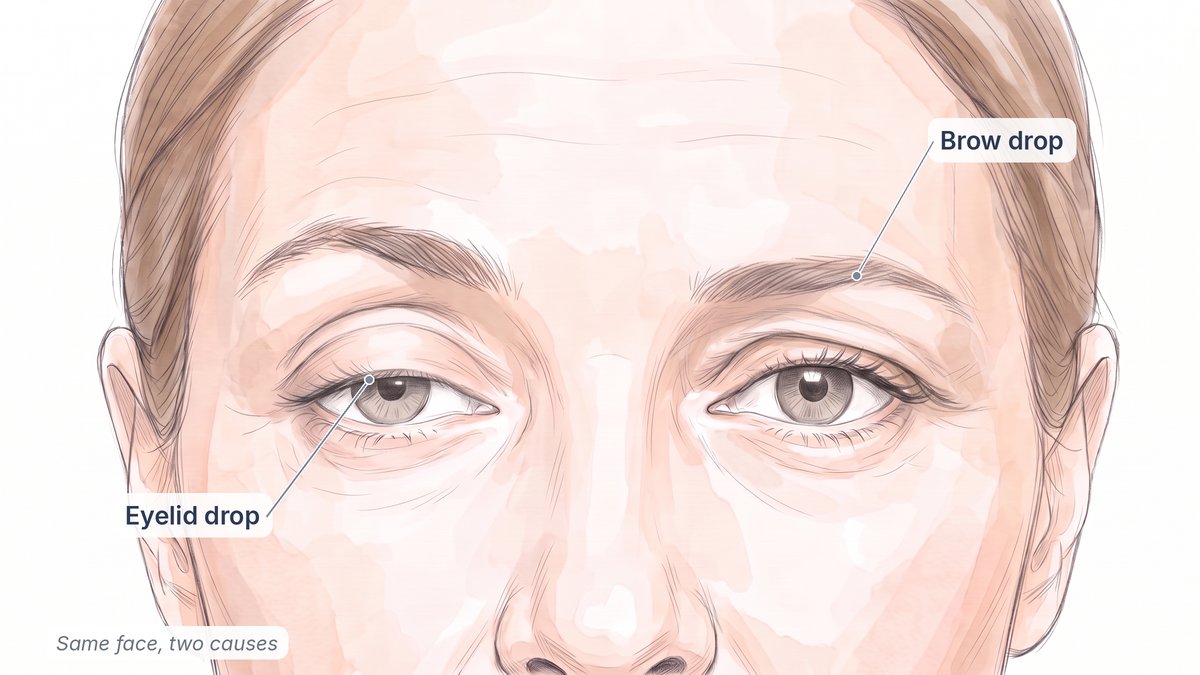
A droopy eyelid after Botox is a temporary lowering of the upper eyelid, or of the eyebrow onto the lid, that starts 3 to 7 days after forehead or frown-line injections and usually settles within 2 to 6 weeks. In eyelid ptosis the lid edge itself sits lower; in brow ptosis a relaxed forehead lets the brow fall onto the lid. They look alike in the mirror but need different fixes.
Quick answers
- Is it permanent? No. Most eyelid droops settle in 2 to 4 weeks and brow drops within about 6; a few last until the toxin fades at 3 to 4 months, and rare referred cases longer.
- Is it my eyelid or my eyebrow? Lift the brow with a fingertip. If the eye opens normally, it is the brow; if the lid edge still sits low over the pupil, it is the eyelid.
- When does it start? Usually 3 to 7 days after the injection, occasionally up to about 2 weeks.
- Do eye drops work? For an eyelid droop, partly: apraclonidine 0.5 percent or oxymetazoline 0.1 percent lift the lid about 1 to 2 mm for a few hours. They do nothing for a low brow.
- Can it be fixed faster? A tiny dose under the brow tail can lift a dropped brow 1 to 2 mm; severe lid droops have been reversed with a microdose near the lashes, in expert hands.
- What is a Spock brow? The opposite problem: the outer brow peaks because that part of the forehead was left too strong. A tiny dose above the peak usually settles it.
- Can Botox lift my eyebrows? A little, about 0.4 to 4.8 mm at the tail. It cannot remove eyelid skin or lift an aged, low brow.
- When is it not just the Botox? Double vision or a pupil change needs a doctor the same day; trouble swallowing, speaking or breathing is an emergency.
Why Is My Eyelid Drooping After Botox?
Because the toxin has weakened one of two muscles: the one that opens the eyelid, so the lid edge drops (eyelid ptosis), or the forehead muscle that holds the brow up, so the brow settles onto the lid (brow ptosis). The difference decides the fix.
Eye drops can lift a dropped lid but cannot raise a brow, so advice that blends the two sends patients to the wrong remedy. A third version is common too: the eyes feel heavy but nothing has moved, because a forehead that used to help open the eyes no longer can.
All three are temporary. A droop that came on over years, not days after an injection, is aging, explained in droopy upper eyelids after 50. “Botox” here means any botulinum toxin, including Dysport, Xeomin and Jeuveau; the evidence cited covers botulinum toxin in general. Toxin that wears off faster than it used to is a separate problem, covered in why Botox stops working.
Is It My Eyelid or My Eyebrow? A Two-Minute Mirror Test
Look at where the lid edge sits against your pupil, then lift the brow with a fingertip and see whether the eye opens. If lifting the brow clears the heaviness and the lid edge sits at its usual height, the brow has dropped; if the lid edge still covers the upper pupil with the brow held up, the eyelid itself has dropped.
Face a mirror at eye level, relax your forehead and look straight ahead. Hold a phone flashlight at arm’s length below the mirror so a dot appears in each pupil, and compare the two sides, or a photo from before the injection.
- Where is the lid edge? Normally the upper lid edge sits about 4 to 5 mm above the dot, a distance doctors call MRD1. If it now reaches the top of the pupil or nears the dot, the lid itself is lower.
- Lift the brow. With a fingertip above the middle of the brow, lift it gently to where it sat before, and watch the lid edge rather than the hooding.
- Raise your eyebrows. After forehead toxin the brows barely move; after a frown-line injection that dropped a lid, you may catch yourself raising them to see.
A lid droop is usually one-sided and follows frown-line injections; a brow drop is usually on both sides and follows forehead injections. These are tendencies, not rules.

Why do my eyelids feel heavy after Botox when nothing looks lower?
Because the forehead was quietly helping to hold the eyes open, and now it cannot. Many people over about 45 have a little extra lid skin or a slightly low brow that the forehead muscle compensates for all day.
Relaxed, that effort shows up as heaviness by evening, with the lid edge in its usual place and the brow only a millimeter or two lower. It wears off with the toxin and is a useful signal for the next plan.
What Causes a Droopy Eyelid After Botox?
An eyelid droops when toxin spreads from the injection into the eye socket and weakens the levator, the muscle that opens the lid. A brow droops when toxin weakens the frontalis, the forehead muscle and the only muscle that lifts the brow, in someone whose brow position depended on it.
How the eyelid itself drops
The levator sits inside the eye socket, behind a thin sheet called the orbital septum. Toxin injected into the frown muscles (the corrugators, along the inner brow just above the rim) can track into the socket. A cadaver dye study showed two routes from a frown-line injection to the levator: along the plane just above the bone, and along small veins that drain into the socket. Superficial placement and low volumes reduce the risk.
A 2025 review describes weak points in the septum around the nerves and vessels that leave the socket at the upper rim. A 2026 review of toxin complications adds that risk rises with injections near the upper rim, particularly in line with the pupil, with larger volumes, deeper injections, and in older patients.
A second, smaller lifter, the Müller muscle, is smooth muscle run by the sympathetic nerves, not by the nerve signal toxin blocks, and it raises the lid about 2.5 mm when it contracts. Eye drops target it, which is why they can help a lid droop.
How the brow drops
The brow is a tug of war. The frontalis pulls it up; the corrugators, the procerus between the brows and the outer ring of the orbicularis oculi around the eye pull it down. Forehead toxin weakens the only lifter, so the downward pull wins, and the brow settles lower and flatter.
A millimeter of drop goes unnoticed in a young forehead, but not over a low brow or heavy lids. A 2016 review calls brow ptosis the only important side effect of forehead treatment with botulinum toxin, and recommends keeping forehead injections at least 2 cm above the brow, and at least 4 cm in older patients.
Why a Spock brow is the opposite problem
A Spock brow, also called a Joker or Mephisto brow, is a brow tail that kicks upward into a sharp peak after forehead toxin. The center of the forehead has been relaxed, but the outer frontalis still pulls, so all the lift concentrates at the tail.
The same review groups it with asymmetry from uneven dosing or excessive paralysis of some segments of the forehead muscle.

How Common Is a Droopy Eyelid After Botox?
In the pivotal trials behind the US label, a true eyelid droop occurred in about 2 to 3 percent of patients and a brow droop in about 2 percent. With experienced injectors, published estimates for eyelid droop fall to around 1 percent or less.
With 20 units in the frown lines, eyelid ptosis occurred in 13 of 405 treated patients (3 percent) and none of 130 on placebo. With 40 units, 20 in the forehead and 20 in the frown lines, eyelid ptosis occurred in 12 of 665 (2 percent) and brow ptosis in 13 of 665 (2 percent), against 1 and 0 of 315 on placebo.
Other figures vary widely. An early multicenter frown-line study reported ptosis in 5.4 percent, 12 of 263 patients, and a rate more likely below 1 percent with experienced injectors. A 2025 review gives 2.5 to 5.4 percent with inexperienced injectors and about 0.5 to 1 percent with experienced ones. Another cites 1 to 14 percent across reviews and series, and eyelid plus brow ptosis making up 6.1 percent of adverse events among 10,577 cosmetic safety reports.
Key numbers
- Eyelid ptosis in US label trials: 3 percent at 20 units in the frown lines; 2 percent at 40 units forehead plus frown lines.
- Brow ptosis in US label trials: 2 percent at 40 units forehead plus frown lines.
- Experienced injectors: eyelid droop around 1 percent or less.
- Onset: usually 3 to 7 days, occasionally up to about 14.
- Duration: eyelid droop 2 to 4 weeks in most, brow drop within about 6 weeks; the toxin itself lasts about 3 to 4 months.
- Drops: oxymetazoline 0.1 percent raised the lid about 1 mm versus 0.5 mm with a placebo drop in trials in acquired ptosis, not toxin ptosis; apraclonidine 0.5 percent about 1 to 2 mm.
- Botox brow lift: about 0.4 to 4.8 mm at the brow tail across 11 studies.
How Long Does a Droopy Eyelid From Botox Last?
Most eyelid droops after Botox settle within 2 to 4 weeks, and a brow drop usually improves within about 6 weeks. Because the droop is caused by the toxin, its usual outer limit is the life of the toxin, about 3 to 4 months, though rare cases referred to specialists have lasted longer.
Timing follows the toxin. The label says it blocks the injected muscles one to two days after injection, but a droop usually appears later, as the toxin spreads and the full effect builds. Patients typically notice it 3 to 7 days after injection, with eyelid ptosis often settling within 3 to 4 weeks and brow ptosis within six weeks. Reviews give most cases resolving in 2 to 4 weeks, with onset as late as day 14 and resolution by about 3 months.

Can a droopy eyelid from Botox be permanent?
The toxin effect itself is not permanent, so a droop caused purely by toxin goes away, though occasionally slowly. In a 2015 case series of 7 patients referred to eyelid specialists, upper eyelid ptosis after cosmetic toxin lasted from 6 weeks to 13 months. A droop still present after the toxin has clearly worn off needs a proper eyelid examination.
The usual question then is whether an age-related ptosis, most often a stretched lid tendon, was already there, hidden by a forehead that was lifting the lids. Toxin does not cause that stretching, but by switching off the forehead’s help it can bring it to light.
How Do You Fix a Droopy Eyelid After Botox Fast?
For a true eyelid droop, prescription eye drops called alpha-agonists, which stimulate the Müller muscle, can raise the lid about 1 to 2 mm for a few hours at a time while you wait for the toxin to wear off. For a brow drop, drops do not help; a small dose of toxin to the muscles that pull the brow down can lift the tail slightly, and otherwise time is the treatment.
First, a doctor confirms which droop it is. If it appears after you have flown home from treatment abroad, send your injector straight-on photos, brows relaxed and then lifted by a fingertip, and see a local doctor who can examine you and prescribe drops.
Apraclonidine (Iopidine) eye drops
Apraclonidine 0.5 percent is a glaucoma drop used off label for toxin ptosis. It makes the Müller muscle contract and lifts the lid about 1 to 2 mm, typically one or two drops three times a day. Its use for toxin ptosis grew from anecdotal reports rather than formal studies, and a small 2017 case series also reported improvement in toxin-related ptosis after apraclonidine 0.5 percent drops.
A 2026 review of eye drops for toxin ptosis notes that apraclonidine is commonly recommended despite possible tachyphylaxis, meaning the effect can fade with repeated use. It is a prescription medicine with its own cautions.
Oxymetazoline 0.1 percent (Upneeq)
Oxymetazoline 0.1 percent was approved by the FDA in 2020 for acquired blepharoptosis in adults, meaning an eyelid droop that develops later in life, though not for toxin ptosis specifically. In two pooled randomized trials of 304 people with acquired ptosis, the lid rose 0.96 mm at 6 hours on day 1 against 0.50 mm with a placebo drop, and 1.16 mm against 0.50 mm on day 14.
In 29 aesthetic patients with ptosis, a single drop raised the lid from 2.3 mm to 4.2 mm above the pupil reflex at 2 hours, with no change in brow position.
The eye-drop review judged oxymetazoline to have the strongest evidence among topical options for toxin ptosis. In the acquired ptosis trials it was used as one drop per eye once daily, and it works within minutes for a few hours. Availability of both drops varies by country.
A microdose near the lashes for a severe eyelid droop
For severe droops, some oculoplastic and aesthetic specialists inject a very small dose of toxin into the strip of the lid’s closing muscle just above the lashes, which lets the lid open slightly further. In 8 women with toxin ptosis of more than 3 mm, 2 to 4 units placed there, with or without oxymetazoline drops, raised the lid by a mean of 3.4 mm, with most resolving about 10 to 15 days later and no complications reported.
That is a case series, the lowest tier of evidence, millimeters from the eye: experienced hands, severe droops, certain diagnosis only.
A small dose to lift a dropped brow
Relaxing the muscles that pull the brow down can help a little. One protocol places a tiny dose just below the outer brow and a deeper one in the frown muscle at the inner brow, aiming to raise the brow 1 to 2 mm. It cannot restore a fully relaxed forehead, but it can take the edge off a heavy tail.
What does not help
The 2026 complications review found that lymphatic drainage, low-voltage electrical stimulation and radiofrequency are supported only by anecdotal reports and did not recommend them. Massage and heat have no better evidence behind them. More toxin in the forehead to “balance” a dropped brow makes it worse.
At a Glance: Which Droop You Have and What Helps
| Eyelid droop (lid ptosis) | Brow drop (brow ptosis) | Heavy feeling only | Spock brow | |
|---|---|---|---|---|
| What you see | Lid edge lower over the pupil, often one side | Brow lower and flatter, skin on the lid | Nothing clearly lower; tired by evening | Outer brow peaked upward |
| Usual trigger | Frown-line injections near the rim | Forehead injections over a low or heavy brow | Forehead injections over a compensating forehead | Outer forehead left strong |
| Brow lifted by a fingertip | Lid edge stays low | Eye opens normally | Feels lighter | Not relevant |
| Usually appears | Day 3 to 7, up to about 14 | Day 3 to 7 | First week | Week 1 to 2 |
| Usually lasts | 2 to 4 weeks; rarely the toxin’s 3 to 4 months or longer | Within about 6 weeks | Until the toxin fades | Until corrected or faded |
| What helps | Alpha-agonist drops; time; microdose near the lashes if severe | Time; small dose to brow depressors | Time; lighter forehead next time | Tiny dose above the peak |
| What does not | Massage, heat, more forehead toxin | Eye drops, more forehead toxin | Eye drops | Nothing harmful in waiting |
How Do You Fix a Spock Brow After Botox?
A Spock brow is usually corrected with a very small dose of toxin into the outer forehead just above the peaked part of the brow, relaxing the strip of muscle still pulling the tail up. It is best done once the first treatment has reached full effect, about two weeks after the injection, so the correction is not aimed at a moving target.
Review evidence is thin but consistent: small corrective doses into the relatively overactive muscle, with mild cases simply observed because the asymmetry fades with the toxin. Too much, or too low, swaps the peak for a dropped tail.
A peaked brow after a surgical brow lift is a different matter, a question of fixation point and lifting direction, covered in why some brows look surprised after a brow lift.
Can Botox Lift Your Eyebrows?
Yes, a little. Relaxing the muscles that pull the brow down, mostly the outer orbicularis oculi under the brow tail, lets the forehead lift the tail a few millimeters, and a systematic review found the most elevation at the lateral brow, about 0.4 to 4.8 mm.
That review pooled 11 studies with 585 patients and recorded only 5 cases of eyelid ptosis. In one series of 22 patients, 7 to 10 units into the outer orbicularis on both sides raised the brow 4.83 mm at the outer corner of the eye but only 1.02 mm in line with the pupil.
A toxin brow lift works by subtraction: it needs a working forehead to do the lifting, so pairing it with a heavy forehead dose defeats itself. Nor can it remove eyelid skin or lift a brow that has aged onto the rim. Those are surgical questions, compared in how a forehead brow lift is held in place and sub-brow lift versus upper blepharoplasty.
How Do You Avoid a Droopy Eyelid After Botox?
Placement prevents most droops: I keep frown-line injections at least 1 cm above the brow and superficial, keep the lowest forehead points at least 2 cm above the brow, and leave the outer forehead a little movement so the brow neither drops nor peaks. I also look at the brow and lid before the lines: if the forehead is holding the brows up to keep the eyes clear, I treat the frown lines first and the forehead lightly and high, or not at all.
Looking before injecting
I am an eyelid and brow surgeon as well as an injector, so I check what I would check before surgery. With the forehead fully relaxed, I note where each brow sits against the bony rim, how much skin rests on the lid, and where the lid edge sits against the pupil. Then I ask the patient to open the eyes wide and watch whether the forehead joins in.
Brows lifted at rest, deep forehead lines in someone who is not frowning, or a lid edge already a little low mean the frontalis is working to keep the eyes open. Those patients are the most likely to feel heavy after forehead toxin, and some are better served by leaving the forehead alone.
Where the needle goes
For the frown lines, I also keep the points no farther out than the line of the pupil and use a small, superficial volume. That follows the FDA label, which states that lateral corrugator injections should be placed at least 1 cm above the bony supraorbital ridge and no toxin closer than 1 cm above the central eyebrow.
For the forehead, my lowest row stays at least 2 cm above the brow, as the label requires, and higher in older patients or anyone with heavy lids. I treat forehead lines together with the frown lines, as the label does, so the brow depressors are not left unopposed. Any outer forehead point goes high, and I would rather leave some movement than chase a perfectly smooth result.
The two-week review and if a droop happens
I see patients again at about two weeks, when the full effect is visible and a peaked tail or small asymmetry can be adjusted. If a droop appears, I first confirm which one it is with the measurements I use before eyelid surgery, and check that pupils and eye movements are normal. For an eyelid droop I prescribe an alpha-agonist drop where one is available and follow it until it settles. For a brow drop I explain that drops will not help, consider a small dose to the brow depressors, and change the forehead plan for next time. I do not add toxin to a forehead that has already dropped.

Which Droop Do You Have? Five Profiles
Most droops after Botox fit one of a few patterns, and the pattern points to the fix. These are illustrative examples, not real patients, and describe decisions, not results.
A 38-year-old woman whose left lid dropped five days after frown-line injections. Lifting her brow does not open the eye. An eyelid droop: drops for comfort, time, and different placement or dose between the brows next time.
A 52-year-old woman with hooded eyes a week after her first forehead treatment. Lifting the brow clears the hood. A brow drop over a forehead that was holding it up: no drops, time, perhaps a dose under the brow tail, and a lighter, higher forehead plan or none next time.
A 47-year-old man whose eyes feel heavy by evening but look unchanged. A compensating forehead switched off. It will pass; next time, less forehead toxin.
A 33-year-old woman whose outer brows peaked at day 10. A Spock brow, usually settled by a tiny dose above each peak at about two weeks.
A 61-year-old woman whose lid is still low four months after toxin. The toxin has worn off, so she needs an eyelid examination for an age-related ptosis the forehead had been masking.
Surgeon’s Insight: The Forehead Was Holding Something Up
Most of the droops I am asked about after Botox are not injection accidents. They are brows and lids that had been resting on a working forehead for years, usually without the patient knowing. Relax that muscle, and the face shows the eyelid question it was hiding.
So sometimes the honest plan is the frown lines only, a lighter forehead, or a conversation about the eyelid itself. A smoother forehead is not worth heavy eyes for three months.
Do Lying Down, Exercise or Rubbing Cause a Droopy Eyelid After Botox?
Probably not much, compared with where, how deep and how much toxin was placed. Clinics, mine included, still ask patients to stay upright, not rub the area, and skip saunas and hard exercise for a few hours, as a precaution.
The 2016 review that sets the 2 cm forehead rule advises patients to avoid sunbathing, saunas and massage for at least four hours after treatment, based on the idea that pressure or heat could move toxin before it binds. But I know of no good trial showing that lying down or a workout after Botox causes a droop. If you dozed on the sofa an hour after injection, that is very unlikely to be why your lid dropped a week later.
When Is a Droopy Eyelid After Botox a Warning Sign?
A droop that starts 3 to 14 days after toxin, affects only the lid or brow, and comes with normal vision, pupils and eye movements is almost always the toxin. Double vision, a pupil that differs on the droopy side, or a droop that changes through the day needs a doctor the same day; trouble swallowing, speaking or breathing needs emergency care.
The label warns that toxin effects can spread beyond the injection site, causing ptosis, double vision or difficulty swallowing, reported hours to weeks after injection, and that swallowing and breathing difficulties can be life threatening. At cosmetic doses this is rare.
A droop with no recent injection can be a nerve or muscle disorder and needs a doctor whatever the cosmetic history. A droop that worsens late in the day, or a new droop with a larger pupil on that side, points away from toxin, which is why both need urgent assessment the same day. A droop after eyelid surgery is covered under blepharoplasty complications, including ptosis after surgery. If filler, not toxin, was injected near the eye and vision changes, that is an emergency: see filler blindness warning signs.
What Should I Ask Before My Next Botox?
Ask your injector to look at your brows and eyelids before your forehead lines, and to tell you whether your forehead is helping to hold your eyes open. If it is, the forehead dose and injection height should change with it.
Ask how far above the brow the lowest points will be, whether you will be seen at about two weeks, and which drop can be prescribed if a lid droops. If you had a droop before, say where and when. Toxin for skin texture is a different treatment, explained in skin Botox (micro Botox).
If you ask only one question, ask this: Is my forehead holding my brows up?
Individual results vary; consultation required.
Written by Dr. Yongwoo Lee, board-certified Korean plastic surgery specialist in facial anatomy and aesthetic procedures at VIP Plastic Surgery, South Korea.
Frequently Asked Questions About Droopy Eyelids After Botox
Can Botox cause permanent droopy eyelids?
Not by itself. The toxin wears off over about 3 to 4 months and a droop caused purely by toxin goes with it, usually much sooner; rare cases in a specialist series lasted longer. A droop that outlasts the toxin needs an eyelid examination, because an age-related ptosis may have been hidden by the forehead.
How long until a droopy eyelid from Botox goes away?
Most eyelid droops settle within 2 to 4 weeks and most brow drops within about 6 weeks. A few follow the toxin for 3 to 4 months, improving gradually.
How soon after Botox does a droopy eyelid start?
Usually 3 to 7 days after the injection, as the full effect builds, and occasionally up to about two weeks.
Why is only one eyelid drooping after Botox?
A true eyelid droop is usually one-sided, because toxin tracked into the eye socket on that side from a nearby frown-line point. A brow drop is more often on both sides.
Which eye drops help a droopy eyelid after Botox?
Prescription alpha-agonist drops, mainly apraclonidine 0.5 percent (Iopidine) or oxymetazoline 0.1 percent (Upneeq), which stimulate the Müller muscle and lift the lid about 1 to 2 mm for a few hours. Availability varies by country, and both need a doctor’s prescription.
Is Upneeq or Iopidine better for Botox ptosis?
They have not been compared head to head in toxin ptosis. Oxymetazoline has the stronger trial data in acquired ptosis, where it was used once a day; apraclonidine has a longer history of off-label use in toxin ptosis, is usually used three times a day, and may lose some effect with repeated use.
Can more Botox fix a droopy eyelid?
Sometimes, in a specific way. A tiny dose under the brow tail can lift a dropped brow 1 to 2 mm, and a microdose near the lashes has reversed severe eyelid droops in a small case series. More toxin in the forehead makes a dropped brow worse.
Can too much Botox cause droopy eyelids?
Dose is part of it, but where and how deep matter as much. The 2026 complications review lists larger volumes, deeper injections and points near the upper rim in line with the pupil as risk factors for an eyelid droop, while a brow drop usually means too much forehead relaxed over a brow that depended on it.
Do massage, heat or eyelid exercises make a Botox droop go away faster?
There is no good evidence for it. The add-on treatments that have been tried rest on anecdotal reports only, and massage, heat and exercises have no better support; the droop fades as the toxin does.
Can lying down or exercising after Botox cause a droopy eyelid?
Very unlikely. Staying upright and skipping hard exercise and saunas for a few hours are common precautions, not proven rules; droops track placement, depth and volume.
Why do my eyebrows feel heavy after forehead Botox?
The frontalis, the only brow lifter, has been relaxed. If it was holding up a slightly low brow or extra lid skin, the eyes feel heavier even though nothing has visibly dropped. It fades with the toxin.
How much can a Botox brow lift raise the eyebrows?
A few millimeters at the tail: about 0.4 to 4.8 mm across 11 studies, and in one series 4.83 mm at the outer corner of the eye but about 1 mm in line with the pupil. It does not remove eyelid skin.
Can I have Botox again after a droopy eyelid?
Usually yes, once it has fully resolved, with a changed plan: different placement, depth or dose between the brows after an eyelid droop, and a lighter, higher forehead pattern or none after a brow drop.
Does a droopy eyelid mean the injector made a mistake?
Not necessarily. Pivotal trials with standardized doses and points still recorded eyelid ptosis in 2 to 3 percent and brow ptosis in 2 percent. Careful placement lowers the rate, but anatomy varies.
Should I avoid forehead Botox if I have hooded eyelids?
Not always, but be assessed first. Hooded lids or a low brow often mean the forehead is helping, so many surgeons treat the frown lines first and the forehead lightly and high, or not at all. Excess skin or a low brow is a surgical question.
This article is for informational purposes only and does not constitute medical advice. Always consult with a qualified medical professional before making any decisions about surgical or non-surgical procedures.
