
Does Masseter Botox Cause Jowls or Sunken Cheeks?
Masseter (jaw) Botox does not create jowls, and no study has shown that it makes jowl fat slide. What it can do, uncommonly, is shrink the chewing muscle enough that loose skin or a hollow under the cheekbone becomes easier to see: in the largest published series, sagging was recorded in 0.20 percent and sunken cheeks in 0.44 percent of 2,036 treatment sessions, and both usually ease as the muscle recovers over the following months.
Key numbers
- Sagging: 0.20 percent of 2,036 sessions at one clinic. Sunken cheeks: 0.44 percent.
- Chewing and smile effects: appear within 2 to 4 weeks and usually resolve within 12 weeks. A hollow follows the muscle and can take longer.
- Dr. Yongwoo Lee’s usual dose: about 25 to 30 units per side of Botulax or Xeomin, at 3 to 5 points, deep in the lower masseter.
“Botox” here means any botulinum toxin type A, whichever product is in the vial. Slimming the masseter is an off-label use: a 2025 placebo-controlled trial notes that onabotulinumtoxinA has been used off-label for masseter prominence for more than two decades. Whether toxin suits a wide lower face at all is a separate question, covered further down.
Is It Really a Jowl, or Something Else That Looks Like Sagging?
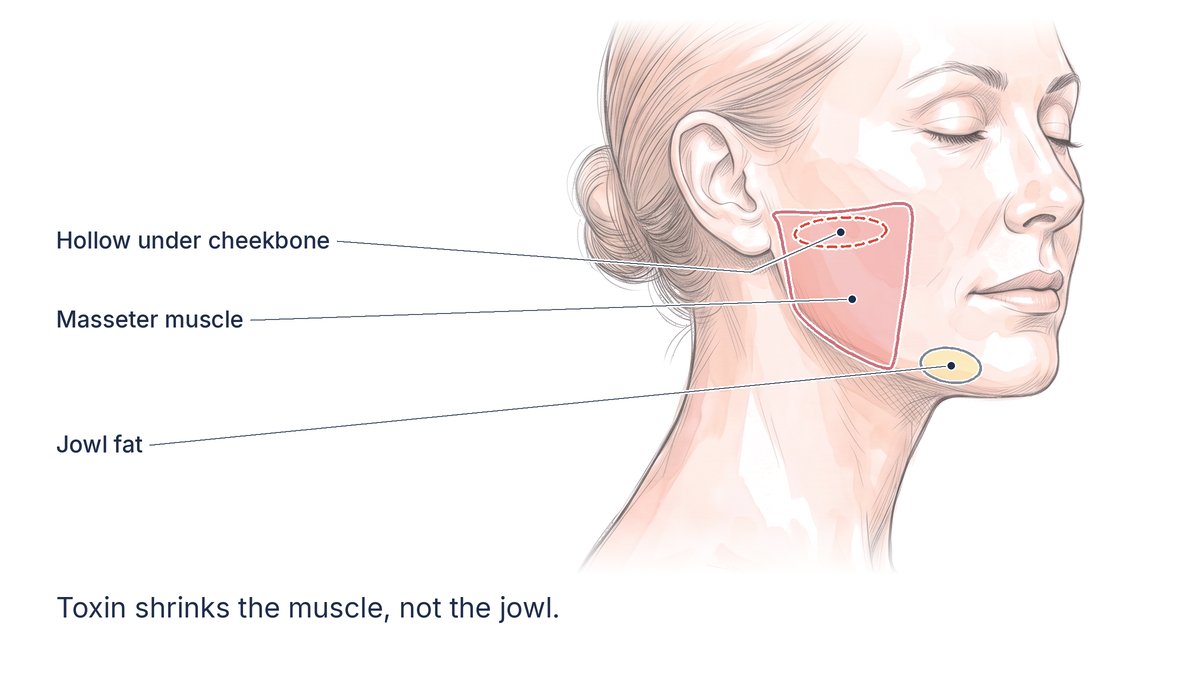
Most “jowls after jaw Botox” turn out to be loose skin that the slimmer muscle no longer hides, a hollow under the cheekbone, or a cheekbone and jaw angle that look stronger beside a smaller muscle. A true jowl, fat that has slid down to the jaw border beside the chin, is a fourth thing, and toxin in the masseter does not cause it.
- Unmasked laxity. A bulky masseter pads the back of the lower face. When it thins, the skin over it is a size too large, and an early jowl that was already there reads heavier.
- A hollow under the cheekbone. A dip appears under the cheekbone, between the ear and the middle of the cheek, after toxin has weakened the upper part of the muscle.
- Relative prominence. Nothing has dropped, but the cheekbone and the jaw angle look stronger because the muscle between them is smaller.
- A true jowl. Fat under the skin beside the chin. If it was there before the injection, it will be there after.
Three checks sort most cases:
- Where is the change? Under the cheekbone, toward the ear, points to the upper masseter. Along the jaw border beside the chin is jowl territory.
- When did it start? A change that appeared 2 to 12 weeks after an injection follows the timing of the toxin. One that crept in over years does not, and an older photograph often shows it.
- Does it clear with a lift? The hand-lift test in jowl treatments by stage shows whether tissue has slid.
Where Is the Masseter, and Where Do Jowls Actually Come From?
The masseter is the chewing muscle at the back of the jaw, running from the cheekbone arch down to the outer surface of the jaw’s back corner (the angle), below and in front of the earlobe. Jowls form further forward, beside the chin, in fat that lies directly under the skin, so weakening the muscle does not move the fat.
Dye studies in 16 cadaver half-faces found jowl fat in two subcutaneous compartments above the jaw border, tethered by a septum attached to the jawbone, with buccal fat as a separate structure.

What the toxin changes is the size of the frame. In a Korean series of 1,021 treated patients, 383 of them followed for at least three months, the muscle was 31 percent thinner on ultrasound at three months, with visible thinning in most by two to four weeks. In a placebo-controlled phase 2b trial, three-dimensional imaging at day 90 showed lower-face volume down 6.15 cubic centimeters and width down 4.17 mm with 48 units in total (24 per side), against 0.33 cubic centimeters and 0.05 mm with placebo.
Skin and fat over the muscle stay the same size. Firm skin follows the new contour; lax skin does not. That Korean series added a second warning: reducing the masseter can make the cheekbone and the jaw angle look relatively more prominent. The placebo-controlled trial did not measure jowls, sagging or cheek hollowing at all, so every rate quoted for those changes comes from retrospective clinic records and expert opinion.
How Often Do Sagging, Sunken Cheeks and Other Side Effects Happen?
Sagging and sunken cheeks are the rare side effects of masseter Botox, and temporary chewing weakness is the common one. In 2,036 sessions given to 680 patients at one clinic in Taiwan between 2011 and 2016, chewing force fell temporarily in 611 sessions (30 percent), bruising followed 51 (2.5 percent), headache 12 (0.58 percent), paradoxical bulging 10 (0.49 percent), sunken cheeks 9 (0.44 percent), sagging 4 (0.20 percent) and a limited smile 3 (0.15 percent).
Those figures come from one retrospective series and count sessions, not patients; a mild change that a patient did not mention may not have been recorded. A 2025 narrative review adds that sagging is reported more often in older patients and in thinner skin, so the rate in lax skin after 40 is likely higher than this average.
A review of 36 articles concluded that most complications appeared within 2 to 4 weeks of injection and resolved within 12 weeks.

At a Glance: What Can Change After Masseter Botox
| Change | What you notice | How often (2,036 sessions) | Main cause | Usual course |
|---|---|---|---|---|
| Unmasked laxity (“sagging”) | Softer lower cheek, heavier early jowl | 0.20 percent | Fast shrinkage under lax or thin skin, usually after 40 | Eases as the muscle recovers |
| Sunken cheek | Hollow under the cheekbone, toward the ear | 0.44 percent | Injection too high, dose too large | Deepest at 2 to 4 months, eases as the upper muscle recovers |
| Paradoxical bulging | A lump that pops out on clenching | 0.49 percent | Part of the outer muscle layer left active | May settle within about 10 days; if still there at 2 weeks, a top-up of 5 to 10 units per side into the bulging part |
| Limited or uneven smile | One mouth corner pulls less | 0.15 percent | Toxin reaching the risorius at the front edge | Recovers in about 1 to 3 months |
| Chewing weakness | Jaw tires on tough food | 30 percent | The intended weakening of the muscle | Starts within 2 to 4 weeks, back by about week 12 |
Why Do My Cheeks Look Sunken After Jaw Botox?
A hollow under the cheekbone after jaw Botox usually means toxin reached the upper part of the masseter, from an injection placed too high, a dose that was too large, or both. Faces with high cheekbones and little cheek fat show it most.
The author of the largest series attributes the sunken cheek to volume loss over the upper masseter after a high injection or an excess dose, and prevents it by keeping injections in the lower part of the muscle. Anatomists reach the same conclusion from 33 cadaver half-faces: the lower masseter is the conventional target because it holds the largest part of the muscle belly, and injecting under the cheekbone arch is generally not recommended because a subzygomatic depression may follow. The same paper notes that some patients still develop the hollow.
In a prospective study of 43 women with a broad lower face and some cheek hollowing before treatment, a new injection plan that redrew the upper boundary of the treated area left hollowing grades nearly unchanged four weeks after injection, and no patient reported that it had worsened. Four weeks is before the muscle reaches its smallest, and there was no control group, so this supports keeping injections low but is not proof of prevention.
Hollows also stack. A cheek already thinned by buccal fat removal, by weight loss, or by fat loss after HIFU has less to hide a smaller muscle.
Who Is Most Likely to See Sagging After Jaw Botox?
People over about 40, and anyone with thin or lax skin, an early jowl, high cheekbones with a hollow under them, or a very large muscle treated with a large dose in one session, are the patients reported to sag or hollow after masseter Botox. In a 25-year-old with firm skin the same dose usually leaves only a narrower jaw.
The evidence is expert opinion built on small numbers. In the chapter based on the 2,036-session series, sagging occurred “usually in patients over 40,” was attributed to rapid shrinkage of the muscle, and was prevented by reducing the dose and separating treatment into multiple sessions. A practice article written for dermatologists gives the same warning for patients with baseline laxity, thin skin, or age over 40, and suggests staged, lower doses. A global consensus on toxins and fillers says, of the face in general, that older patients whose muscle mass or function is reduced may need fewer injection sites and smaller doses at each site. No trial has compared a staged dose with a single dose for this purpose, and age alone is not a ban.
Why Does My Jaw Bulge When I Clench, or My Smile Look Uneven?
A lump that pops out on clenching after jaw Botox is paradoxical bulging: part of the muscle’s outer layer is still working while the rest has gone quiet. An uneven smile means toxin reached the risorius, a small muscle at the front edge of the masseter that pulls the corner of the mouth sideways. Both are temporary.
Paradoxical bulging
The masseter has layers. A study of 44 cadaver half-faces found a deep inferior tendon inside the lower third of the superficial part, covering about 22 percent of its area, which can stop toxin from spreading through the whole outer layer; the untreated strip then bulges when the teeth clench. In an ultrasound series, 3 of 324 patients (about 0.9 percent) developed bulging after 25 units of letibotulinumtoxinA per side, with either the front or the back part of the muscle contracting strongly.

Reported rates vary widely, from 0.5 to 18.8 percent in one commentary, whose illustrated case was fully corrected within two weeks of an additional 16 units per side. The chapter by the series author describes a bulge that often settles within about 10 days, and a booster of about 5 to 10 units into the active part when it has not settled by 10 to 14 days.
An uneven smile
In the phase 2b trial, smile weakness occurred in 1 of 53 participants at 48 units in total and 2 of 49 at 72 units, and resolved in 60 to 101 days; the authors attributed it to a temporary effect on the risorius. Their advice was to keep at least 1 cm behind the front border of the masseter and to inject as deep as possible.
How Does Dr. Yongwoo Lee Inject the Masseter to Protect the Cheek and Jawline?
I inject the masseter myself, with about 25 to 30 units per side spread over 3 to 5 points, placed deep in the lower part of the muscle and kept away from the front edge, where the risorius lies. I repeat it every three to four months at first, and the intervals lengthen after several rounds.
What I check before the first injection
I ask the patient to clench and feel the muscle under my fingers, because the position of the bulge decides where the points go. Then I look at the two places I check before any treatment that takes volume out of a face: the temple and the hollow under the cheekbone. A smaller masseter makes an existing hollow under the cheekbone easier to see, and the temple can sink too, rarely, when toxin spreads to the chewing muscle there; if either area is already thin, I say so before injecting.
Next I look for an early jowl and lift the cheek by hand to see how much of the lower face is loose tissue and how much is muscle. For lax skin or an early jowl, the published advice is a lower dose built up over more than one session.
Dose, depth and position
Published doses vary: the phase 2b trial used 24 or 36 units of onabotulinumtoxinA per side, and a 2025 review found no agreed average dose: three-point totals of 24 to 60 units of onabotulinumtoxinA or incobotulinumtoxinA, or 60 to 300 units of abobotulinumtoxinA, whose units are counted differently. My 25 to 30 units per side refer to the two products I use, Botulax (letibotulinumtoxinA) and Xeomin (incobotulinumtoxinA). Units do not convert exactly between products, so ask which one you are receiving.
I place the points low, where the bulk is, sparing the upper muscle where a hollow can form, and deep and away from the front edge to spare the smile. The published safety zone describes the same idea in landmarks: the front and back edges of the muscle, the lower border of the jaw, and above, a line from about the corner of the mouth to the earlobe, with 3 to 4 points kept roughly 1 cm inside every border.

Review, repeat and totals
I see patients again at about two weeks and check the bite, the smile and the muscle on clenching. As with my other toxin treatments, I change the dose at the next session instead of adding top-ups soon after an injection; the exceptions are a clear asymmetry and a bulge still there at two weeks, which I top up with 5 to 10 units per side of Botulax or Xeomin into the bulging part.
I do not repeat the treatment sooner than three months, and the gap lengthens after several rounds because the muscle tends to stay smaller for longer. Jaw doses are among the larger cosmetic doses and count toward the same running total as every other area, so for these patients I discuss a complex-free product as a precaution and explain that the evidence for it is indirect; the reasoning is in why Botox can stop working.
When the answer is not more toxin
A jaw angle that still shows once the muscle has shrunk is bone, and no further dose will change it; I confirm it with CT, and the choice between toxin and jaw-angle surgery, which I perform myself, is laid out in Botox versus jaw reduction for a square jaw. Jaw-angle surgery, like any major operation, needs no nicotine in any form (cigarettes, vapes, patches, gum) for 4 weeks before and after, or it is postponed.
Which Jaw Botox Patient Are You?
The three faces below are composites for illustration, not real patients; they show how a plan changes, not what a result looks like.
A 34-year-old with high cheekbones and a slim face, or with buccal fat already removed. Slimming the jaw will sharpen the hollow under the cheekbone. A lower dose placed strictly low, or accepting a little width, is the trade.
A 46-year-old who clenches, with a strong muscle and an early jowl. Here the muscle is partly padding. A reduced, staged dose is the published way to protect the jawline, and the jowl itself is a separate problem.
A 38-year-old with a new dip under the cheekbone two months after an injection. Toxin most likely reached the upper muscle. Time comes first, then a lower and smaller plan, and volume only if the hollow outlasts the toxin.
How Long Do Sagging and Sunken Cheeks Last, and What Fixes Them?
Changes caused by the toxin follow the muscle. Chewing and smile effects usually resolve within 12 weeks, but a hollow or looser lower cheek tracks the muscle’s size, which is smallest around two to four months and usually recovers over roughly four to six months after a single session, longer after several rounds. Nothing dissolves botulinum toxin the way hyaluronidase dissolves filler, so the first treatment is time.
In the trial the effect plateaued between day 60 and day 120. At day 180 toxin still differed from placebo, but a two-grade improvement was kept by 35.8 to 47.8 percent of treated participants, down from 66.0 to 71.7 percent at day 90.
If the lower face looks loose or hollow in the meantime:
- Do not repeat the masseter injection yet. More toxin in the same muscle extends the problem.
- Wait and photograph. Photographs taken in the same light show the hollow filling back as the muscle recovers.
- Add volume only to a hollow that stays. Judge it once the muscle has recovered, usually not before about six months after the last injection. A small, defined dip can be filled with a hyaluronic acid filler, which can be dissolved if it is wrong; a broad hollow in a thin face is better served by the patient’s own fat, a split explained in facial fat transfer versus filler. Either can, rarely, block a blood vessel: skin turning white, gray or blue, or any change in vision, during or after the injection is an emergency; call emergency services first, then the injector.
- Treat a true jowl as a jowl. Looseness that remains after the muscle has fully recovered was usually there before, and its treatment depends on its stage.
- Change the next plan. Lower on the muscle, fewer units, or a longer gap.
Sagging after cheekbone surgery has a different cause, soft tissue released from bone, covered in cheek sagging after zygoma reduction.
Surgeon’s Insight: The Muscle Was Part of the Frame
A strong masseter is width, but it is also padding. Before I slim one, the question I ask is not how big the muscle is. It is what the skin over it will do when a third of that thickness is gone.
In firm skin, the skin follows and the face simply narrows. In a face with an early jowl, the same dose removes support from skin that already had too little, and the patient concludes that Botox made the jowl. It did not. It took away what was hiding it. That is why the skin matters as much as the muscle when a dose is planned, and why a hollow is easier to prevent than to explain.
Is Masseter Botox Safe? Chewing, Jawbone and Warning Signs
At the doses studied, masseter Botox has a good short-term safety record: in the placebo-controlled phase 2b trial, treatment-related adverse events occurred in 10.8 percent of treated participants, mainly temporary smile weakness and chewing difficulty, and no distant spread of toxin was seen. The open questions are the jawbone over years of repeated treatment and resistance after large cumulative doses.
Chewing. Weaker chewing is the common effect, recorded after 30 percent of sessions in the largest series. In the trial, chewing difficulty was reported as an adverse event by about 3 percent and resolved within a month. The 2025 review adds that repeated injections at short intervals may leave lasting thinning.
Jawbone. Small studies disagree. In a 12-month randomized, placebo-controlled trial with CT scans of 123 adults, the only statistically clear change was a 2.15 percent fall in bone density at one jaw joint after two 72-unit treatments, against 0.17 percent with placebo, which the authors judged to be within normal variation and not clinically significant. A companion analysis of 187 participants found no difference from placebo in jaw width, cortical thickness or jaw angle, while noting that effects beyond 12 months cannot be excluded. Both analyses come from one manufacturer-funded trial.
Against them stands a retrospective CT study of 77 women with jaw-muscle pain, 43 of whom received toxin in the masseter and the temporalis at two sessions six months apart, in which cortical bone quality fell in the toxin groups, at the jaw joint in younger women and in the jaw’s vertical branch after menopause, where the authors found the effect more marked.
In the controlled trial, one year of treatment showed no clinically meaningful change; nobody has measured ten years.
Who should wait or avoid it. Toxin is not given during pregnancy or breastfeeding, to people with a neuromuscular disease such as myasthenia gravis or Lambert-Eaton syndrome, or over skin that is infected. Tell the injector about every medicine you take, including aminoglycoside antibiotics and blood thinners. Never stop a prescribed blood thinner to reduce bruising without asking the doctor who prescribed it.
Spread. Botulinum toxin labels carry a boxed warning about effects away from the injection site, described in Botox for neck bands. New trouble swallowing, speaking or breathing after any toxin injection is an emergency: call emergency services or go to the nearest emergency room first, then tell the doctor who injected you. Double or blurred vision, drooping eyelids, a hoarse voice or weakness spreading beyond the jaw also need a doctor the same day; if any of them comes with difficulty breathing or swallowing, treat it as the emergency above.
What Should You Ask Before Jaw Botox?
Ask what your lower face is made of, and what your skin will do when the muscle gets smaller.
- Is my width muscle, bone or fat? Only muscle responds to toxin.
- Do I already have an early jowl, thin skin or a hollow under the cheekbone? If so, how will the dose change?
- Which product, how many units per side, and how low on the muscle? Units are product-specific.
- Will I be seen at two weeks, and when would you repeat it? In my practice, a full repeat treatment comes no sooner than three months.
If you ask only one question, ask this: If this muscle gets a third thinner, will my skin follow it?
Individual results vary; consultation required.
Written by Dr. Yongwoo Lee, board-certified Korean plastic surgery specialist in facial anatomy and aesthetic procedures at VIP Plastic Surgery, South Korea.
Frequently Asked Questions About Masseter Botox, Jowls and Sunken Cheeks
Can masseter Botox make your face look older?
It does not create jowls, but in lax skin it can make existing looseness easier to see, because a smaller muscle removes padding from skin that already had too little. The largest series recorded sagging in 0.20 percent of 2,036 sessions, and it usually eases as the muscle recovers.
Where should masseter Botox be injected to avoid a sunken cheek?
Low and deep: in the lower part of the muscle, where most of its bulk is, roughly 1 cm inside its borders and below a line from about the corner of the mouth to the earlobe. Injecting under the cheekbone arch is generally not recommended because a hollow may follow.
Is sagging after masseter Botox permanent?
Usually not. After a single session the muscle recovers as the toxin wears off, and the padding returns with it over several months. After several rounds the muscle can stay smaller for longer, so recovery is slower. Looseness still present after the muscle has fully recovered was usually there before the injection.
Can anything speed up recovery from sunken cheeks after jaw Botox?
No. Nothing dissolves botulinum toxin the way hyaluronidase dissolves filler, so the first treatment is time. Do not repeat the masseter injection meanwhile; volume is added only to a hollow that stays once the muscle has recovered.
Am I too old for masseter Botox at 40 or 50?
Not by age alone. Reports of sagging cluster in patients over 40, but skin firmness, an existing jowl and cheek volume decide. Published advice for older or laxer faces is a smaller dose split across sessions.
How many units of Botox are used for jaw slimming?
There is no agreed dose. A 2025 review lists 24 to 60 units over three points of onabotulinumtoxinA or incobotulinumtoxinA (several times more for abobotulinumtoxinA, whose units differ), and a placebo-controlled trial used 24 or 36 units of onabotulinumtoxinA per side. Dr. Yongwoo Lee uses about 25 to 30 units per side of Botulax or Xeomin, at 3 to 5 points.
How long does masseter Botox last, and when does the slimming show?
Thinning is visible at about 2 to 4 weeks and peaks around 3 months, when the muscle is about 31 percent thinner on ultrasound; after one session it recovers over roughly four to six months, and a controlled trial still measured the effect at day 180. Dr. Yongwoo Lee repeats it every three to four months at first, with longer gaps after several rounds.
How is a jaw bulge after Botox fixed?
Often by waiting: the author of the largest series reports it often settles within about 10 days. When it is still there at about two weeks, Dr. Yongwoo Lee adds 5 to 10 units per side of Botulax or Xeomin into the bulging part.
How long does an uneven smile from jaw Botox last?
In a controlled trial it resolved in 60 to 101 days, roughly two to three months. It happened in about 3 percent of treated participants, when toxin reached the risorius, a small smile muscle at the front edge of the masseter; the published advice is to inject deep and at least 1 cm behind that edge.
Does repeated masseter Botox weaken the jawbone?
It is not established. A 12-month placebo-controlled trial with CT scans found no clinically meaningful change in jawbone density or shape, while a small study of women treated for jaw-muscle pain found lower cortical bone quality in the jaw after toxin, more so after menopause.
Can filler or fat fix a hollow cheek after jaw Botox?
Yes, if the hollow persists, but waiting comes first because most ease as the muscle recovers, usually over about six months. A small, defined dip suits a hyaluronic acid filler, which can be dissolved; a broad hollow in a thin face suits fat grafting.
Can I get masseter Botox after buccal fat removal?
With caution. Both reduce volume under the cheekbone, and together they can leave a hollow that neither would cause alone. A lower dose, kept strictly in the lower muscle, is the safer plan.
This article is for informational purposes only and does not constitute medical advice. Always consult with a qualified medical professional before making any decisions about surgical or non-surgical procedures.
