
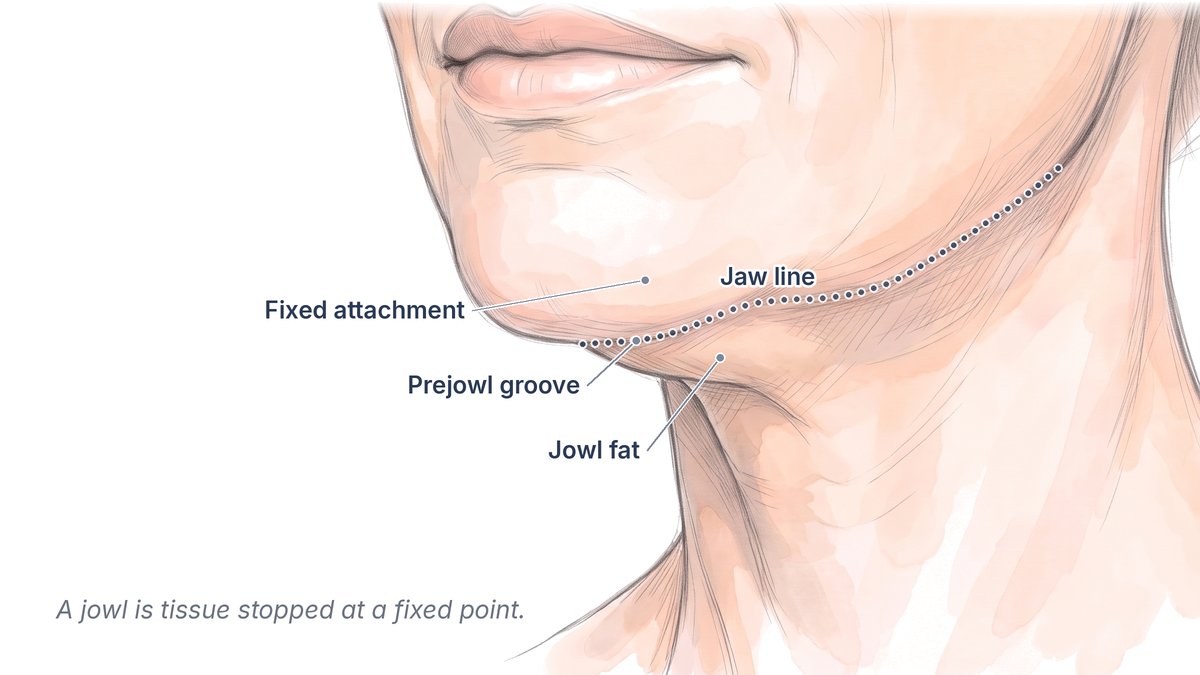
Jowls are the soft bulges of skin and fat that form along the jawline on either side of the chin, breaking the line from chin to ear. How to get rid of jowls depends on where the jowl sits. A jowl is tissue that has slid down until a fixed attachment at the front of the jaw stops it, often in front of a jaw that is itself receding. Tightening and filling treatments help while the jowl still sits above the jaw border; once it hangs past the border, only a surgical lift that moves the tissue back up changes where it sits.
Quick answers
- What is the best treatment for jowls? The one matched to where the jowl sits: above the jaw border, devices and support; at or below it, a surgical lift that repositions the tissue.
- Can jowls be fixed without surgery? Early, soft jowls can be softened; a jowl hanging below the jawline cannot be held back up for long by a device, a thread or filler.
- Does filler help jowls? Filler on the chin and in the groove in front of the jowl can straighten the line; filler put into the jowl adds weight to it.
- Does Ultherapy (HIFU) work on jowls? Modestly, in mild laxity, with no jowl-specific data; it is FDA cleared for the brow, under the chin and the neck, not the jowl.
- Do thread lifts work on jowls? Temporarily: in 160 patients the lift had faded by 6 months and was gone by a year.
- Does Kybella work on jowls? It is off-label there; the main published jowl series is 66 uncontrolled patients, with temporary lower-lip weakness in 5 percent.
- How long does a facelift last for jowls? In one 5.5-year study the jowl kept about four-fifths of its correction, while the neck lost 69 percent of its gain.
What Are Jowls, and What Actually Causes Them?
A jowl is a pocket of skin and fat lying on top of the platysma, the thin sheet of muscle that runs from the neck up over the jaw and continues into the SMAS, the fibrous layer that wraps the facial muscles. It has slid down until it bulges behind a firm attachment near the front of the jaw, and it shows more as the bone in front recedes and the skin loses its snap.
Two fat compartments and a tether
Dye studies in cadavers show jowl fat sitting in two overlapping compartments above the jaw border, held off the neck by a band that tethers the skin to the bone. Buccal fat, the deeper pad inside the cheek, is a separate structure. Under the front half of the jowl, a ligament ties the soft tissue to the jaw beneath the platysma, and in a 2023 anatomy study the nerve that moves the lower lip ran within about 1 to 2 mm of it, which is why that spot is treated with care.
The ligaments themselves have not been shown to weaken with age; what slides is the tissue between them, as set out layer by layer in what bone, fat, ligaments and skin do at 40, 50, 60 and 70.
Why the groove in front of the jowl deepens (the prejowl sulcus)
Between the jowl and the chin a shallow groove, the prejowl sulcus, often forms, and part of it is bone: CT scans of 120 adults show the jaw body losing height and length with age, though not every skull study agrees. A facelift repositions soft tissue but does not replace bone lost in front of the jowl, so chin and prejowl support is a separate decision.
Skin also loses recoil, the speed with which it springs back, and recoil decides whether a device or fat removal under the jaw can leave a smooth line.

How Bad Are My Jowls? A Four-Stage Self-Check You Can Do in a Mirror
Four findings place a jowl on the ladder: where it sits relative to the jaw border with your head upright, whether it clears when you lift your cheek by hand, whether the skin snaps back after a pinch, and whether the neck has joined in. The four stages below are a patient guide built from those findings, not a validated score.
- Where it sits. In profile, head level, does any bulge stay above the jawbone or hang over it?
- The hand-lift test. Place your fingertips flat on the cheek in front of the ear and lift gently up and back toward the temple. If the jowl disappears and the jawline straightens, the tissue is mobile. If nothing improves, the problem is more lost volume than descent.
- The pinch and recoil test. Pinch a fold of skin under the jaw and let go. If it flattens at once, recoil is good; if it settles back slowly, it is not.
- The grimace test. Tense the neck. Vertical cords that jump forward are platysmal bands, a neck problem rather than a jowl problem.
- The profile of the chin. A chin that sits back breaks the line on its own, as weighed in genioplasty versus chin implant versus chin filler.
Stage 1: no jowl yet. The jawline looks softer in photographs, but no bulge breaks the line.
Stage 2: a soft jowl above the border. A small bulge stays above the jaw border with the head upright, the skin recoils and the neck is clean.
Stage 3: a jowl at or past the border. The bulge breaks the jawline at or just over the bone, with some looseness or fat under the chin.
Stage 4: a heavy jowl below the border, with the neck. The jowl hangs below the jaw, the neck skin is loose, and bands or creases show.

What Is the Best Treatment for Jowls? The Ladder at a Glance
There is no single best treatment for jowls, only the one that reaches the layer that failed, at the stage you are in. Skin treatments improve the skin, support treatments fill the groove in front of the jowl, fat treatments shrink it, and only a surgical lift changes where the jowl sits.
Key numbers
- Microfocused ultrasound: investigators rated 92 percent improved at day 90, about half of them mildly, across face and neck areas, with no jowl-specific data and none past about a year.
- Barbed threads: lift gone by 1 year in 160 patients; about 1 in 3 had an early complication.
- Facelift: about 6 mm of jowl height gained, about 79 percent of it still present at 5.5 years (one surgeon, 50 returning patients).
- Mini vs full facelift: no significant jawline difference at 5 years in 11 twins and triplets; the neck was better after the full lift.
Jowl Treatments at a Glance: What Each One Reaches
| Treatment | Layer it acts on | What it does for a jowl | Stage | Evidence follows it for | Main limit |
|---|---|---|---|---|---|
| Skin boosters (Re2O, Rejuran, Juvelook) | Dermis | Skin quality | 1 | Not studied for jowls | Moves no tissue |
| Microfocused ultrasound (Ultherapy, Shurink) | Deep dermis, SMAS | Mild tightening | 1 to 2 | About 1 year | Not cleared for jowls; weaker with BMI over 30 |
| Radiofrequency (Thermage, Oligio) | Dermis | Skin tightening | 1 to 2 | 4 to 6 months | Modest; no jowl measure |
| Filler or fat to chin, prejowl groove, jaw angle | Support over bone | Straightens the line | 1 to 3, as an addition | 12 months (Volux); 60 weeks (Radiesse) | Adds weight if put in the jowl |
| Barbed threads | Subcutaneous fat | Temporary elevation | 2 | Gone by 1 year | 34 percent early complications |
| Deoxycholic acid (Kybella) | Subcutaneous fat | Shrinks a small fatty jowl | 2 | Short, uncontrolled | Off-label; lip weakness 5 percent |
| Buccal fat removal | Buccal pad, above the jowl | Narrows a heavy lower cheek | Addition | Not measured for jowls; not reversible | Not a jowl treatment |
| Neck liposuction | Fat under the chin | Clears the neck below | Addition | Not measured for jowls | Needs skin recoil |
| Mini facelift | SMAS and skin, face only | Repositions an early jowl | 2 to 3, neck clean | No significant jawline difference from a full lift at 5 years | Neck relapses |
| Deep plane face and neck lift | Released composite layer, platysma | Repositions jowl and neck | 3 to 4 | About 79 percent of jowl correction kept at 5.5 years (one facelift series, technique not specified as deep plane) | Surgery and recovery |
Stacking does not add up to a lift. Ultrasound, threads and jawline filler tighten the skin, prop the fat for months and fill in front of the jowl, yet the jowl stays where it was, because no step freed it.

Can You Get Rid of Jowls Without Surgery?
A soft jowl above the jaw border can be softened and camouflaged without surgery. A jowl that hangs below the border cannot be moved back up for long by a device, a thread or filler, because none of them frees the tissue held at the front of the jaw; threads lift it only for months.
Ultherapy, Shurink (HIFU), Thermage and Oligio: tightening, not lifting
Ultherapy was FDA cleared in 2013 to lift the eyebrow and lax tissue under the chin and on the neck, not the jowl. In a 2023 review of microfocused ultrasound (HIFU), the technology of Ultherapy and Shurink, investigators rated 92 percent of 337 pooled patients improved at day 90, about half of them mildly, across face and neck areas rather than the jowl, with no data beyond about a year, and few patients with a BMI over 30 improved.
Radiofrequency heats the skin itself: improvement four months after one or two Thermage-type treatments was modest for most, and a small uncontrolled study of Oligio, a Korean device, rated most of its 30 patients improved at six months. Dr. Yongwoo Lee chooses among these devices by the skin and the stage rather than the brand; the technologies are compared in Ultherapy versus Thermage versus Shurink.
Jawline filler: support the frame, do not fill the jowl
In the US, Juvederm Volux and Radiesse (+) are FDA approved for the jawline, for definition or contour rather than lifting. In the Volux pivotal trial, 69.9 percent of 146 adults had improved jawline definition at 6 months and 82.3 percent were satisfied through 12 months, and Radiesse (+) was approved in 2021 after a 180-subject randomized trial running 60 weeks.
Placement matters more than product: on the chin, in the prejowl groove and at the jaw angle, filler supports the frame; into the jowl, it adds weight to tissue that has already slid. When years of filler have made a face heavy, see whether to dissolve filler or lift the face.
The facial artery crosses the jaw border at the front edge of the masseter, one reason Dr. Yongwoo Lee uses a blunt cannula almost everywhere he places filler; a cannula lowers the risk of entering a vessel but does not remove it, and the warning signs are in filler blindness and what to do immediately.
Thread lifts: months, not years
Barbed threads hook the fat under the skin and pull against ligaments that were never released. In 160 patients treated in the cheek, the nasolabial area and along the jawline, the lift had faded by 6 months and was gone by a year, and about 1 in 3 (34 percent) had an early problem such as superficial thread displacement, redness, infection or dimpling. Why threads last months rather than years is set out in what a barbed thread can hold, and for how long.
Kybella and fat reduction on the jowl
Deoxycholic acid (Kybella) dissolves fat cells, and its label advises against use outside the area under the chin; in its trials 4 percent had lower-lip weakness, all resolving on their own after a median 44 days (range 1 to 298). In the main published jowl series, 66 adults treated off-label without a control group, most improved, but 5 percent had temporary lower-lip weakness and 5 percent temporary hair loss at the site. Liposuction is the more established way to reduce jowl fat, and either helps only when the jowl is mostly fat and the skin recoils.
Botox at the jawline (the Nefertiti lift)
Botulinum toxin along the jaw and neck, the Nefertiti lift, relaxes the platysma, which is thought to pull the lower face down; Botox Cosmetic was FDA approved in 2024 for neck bands, not for jowls, and its effect wears off with the toxin. What that approval covers, and when neck bands need a neck lift instead, is explained in platysmal neck bands: Botox vs neck lift.
Skin boosters
Skin boosters are dermal injections intended to improve skin quality, not position, and the evidence differs by product. Dr. Yongwoo Lee’s usual first choice is explained in the Re2O ECM skin booster guide, and the others are compared in Rejuran versus Juvelook versus Skinvive.
When Do Jowls Need Surgery, and Which Operation?
Jowls need surgery when they sit at or below the jaw border but clear with the hand-lift test, or when the neck has joined in, because that means mobile tissue in the wrong place. The operation is chosen by the neck and the midface, not by the word “mini.”
Buccal fat removal: a lower-cheek problem, not a jowl problem
Buccal fat sits above the jowl, not in it, although a descended pad can add fullness just above it, and the pad may not begin to shrink until after 60 or 70. Removing it leaves the jowl fat untouched; who hollows out later is covered in buccal fat removal and long-term hollowing.
Mini facelift: when the neck is clean
A mini facelift lifts the jowl through an incision that stays in front of the ear and reaches the neck little, if at all. In a study of 11 identical twins and triplets, the jawline showed no significant difference at 5 years between a short-scar and a full lift, but the neck was better after the full lift. In Dr. Yongwoo Lee’s practice a mini facelift is the same deep plane release through a shorter incision, as detailed in mini facelift versus full facelift.
Deep plane facelift: when the tether has to be released
A deep plane facelift works beneath the SMAS and moves skin, fat and SMAS together, so the jowl is repositioned rather than pulled against its attachment. In 89 patients followed a mean 19 months after an extended deep plane lift aimed at the jawline, the visible jawline lengthened from 7.1 to 9.8 cm, in the originating surgeon’s uncontrolled series. Head-to-head data do not show one lift giving a better jowl than another; the trade-offs are in deep plane versus SMAS facelifts.
How Long Do Jowl Treatments Last?
Studies follow nonsurgical jowl treatments for months to about a year and facelifts for years. Ultrasound data stop at about a year, the thread lift was gone by a year, the filler trials ran 12 months and 60 weeks, and most of a facelift’s jowl correction remained at 5.5 years.
In the longest jowl measurement, patients who came back 5.5 years after a facelift still had about 79 percent of their jowl correction, about 6 mm raised with about a fifth lost, while the angle under the chin had lost 69 percent of its gain. That is one surgeon, in the 50 patients who returned.
Early relapse is reported at a low rate in the few papers that measure it: early relapse-related outcomes had a weighted median of 2.4 percent, in a reported range of 0.2 to 50 percent, among the 19 of 433 facelift papers that reported them. Deep plane lifts are not immune to recurrence either: one critical review of 78 deep plane procedures documented early return of the nasolabial fold and jowl between six and twelve months. Facelift results have been documented to 13 years. Aging continues after any treatment.

How Does Dr. Yongwoo Lee Treat Jowls in Surgery?
In surgery I treat a jowl with a deep plane facelift: I release the retaining ligaments over the cheek, free the jowl near the jaw border in the layer just under the skin, move the SMAS and skin up and back as one layer, and fix it with permanent sutures. I treat the neck in the same operation when it needs it, and often replace the volume missing in front of the jowl with the patient’s own fat.
Examination before any plan
I check the jowl with the hand-lift test before discussing any treatment: a jowl that does not improve when I lift the cheek by hand will not improve with a surgical lift either, because that face needs volume, not release. If the jowl still sits above the jaw border and the skin recoils, I start with devices and support, not surgery. When the neck has any laxity, I do not recommend a short-scar lift for the jowl.
The SMAS incision and the release
My SMAS incision starts near the outer rim of the eye socket, runs horizontally back toward the ear, then turns down about 1 cm in front of the tragus, over the parotid gland, and continues toward the angle of the jaw and into the neck. Through it I go beneath the SMAS over the cheek and release the retaining ligaments there as completely as the anatomy allows, because that release is what lets the tissue move.
Near the jaw border I do not divide the deep mandibular ligament. It lies beneath the platysma under the front of the jowl, and in cadavers the marginal mandibular nerve, the branch that moves the lower lip, runs within about 1 to 2 mm of it. There I free the jowl in the subcutaneous layer instead, above the platysma, watching that nerve branch throughout.
Fixing it up and back with permanent sutures
I then fix the SMAS up and back (superolaterally), toward the upper ear and temple, with permanent sutures. Direction matters because the face descended vertically, and pulling it straight back toward the ear produces the swept look described in the windblown facelift. With the deep layer carrying the load, the skin can be closed without tension.
The neck in the same operation
When a jowl needs surgery, the neck often does too, and I commonly treat both in one operation, working on the fat beneath the neck muscle, a bulging muscle under the chin and the loose platysma itself, depending on the examination.
Fat to the prejowl groove and the marionette area
A lift moves tissue but cannot rebuild bone or fat that is gone, so I often graft fat in the same operation to the temple, forehead, brow, cheek and lateral cheek, the nasolabial fold, the marionette area beside the mouth, and the prejowl groove. When a patient is open to surgery, I prefer fat to filler for volume, and for the nasolabial folds in particular; filler remains the choice for a quicker result or no surgery. Only part of grafted fat survives, on the terms in how much transplanted fat lasts.
Buccal fat, and what I do not do
I often suggest buccal fat removal to facelift patients whose lower cheek is heavy, because patients rarely know to ask, and I decline when the temple or the hollow under the cheekbone is already thinning. I do not reposition buccal fat beneath the SMAS, and I place jawline filler on support points rather than into the jowl.

The weeks after surgery are covered in facelift recovery week by week.
Which Jowl Patient Are You?
The stage, not the age, points to the tool. These illustrative examples are not real patients and describe decisions, not results.
Late 30s or 40s, a jawline soft in photos, no real jowl. Stage 1: skin quality, a device chosen for the skin, and small support at the chin or prejowl groove if the frame is short.
An early jowl that clears with the hand-lift test, neck clean. Stage 2: devices or threads can soften it for months, and a short-scar lift is the option for a longer-lasting change.
“I have done Ultherapy, threads and filler, and the jowl is still there.” Stage 3 after stacking: nothing has released the tissue, and heavy hyaluronic acid filler may need dissolving, and time to settle, before a lift.
A jowl plus a full neck. Stage 3 to 4: the jowl and neck are treated together, and liposuction alone fits only skin that recoils, as set out in neck liposuction versus a neck lift.
Heavy lower cheeks and jowls at a stable weight. Buccal fat is assessed alongside the lift and removed only when it is the surplus.
Jowls that appeared after weight loss on a GLP-1 drug. The face keeps deflating while weight falls, so weight should be stable first, as explained in Ozempic face after GLP-1 weight loss.
Men’s jowls follow the same ladder, with differences in skin, beard and bleeding risk covered in what changes in a male facelift.
Surgeon’s Insight: A Jowl Is Held at a Fixed Point, So It Is Moved by Releasing, Not by Adding
Every nonsurgical jowl treatment works on the tissue around the fixed point: it tightens it, adds to the groove in front of it, or shrinks it, and each helps while the jowl is still above the jaw border. Once it has passed the border, adding volume makes it heavier, and tightening pulls against an attachment that never weakened.
What changes the position of a jowl, in my approach, is freeing it and moving it up and back with the SMAS, then putting back the fat that is missing in front of it. That is why I am comfortable telling a patient with a stage-2 jowl that a device is a reasonable choice, and why I tell a patient with a stage-4 jowl that a fourth session will not do what the first three did not.
What Are the Risks of Jowl Treatments?
The nerve that moves the lower lip, the marginal mandibular branch, runs close to the jowl, so every treatment that works there, from deoxycholic acid to liposuction to a facelift, carries a small risk of lower-lip weakness, usually temporary. Filler, and fat grafted by injection, can rarely block an artery, and surgery adds bleeding and healing risks.
- Facial nerve weakness after a facelift. In a 2026 meta-analysis of the deep plane facelift, temporary injury was 1.2 percent in pooled retrospective series, while a prospective study that examined every patient found transient weakness in about 11 to 12 percent; branches and recovery are covered in facial nerve injury after a deep plane facelift.
- Vascular occlusion from filler or injected fat. Rare but urgent: skin turning white, gray or blue, unusual pain or a change in vision needs immediate care.
- Device side effects. In the microfocused ultrasound review, bruising, temporary altered sensation, burns and skin marks occurred in about 2 percent (14 of 573).
- Hematoma after a facelift. Bleeding under the skin is the most common serious complication of a facelift, 1.1 percent across 11,300 patients in one database; prevention is set out in preventing facelift hematoma with a hemostatic net.
What Should I Ask Before Choosing a Jowl Treatment?
Ask where your jowl sits relative to the jaw border, whether it clears when the cheek is lifted by hand, whether your skin recoils, and whether your neck is involved. Those four answers pick the treatment; its name comes after.
A plan that offers a device, then threads, then filler for a jowl that already hangs below the jaw is treating the brochure, not the jowl.
Individual results vary; consultation required.
Written by Dr. Yongwoo Lee, board-certified Korean plastic surgery specialist in facial anatomy and aesthetic procedures at VIP Plastic Surgery, South Korea.
Frequently Asked Questions About Jowls Treatment
What causes jowls in your 30s or 40s?
Usually a mix of early sliding of the fat above the jaw, a heavy lower cheek, genetics and weight, sometimes with a short chin that breaks the line sooner. Jowl fat and buccal fat are separate, and the hand-lift test and a profile view tell them apart.
At what age do jowls usually appear?
There is no fixed age. Jowls follow the tissue rather than the calendar: they appear when fat above the jaw has slid, when the bone in front of the jowl has receded, or when the skin has lost recoil. The stage of the jowl, not the birthday, decides what helps.
Can jowls be reversed?
Their position can be changed only by a surgical lift that repositions the tissue. Before that point, their appearance can be softened by tightening the skin, supporting the groove in front of the jowl or shrinking fat, while the jowl still sits above the jaw border. Aging continues after either approach.
Can facial exercises or face yoga get rid of jowls?
No controlled study has shown it. The best-known small exercise study had no control group and measured cheek fullness, not jowls. Imaging and cadaver studies also found no measurable change in the muscles of expression or the ligaments with age, so a jowl is sliding skin and fat, not a weak muscle that training could tighten.
Does weight loss make jowls better or worse?
It can do either. Losing fat can shrink a fatty jowl, but large or rapid loss can leave skin that no longer recoils, which makes jowls look looser. After weight loss on a GLP-1 drug, weight should be stable before a lift or fat grafting is planned.
Can filler make jowls look worse?
Yes, if it is injected into the jowl or used in large volumes to chase a jowl that has slid, because it adds weight to descending tissue. Filler on the chin, in the prejowl groove and at the jaw angle supports the frame instead, so the jowl reads smaller.
How long does jawline filler last?
It depends on the product and the trial. In the Volux pivotal trial 69.9 percent had better jawline definition at 6 months and 82.3 percent were satisfied through 12 months, and the Radiesse (+) jawline trial ran 60 weeks. Both are approved for jawline definition or contour; neither trial measured a jowl lift.
Is Ultherapy or Thermage better for jowls?
Neither lifts a jowl that has passed the jaw border. Ultherapy, a microfocused ultrasound (HIFU) device, reaches the SMAS and suits mild sagging, while Thermage heats the dermis and suits lax, crepey skin. Ultherapy is not FDA cleared for the jowl, and its follow-up data stop at about a year.
Does Botox help jowls?
Not directly. Botulinum toxin along the jaw and neck, the Nefertiti lift, relaxes the platysma, which is thought to pull the lower face down. Botox Cosmetic is FDA approved for vertical neck bands, not jowls, and the effect wears off; it does not move jowl fat.
Is jowl liposuction a good idea?
It can be, for a jowl that is mostly fat in skin that snaps back, and it is often combined with a lift. It is a more established way to reduce jowl fat than injections, but the nerve that moves the lower lip lies close by, so work near the jaw border stays in the layer above the platysma.
Does buccal fat removal help jowls?
Not directly. Buccal fat sits above the jowl, so removing it narrows a heavy lower cheek; in older faces a descended pad can add to fullness just above the jowl, but the jowl fat itself stays in place. It is usually an addition to a lift, not a jowl treatment.
Will a mini facelift fix my jowls?
It can, for an early jowl with a clean neck. In a study of 11 identical twins and triplets, the jawline showed no significant difference at 5 years between a short-scar and a full lift, but the neck was better after the full lift, so the neck usually decides.
How long does a facelift last for jowls?
In one study of 50 patients measured 5.5 years after surgery, the jowl had been raised about 6 mm and about 79 percent of that correction remained, while the neck had lost 69 percent of its gain. Results have been documented to 13 years, and the face keeps aging.
Can jowls come back after a facelift?
Yes, gradually, as the face keeps aging, and occasionally early. A review put early relapse-related outcomes at a weighted median of 2.4 percent, and one review of 78 deep plane procedures described the jowl returning between 6 and 12 months. In the 5.5-year study the jowl held better than the neck.
Do I need a neck lift too?
Often, if the jowl sits at or below the jaw border. Loose neck skin, platysmal bands on a grimace or fat beneath the muscle need neck work, and in one 5.5-year study the neck relapsed more than the jowl. Liposuction alone suits only skin that snaps back.
What is the difference between jowls and marionette lines?
A jowl is a bulge of skin and fat along the jaw border, behind a fixed attachment near the front of the jaw. Marionette lines run down from the corners of the mouth. A jowl has slid and needs repositioning; the marionette area and the prejowl groove have lost volume and are supported with filler or fat.
This article is for informational purposes only and does not constitute medical advice. Always consult with a qualified medical professional before making any decisions about surgical or non-surgical procedures.
