
Is a Buried-Suture Double Eyelid Permanent, or Does It Wear Off?
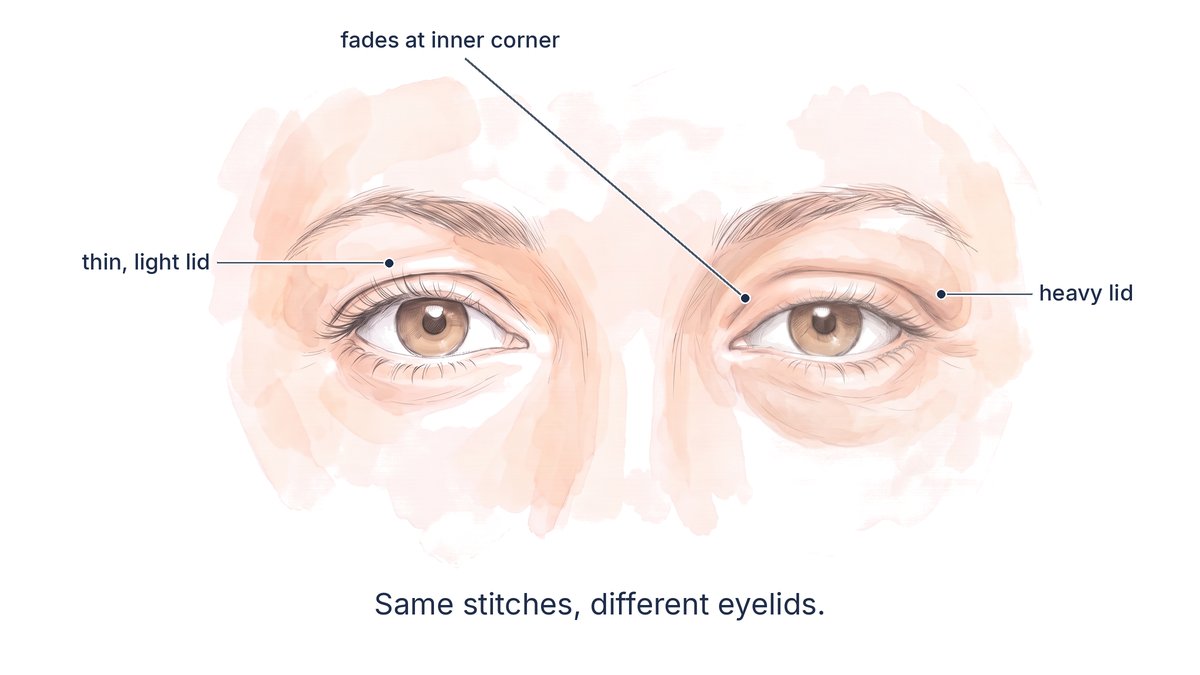
Neither. A buried-suture double eyelid, the non-incisional suture method of Asian blepharoplasty, has no expiry date: on a thin, light eyelid it can hold for many years, but a measurable share of folds loosen. In the largest long-term comparison, between 13 and 26 percent of patients had needed a second operation within four years, depending on how the sutures were placed.
Some patients assume permanent stitches mean a permanent fold; others picture a fold with a timer on it, like filler. A buried-suture fold is held by a few fine threads and the scar around them, and whether it holds depends far more on the eyelid than on the calendar.
Why Does a Buried-Suture Double Eyelid Fold Loosen or Disappear?
A buried-suture fold loosens when the load on the threads outlasts the adhesion they created. Thick skin, fat, muscle bulk, excess skin or a weak lifting muscle keep pulling the skin away from its deep anchor, and over months to years the thread stretches, cuts through tissue, or the adhesion gives way. Most loosening is a mismatch between the eyelid and the method, not a stitch that failed for no reason.
A crease exists where eyelid skin is tied to the lid’s lifting system: the levator aponeurosis and the tarsal plate it raises, the firm plate that stiffens the lid just above the lashes. A buried suture makes that tie with thread, and the body lays down scar along it. One series notes that a persistent fold depends on adhesion between the orbicularis muscle and the levator aponeurosis, which is why the first months matter: until that adhesion matures, the thread does most of the work.
Five things load that connection.
- Skin thickness. A study of Korean eyelids measured skin at about 0.32 mm near the lash line and about 0.86 mm at 7 mm above the lashes. A heavier curtain asks more of every stitch.
- Fat. In an anatomical study of East Asian upper lids, the lower edge of the preaponeurotic fat pad sat around the upper border of the tarsal plate, right where a fold has to form, cushioning the skin away from its anchor.
- Muscle bulk. In a Japanese series, folds were lost in 26 percent after buried suture alone, against 9.6 percent when the pretarsal orbicularis muscle was thinned through a small incision, over a follow-up the abstract does not state.
- Excess skin. Hanging skin cannot be tucked away by a stitch. A 1997 Korean series recommended the non-incision method for a thin upper lid with small fat and little redundant skin.
- A weak levator. Mild ptosis, a lid that sits slightly low because its lifting muscle pulls weakly, is the factor patients least expect. In a Korean series of 7,963 patients treated with a partial-incision method, 32 of the 43 folds that loosened (74 percent) were in eyes with mild ptosis before surgery.

Two more forces act at the inner corner. Epicanthal fold tension pulls on the inner end of the crease, which is why loosening so often starts at the inner corner and spreads outward, and the authors of the 7,963-patient series presumed a weaker levator attachment toward the inner part of the lid as well.
Finally, the thread itself can lose its grip. An expert review warns that permanent buried sutures may erode through the lid tissues, resulting in regression of the crease. The same load logic makes suture-held results fade in a thread lift.
How Long Do Buried-Suture Double Eyelids Actually Last? What the Studies Show
Published fold-loss rates after buried-suture double eyelid surgery run from under 1 percent to about 26 percent, and the spread is mostly explained by follow-up length and by how a loss is counted. Most recorded losses come within the first five years, and the largest long-term comparison, four years in 1,500 cases, supplies the upper end of that range.
The four-year comparison
A retrospective cohort from a Japanese clinic network drew 500 cases each of three buried-suture methods and followed them for four years. Reoperation was needed in 26.2 percent after a two-point interrupted method, 19.4 percent after a transconjunctival method and 13.4 percent after a continuous single-knot method. Suture loosening accounted for about 23.4, 10.0 and 8.4 percent. Average time to reoperation was about 16 to 17 months for all three.
Its limits: one network, no record of eyelid thickness, tarsal height or fat, an author with an industry affiliation, and small text-table disagreements; its 1,000-day survival estimates (about 65 to 81 percent of folds retained) even imply more losses than its own four-year reoperation counts. Treat its figures as approximate.
When folds let go
In the oldest large series, 50 of 1,572 patients came back with a disappeared fold, and of those disappearances 30 percent occurred within the first year and 88 percent within five years. The estimated rate of 3.43 percent counted only patients who returned to the same clinic, so the true rate is likely higher.

Why the other numbers disagree
| Series | Reported loss | Why it differs |
|---|---|---|
| 7,963 Korean patients, partial incision plus continuous suture | 0.54 percent loosening | Hybrid method, variable follow-up of 1 to 8 years |
| 250 Korean patients, single-knot continuous | 1.2 percent needing revision | Most patients followed for a month or less |
| EyeWiki summary of suture methods | Under 3 percent | Older series, variable follow-up |
| 333 patients, small incision plus interrupted suture | 7.8 percent at up to 5 years | 3.4 percent after full incision; difference not significant |
| 349 Japanese patients, two modified buried-suture techniques | 26 percent | 26 percent without muscle thinning vs 9.6 percent with it; group sizes and follow-up not reported |
A systematic review of small-incision techniques (4,177 patients, not pure buried sutures) pooled fold loss at about 2 percent. No study follows a fold for a lifetime, and series shorter than a year almost always report near zero, which says nothing about years two to five.
Which Buried-Suture Design Holds Longest? Methods at a Glance
In the only large head-to-head comparison, a continuous single-knot thread outlasted a two-point interrupted design, with a transconjunctival method in between. More fixation points tend to hold better, but every extra knot is one more thing that can surface, and no suture design rescues an eyelid too heavy for thread.
That trade-off is old. Citing earlier work, a Korean team reported that two sutures had a lower loosening rate than one (1.31 percent against 3.43 percent) but a higher inclusion cyst rate (3.2 percent against 1.7 percent).
Buried-Suture Methods at a Glance
| Method | How the fold is held | Where the knot sits | Longest data | Main trade-off |
|---|---|---|---|---|
| Two-point interrupted | Two separate loops through the tarsus | Under the skin | 26.2 percent reoperated at 4 years | Load rests on two knots |
| Continuous single-knot | One thread running across four or five points | One knot under the skin | 13.4 percent reoperated at 4 years | Whole fold depends on one thread |
| Transconjunctival | Loops placed from the inner surface of the lid | Inner surface of the lid | 19.4 percent reoperated at 4 years | Knot near the eye; corneal irritation reported |
| Separate paired lines (my method) | Four to five lines, each through two punctures about 2 mm apart, partial tarsal bite that never reaches the inner lining | Buried beneath the skin | No published series of this layout | More knots than a single-thread design |
| Buried suture plus small-incision muscle thinning | Thread plus less muscle in the way | Under the skin | 9.6 percent loss vs 26 percent without thinning | Ptosis may increase; a partial incision, which I do not use |
| Full incision (TAO fixation in my practice) | Tissue removed, direct deep fixation | Inside the closed incision | 3.4 percent recurrence at up to 5 years in one series | Scar in the crease, longer swelling |
Who Is a Good Candidate for a Buried-Suture Double Eyelid? How I Place the Sutures
I offer a buried suture only to a thin, light eyelid with no meaningful excess skin, no fat bulge and a levator that lifts well, or mild ptosis that I correct in the same sitting. I place it as separate lines rather than one running thread: each line goes through a pair of punctures about 2 mm apart, takes a partial bite of the tarsal plate that never goes through to its inner lining, passes back and forth between the two punctures, and is tied with its knot buried beneath the skin, four to five lines and eight to ten points in total along the fold.

The layout
Spacing the pairs along the planned crease line holds the fold at several separate places instead of resting it on one or two knots, which is where older designs with fewer points tend to give way. Burying each knot beneath the skin, rather than near the surface, is meant to keep it from working its way out or leaving a small bump you can feel months later.
An honest note on evidence: the four-year comparison favored a continuous single-knot method over a two-loop interrupted one, but it did not test four to five separate lines over eight to ten points. What the literature supports is the principle my layout relies on, that more fixation points share the load, and its price, that more knots mean more chances for one to surface. No published series has measured this exact layout, so I quote no loosening rate for my own patients.
Who I offer it to
Before I offer a buried suture, I check four things: skin thickness, the fat behind it, excess skin, and how strongly the levator lifts. If the lid is thick or fatty, or skin is already starting to hood, I recommend an incision with TAO fixation, which anchors the tarsus, the levator aponeurosis and the orbicularis muscle together, because thread cannot remove tissue; I do not use the partial incision. The full reasoning is in how I choose between incisional and non-incisional double eyelid surgery.
Ptosis is the check I am most careful about, because it so often sits behind a fold that loosens later. An expert review puts the principle plainly: even mild 1 to 2 mm ptosis should be corrected separately, and a crease set too high adds to the levator’s load.
I recommend correcting ptosis together with the fold when MRD1, the distance from the corneal light reflex to the upper lid margin, is 3.5 mm or less. On a thin lid having a first operation, that can be a Müller’s muscle tuck through three small punctures in the same sitting; more ptosis, a thick lid or a fold that has already loosened over ptosis goes to an incision. How the tuck is placed, and how mild ptosis is told from a missing fold, is covered in mild ptosis correction during double eyelid surgery.
Height matters for the same reason. A fold placed within the height of your own tarsal plate, which measured about 8.9 mm in Korean eyelids, asks the least of the threads.
The check in motion
A buried suture in my practice is done under the same sedation as an incisional fold: local anesthesia with midazolam and ketamine, light enough that I can wake you partway through and ask you to open your eyes, while a dedicated nurse watches the monitors continuously. A fold that looks right on a closed, sedated lid can sit high or uneven once the levator fires, and checking height and symmetry while adjusting is still possible helps keep early asymmetry down.
When a Buried-Suture Fold Loosens, Can It Be Re-Sutured or Do You Need an Incision?
Both are possible, and the eyelid decides. My rule: if the lid now carries excess skin, fat or ptosis, I switch to incisional surgery with TAO fixation; if it is still thin and light with none of those, I re-bury the sutures. Because a fold often loosens for one of those reasons, many loosened folds call for an incision.
That rule fits what I have written about double eyelid revision and sausage eyes, where the non-incisional technique is not recommended in most revision scenarios. Sausage eyes, scarred incisional folds and loosening driven by a heavy lid need direct access to clear scar, remove tissue and fix the fold properly.
Published series show the same split. In a Japanese surgeon’s series of patients presenting with buried-suture problems, 104 had a new fold made at the time of removal: 18 by buried suture again, 23 by buried suture with muscle thinning through a small incision, and 63 by full incision.
Timing and old sutures
I wait at least six months after the first operation before revising a fold, often longer. An exposed or infected suture is the exception and is removed without waiting. In a series of 392 women that included failed buried sutures, folds that had partly or fully disappeared were revised more than six months after the first operation.
In the revision series cited here, old sutures were removed during the new operation, and finding every one is harder than it sounds: in the Japanese removal series, the surgeon could not find all of the suture in 37 percent of eyelids through a small incision, against 4.8 percent through a full incision. Every reoperation also builds scar, so a fold already re-sutured more than once is a reason to look hard at an incision.
What Should You Do If Your Buried-Suture Fold Changes? Five Situations
Most patients after a buried suture fit one of five situations: a fold that is holding, fading from the inner corner, gone on a still-thin lid, gone on a heavier lid, or a bump or red eye. Take the closest one to consultation as a starting point, not a conclusion.
1. Your fold is holding, and you want to know whether it will last
If your fold has held for a year or more on a thin lid, you are past the first year, when about 30 percent of losses happened in the oldest large series, though later losses still occur. Have it looked at if the inner end grows shallower or one side changes shape.
2. Your fold is fading from the inner corner, on one side
Inner-corner loosening is the classic pattern. The question is whether that eye also sits a little lower than the other. If it does, mild ptosis may be part of the story, and it changes the plan.
3. Your fold has disappeared, and your eyelid is still thin
No excess skin, no fat bulge, a lid that opens well: this is where re-burying the sutures is reasonable, after the six-month wait.
4. Your fold loosened, and your lid feels heavier or your eyes look sleepy
Hooding skin, a padded fatty lid or a lid covering more of the iris all point to an incision. If the heaviness seems to come from the brow or from aging skin, droopy upper eyelids after 50 and sub-brow lift versus upper blepharoplasty explain how those are told apart.
5. You feel a small bump, or one eye has become red and scratchy
A bump along the crease can be a knot near the surface, a small cyst or a granuloma. A red, watery, light-sensitive eye needs the upper lid flipped and checked for an exposed thread, promptly, even years after surgery; severe pain, worsening blur or a white spot on the cornea means an eye doctor the same day. Do not try to pull or trim a visible thread yourself.
When Can You Judge a Buried-Suture Fold After Surgery?
Most visible swelling after a buried suture settles in one to two weeks, and the fold keeps softening for a few months, so it cannot fairly be judged too high or uneven in the first weeks, and whether it will hold long-term cannot be judged for a year or more. There are no skin stitches to remove.
Every fresh fold looks higher and thicker than it will end up, which is why I prefer to wait out the early months before calling a fold uneven. Even in an incisional series that also tightened the lid-lifting muscle, the eyes could look deceptively asymmetric for two to three months. For patients flying home, a wound check at two to three days is usually enough, and how long to stay in Korea after plastic surgery puts a flight after a buried suture at about day three to five.
Whether eye rubbing, contact lenses or sleeping face down undo a fold has never been measured. The general advice is to handle the eyelids gently in the first weeks, while the adhesion is forming, and to ask your own surgeon about contact lenses. Call your surgeon if swelling, redness or pain increases after the first few days instead of settling, if there is discharge or fever, or if the eye becomes scratchy or light-sensitive. A sudden loss or change of vision is an emergency: go to the nearest emergency room first, then contact your surgeon.
Surgeon’s Insight: A Loosened Fold Is a Diagnosis, Not Bad Luck
When a patient tells me their fold “just came undone,” the first thing I look at is not the old sutures. It is how far the eyelid opens. Mild ptosis is very often behind a loosened fold: a lid that never lifted strongly enough to keep the skin tucked in, so the threads carried a load they were never meant to carry. Re-suturing that eyelid would rebuild the same failure.
So I diagnose before I choose a method. When the cause is tissue or a weak lift, it has to be removed or corrected, not re-stitched.
What Suture Problems Can Show Up Months or Years Later?
Besides loosening, buried sutures can cause a knot that surfaces or can be felt under the skin, a small cyst or chalazion-like granuloma, a thread exposed on the inner surface of the lid that scratches the cornea, and chronic pulling discomfort. These can appear months or even years after surgery, and most are treated by removing the suture.

How late they appear
In a series of 116 patients who came for buried-suture removal, the average interval from surgery to removal was 5.3 years, ranging from one month to 30 years. About a third had had the operation more than once, and the surgeon wrote that most affected patients had long-term mild pain or an uncomfortable pulling sensation. Because these were people who came for removal, the series shows how late problems can appear, not how often they occur.
In a single-surgeon series of 200 transconjunctival cases, two threads became exposed at 6 and 8 months and were managed by simple removal. Complications fell from 13 percent in the surgeon’s first 100 cases to 3 percent in the next 100, a reminder that experience matters even in a small operation.
The red-eye warning
A buried suture exposed on the inner surface of the lid can rub the cornea. In a series of 14 such patients, nine had first been diagnosed with viral keratitis, three with dry eye and two with allergic conjunctivitis, and six had developed a corneal ulcer. All healed and kept their double eyelid after the thread was removed, some with corneal clouding, and in a follow-up reply the authors urged eye doctors to turn the upper lid in time. With buried sutures and light sensitivity, tearing, pain or a foreign-body feeling, tell whoever examines your eye. Eye-surface problems after eyelid surgery covers the other causes.
Where the thread runs affects this risk. Sutures that penetrate the tarsal plate have been linked with corneal irritation and chronic inflammation of the tarsus, while fixation to the levator has been linked with a dent in the lid and possible ptosis. In a series of 349 patients, fixing the inner lining to the front of the tarsal border without penetrating the plate was reported to cause no complications on the inner surface of the lid, though group sizes and follow-up were not given. My own bite takes only part of the tarsal plate and never passes through to the conjunctiva.
Bumps, cysts and pulling pain
A knot too close to the skin can be felt as a bump or can work its way out; in the single-knot Korean series, one palpable knot was removed in clinic and the fold was kept. Cysts and granulomas form around the thread or knot. Pulling pain and headaches are less common but real: in one reported case, headaches that had lasted six months resolved two months after all buried sutures were removed.
Should You Redo a Loosened Double Eyelid? Ask Why It Loosened First
Not before you know why it let go. A buried-suture double eyelid is neither permanent nor temporary: on a thin, light eyelid with a levator that lifts well it can hold for many years; on a thick, fatty, hooded or slightly ptotic eyelid it carries a load thread cannot carry for long.
If your fold has loosened, the useful question is not “can it be re-stitched?” It is “why did it let go?” A surgeon who answers that question before naming a method is treating your eyelid rather than repeating the last operation.
Individual results vary; consultation required.
Written by Dr. Yongwoo Lee, board-certified Korean plastic surgery specialist in facial anatomy and aesthetic procedures at VIP Plastic Surgery, South Korea.
Frequently Asked Questions About How Long a Buried-Suture Double Eyelid Lasts
How long does a non-incisional (buried suture) double eyelid last?
There is no fixed lifespan: on a well-selected thin eyelid it can hold for many years, but in a four-year study of 1,500 cases, 13 to 26 percent of patients needed a second operation, depending on the suture design. Most recorded losses come within the first five years.
Do buried sutures dissolve?
No. The threads are non-absorbable, but the fold they hold is not necessarily permanent: on a heavy eyelid the load can stretch the scar adhesion or let the thread cut through tissue.
Why did my double eyelid disappear after a year?
Usually because the eyelid carried more load than the threads could hold: thick skin, fat, muscle bulk, excess skin or mild ptosis. In one large Korean series using a partial-incision buried suture, three in four loosened folds were in eyes with mild ptosis before surgery.
Why is only one of my double eyelid folds fading?
Loosening is often one-sided and often starts at the inner corner, where epicanthal tension pulls on the end of the crease and the levator attachment may be weaker. If the fading side also sits slightly lower, mild ptosis on that side may be the reason, and it should be measured before anything is redone.
Are continuous buried sutures better than point methods?
In the only large comparison, yes: a continuous single-knot method needed fewer reoperations at four years than a two-point interrupted method, though no design rescues an eyelid too heavy for thread.
I can feel a small bump on my eyelid years after buried suture surgery. What is it?
Most often a knot sitting closer to the surface than intended, a small inclusion cyst or a granuloma around the thread. It is usually treated by removing the suture, and the fold is often kept.
My eye is red and scratchy years after double eyelid surgery. Could it be the suture?
Yes. A buried thread exposed on the inner surface of the lid can scratch the cornea, and in one series most such patients were first misdiagnosed with viral keratitis, dry eye or allergy. Tell whoever examines you that you have buried sutures and ask them to flip the upper lid. Removing the exposed thread is the treatment. If your vision blurs or the pain is severe, be seen the same day.
Can buried sutures be removed, and will my fold disappear if they are?
They can be removed, and the fold often survives because years of scar hold the crease. It is not certain: in one series, 3 of 12 cases lost the fold after removal alone, while in another all 14 kept it.
Can a loosened buried-suture double eyelid be redone with sutures, or do I need an incision?
It depends on the eyelid. My rule is to switch to incisional surgery with TAO fixation if there is excess skin, fat or ptosis, and to re-bury the sutures if the lid is still thin and light with none of those.
How long should I wait before fixing a double eyelid that came undone?
For re-making a fold that loosened, at least six months after the first operation; revising earlier means operating on tissue that has not yet shown its final shape. An exposed thread, a knot working through the skin or signs of infection are different: those are treated, usually by removing the suture, as soon as they are found.
Can buried sutures cause a droopy eyelid?
They can contribute: sutures fixed to the levator have been linked with a dent in the lid and possible ptosis, and a crease set too high adds load to the lifting muscle. More often, the ptosis was there before surgery, unrecognized, and it is a main reason a fold later loosens.
This article is for informational purposes only and does not constitute medical advice. Always consult with a qualified medical professional before making any decisions about surgical or non-surgical procedures.
