
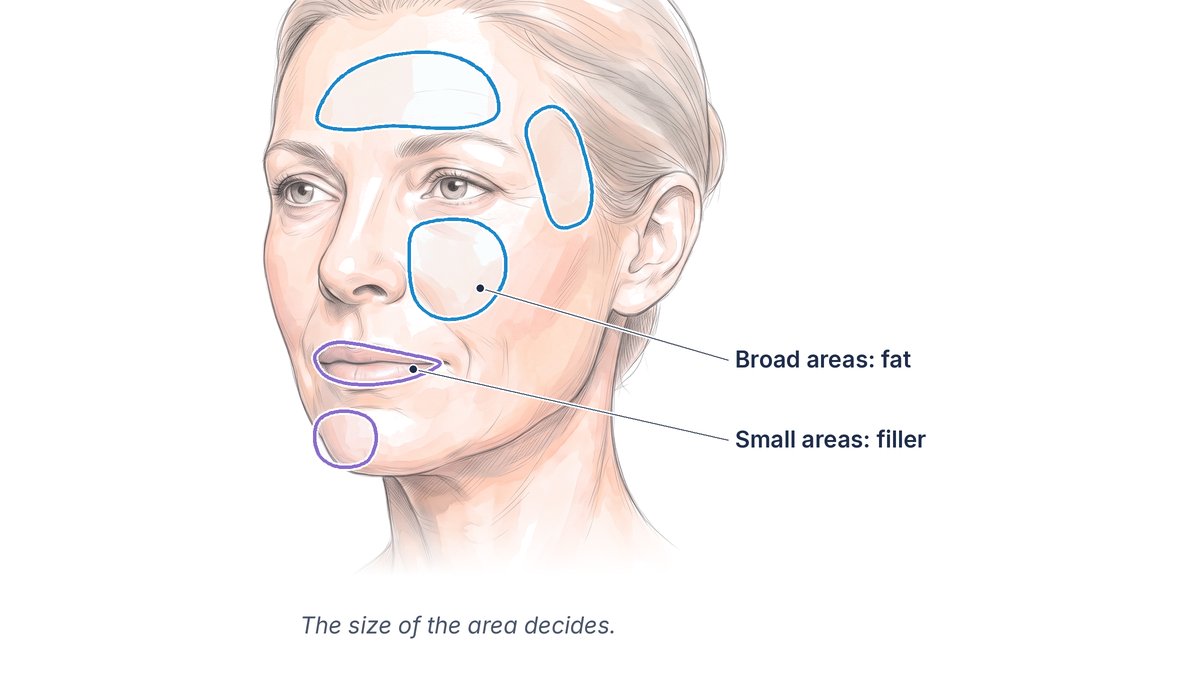
Facial fat transfer vs filler: key facts
- Cheek filler, as measured: in the FDA approval trial of one hyaluronic acid (HA) cheek filler, 85.2 percent of treated patients still followed were improved at 12 months and 67.1 percent at 24 months
- Fat, as measured: a pooled 47 percent of grafted volume retained across 27 studies, with a range of 26 to 83 percent; fat that survives is living tissue
- Reversible: HA only, with hyaluronidase; grafted fat cannot be dissolved
- Dr. Lee’s rule: fat for broad areas (temples, front of the cheeks, forehead), filler for small precise areas (lips, chin tip); slight overcorrection with fat in the face, a second session only if needed
Is Facial Fat Transfer Better Than Filler?
Neither is better for the whole face: facial fat transfer suits broad areas that have lost volume, and hyaluronic acid (HA) filler suits small areas that need precision. A common mistake is to choose by which one lasts longer, when the size of the area and whether the result can be undone matter more.
The US Food and Drug Administration (FDA) describes fillers as medical device implants used to create a smoother or fuller appearance in the face, and notes that absorbable ones may need to be repeated. A fat transfer, also called fat grafting, moves your own fat from the abdomen or thigh to the face. It is a small operation, and what is placed is living tissue, not a product.
Which Lasts Longer, Fat Transfer or Filler?
Fat that survives lasts longer than filler, because it is living tissue that stays, but only part of a graft survives and the share cannot be predicted for one patient. HA filler is absorbed gradually, though in the cheek at least one HA filler has lasted longer than the 6 to 12 months many patients are told; durability differs by product.

Filler, measured as visible improvement. Studies measure filler and fat in different ways, so these figures are not points on one curve. The clearest filler data come from the FDA approval trial of one HA cheek filler, a multicenter randomized trial in which 235 treated patients and 47 untreated controls were graded by blinded evaluators on a six-point midface volume scale. Patients could have one touch-up about a month after the first injection. At six months, 85.6 percent of treated patients had improved by at least one grade, against 38.9 percent of controls.
Among treated patients still being evaluated, the share was 85.2 percent at 12 months (of 203), 71.5 percent at 18 months (of 179) and 67.1 percent at 24 months (of 167). An older FDA consumer page says the effect of HA fillers lasts about 6 to 12 months; in the cheek trial, two in three of the patients still followed were improved at twice that.
Filler, measured as gel on MRI. Visible improvement and remaining gel are separate questions. In an MRI review of 33 patients, HA filler in the midface was still detectable at least two years after the last injection in all 33; 21 had not been injected for 2 to 5 years and 12 for more than 5 years. That group was small, and detectable gel is not a visible result, but old filler may still be there.
Fat, measured as volume retained. A meta-analysis of 27 studies and 1,011 patients, limited to objective volume measurement, found a pooled retention of 47 percent, with a 95 percent confidence interval of 41 to 53 percent and a range of 26 to 83 percent between studies. Follow-up ran from 3 to 24 months, the measuring method significantly changed the reported rate, and the authors concluded that “the exact percentage of facial fat grafts retained is currently unpredictable.”
Most of the loss comes early, as 3D scans of temple grafts followed for 12 months show; why it happens early and then levels off is explained in how much transplanted fat actually lasts.
Why Does Filler Fade While Only Part of a Fat Graft Survives?
HA filler is a crosslinked gel that the body slowly absorbs, while grafted fat is living tissue that has to gain a blood supply in its new place. Fat that gains one stays, and fat that does not is cleared in the first months.
How filler behaves over time
How fast HA goes depends partly on where it sits. In a single patient followed with MRI at 2 days and at 19, 21 and 27 months, filler in most chin sites had resolved by 19 to 27 months, while deposits in the deep fat under the eye muscle (the sub-orbicularis oculi fat, or SOOF) and in the recess beside the nostril were still present at every scan. One patient cannot give a rate.
Filler can also move. A narrative review of 28 reports found that filler migration away from the injection site can appear even several years after treatment, more often with permanent fillers, and that HA can persist in the fat under the skin for several years. It gives no overall figure for how often.
How fat behaves over time
A fat graft keeps changing for months. A review by one experienced facial plastic surgeon describes a result that may dip at two to three months and then improve gradually over 6 to 18 months, and calls grafted fat “truly a live graft”: weight gain can make the face look too full, and weight loss can make the graft look absorbed. That is one surgeon’s experience, not a trial. Because the graft is alive, it also cannot be dissolved: hyaluronidase, the enzyme that breaks down HA, has no effect on fat.
Fat Transfer vs Filler: How Do They Compare Side by Side?
Filler is a quick, adjustable, reversible office treatment that has to be repeated; fat transfer is a small operation with a harvest, an uneven take and no undo, but what survives stays.
At a Glance: facial fat transfer vs HA filler
| HA filler | Fat transfer | |
|---|---|---|
| What it is | Crosslinked HA gel, a medical device implant, injected in the office | Your own fat, harvested and grafted in a small operation |
| Measured durability | Cheek trial: 85.2 percent still improved at 12 months, 67.1 percent at 24 months | Pooled 47 percent of volume retained (range 26 to 83 percent), unpredictable for one patient; what survives stays |
| Can it be dissolved | Yes, with hyaluronidase | No |
| Weight change | A gel, not living tissue | Can enlarge with weight gain and look absorbed after weight loss |
| Downtime | About a day of mild swelling in one facial plastic surgeon’s review; trial diaries record more | 7 to 10 days of recovery and about a week off work in the same review; swelling can last 1 to 2 weeks |
| If it enters an artery | Hyaluronidase exists, though it did not reliably restore vision in published cases | No dissolving agent; about 7 times the odds of stroke compared with HA among published cases of vision loss |
| Suits | Small, precise areas; patients who want to test a change | Broad areas of volume loss; volume added during a facelift |
What the two direct comparisons found
One randomized study treated 57 patients in the nasolabial folds with either fat or HA: blinded ratings showed no significant difference up to nine months and a significant difference in favor of fat at 12 months. Early injection-site reactions were more frequent with fat.
A second study, not randomized, followed 40 women treated in the cheeks, 20 with fat and 20 with HA, for 12 months. All of the fat group and 85 percent of the filler group were very satisfied, and satisfaction with evenness was 75 percent against 35 percent. Minor complications were more frequent with fat, including swelling in 55 percent and donor-site bruising in 15 percent.
Two small studies do not settle which is better.
How Does Dr. Yongwoo Lee Decide Between Fat and Filler, Area by Area?
I use fat for broad areas, namely the temples, the front of the cheeks and the forehead, and HA filler for small areas that need precision, namely the lips and the chin tip. In the face I overcorrect a fat graft slightly, and a second session after three to six months is added only when an area still needs more.

Area by area
| Area | My usual choice | Detail |
|---|---|---|
| Forehead | Fat | Broad surface |
| Temples | Fat for marked hollowing; HA for a small hollow | Fat by blunt cannula; HA by needle on the bone |
| Front of the cheeks, cheekbones, side of the cheeks | Fat | Often grafted during a facelift |
| Nasolabial folds | Fat, 1 to 2 mL per side | Filler if the patient wants no surgery |
| Marionette area | Fat | During a facelift |
| Sunken upper eyelid | Microfat, about 1 to 2 mL per side | Small amounts in several layers; no overcorrection |
| Under-eye hollow | HA in eyelids that suit it, 0.3 to 0.5 mL per side or less; fat only as a small graft on the bone | Bulging fat or loose skin needs surgery, not volume |
| Lips | HA filler | Small, adjustable amounts |
| Chin tip | HA filler | Larger changes need bone surgery or an implant |
| Nose | No filler | I never inject filler into the nose |
Two of these areas have their own articles: temple hollowing with fat or filler and sunken upper eyelids after blepharoplasty.
Why size decides
A broad area filled with gel takes several milliliters, repeated as the gel is absorbed: in the cheek filler’s labeling, the median amount was 6.6 mL for both cheeks combined, against 2.4 mL in its chin trial. Fat that survives does not need topping up, and a small variation in take is hard to see across a cheek or a forehead. At a lip or a chin tip, a small, defined amount has to sit exactly where it is put, and it helps that HA can be adjusted or dissolved.
How I graft fat
I take fat from the abdomen or the inner thigh. I process it by low-speed centrifugation, and it then goes in through a blunt cannula in thin threads, injected only as the cannula is withdrawn, in small amounts and at low pressure. In the cheek most of it goes deep, on the bone, with a small amount under the skin when needed, spread over several layers. Under the eye I place fat only in the deep layer on the bone.
How much fat I place
Part of every graft is absorbed, and one review notes that up to 50 percent of fat may not survive, so slight overcorrection is common. In the face I place slightly more fat than the area needs, so that what survives lands closer to the goal. I keep the excess small, because too much fat cannot be taken back with an injection. A sunken upper eyelid is different, and there I do not overcorrect at all.
How I place filler
Filler goes in through a blunt cannula in most areas; the temple is one exception, where I use a needle that rests on the bone. I do not use calcium hydroxylapatite (Radiesse) or poly-L-lactic acid (Sculptra) in any area, so the choice in my practice is between HA and fat.
If you already have filler
When old HA filler sits in an area I am about to graft, I always dissolve it with hyaluronidase first and then wait at least two weeks, usually two to four, before the fat graft. With filler still in place I cannot see how much volume the area really lacks, and because gel can remain for years on MRI, “my filler was three years ago” does not mean the area is empty. A heavily filled face heading for a facelift is a separate situation with a longer wait, covered in dissolving filler for an overfilled face.
Weight, medication and anesthesia
I graft fat only after weight has stayed within about 2 kg for three months, including on a GLP-1 drug such as semaglutide or tirzepatide. That drug is paused one month before the graft, because a slowed stomach is a risk under sedation or anesthesia, and restarted one to two weeks after, both agreed with the prescriber. Other stop dates are in what to stop before plastic surgery, and a prescribed blood thinner or diabetes drug is never stopped without its prescriber.
A fat graft alone is done under IV sedation that I give myself plus local anesthesia; patients living in Korea go home the same day, and those from abroad are admitted for the first night. Grafted during a facelift, it shares the facelift’s general anesthetic, given by a board-certified anesthesiologist, and its one-night stay. Either way the nicotine rule applies: no nicotine in any form, including cigarettes, vapes, patches and gum, for four weeks before and four weeks after, or the surgery is postponed.
Which Patient Are You: Fat, Filler or Neither?
Three questions sort most patients: how broad the area is, whether old filler is present, and whether volume is the real problem.
The 29-year-old who wants fuller lips and a little more chin. Small, precise areas in a face that has lost little volume: filler. One facial plastic surgeon’s review agrees that patients under 40 with stable weight and little volume loss may be better served by filler.
The 52-year-old with flat cheeks, hollow temples and a forehead that has lost its curve. Broad areas, real volume loss, stable weight: fat, slightly overcorrected, with a second session only if needed.
The 47-year-old with years of cheek filler who now wants “something permanent.” Gel may still be there. It is dissolved first and the face is reassessed two to four weeks later; sometimes less volume is needed than she thought.
The 38-year-old on tirzepatide who is still losing weight. Volume placed now lands on a face that is still changing. She waits for three months of stable weight before a fat graft.
The 60-year-old with jowls and deep folds who asks for more filler. Her tissue has descended, so volume is not the main problem. A lift moves the tissue back and fat replaces what is missing in the same operation, as described in combining a facelift with fat grafting and eyelid surgery.
What Is Recovery Like After Facial Fat Transfer Compared With Filler?
Filler recovery is counted in days and fat transfer recovery in weeks: mild swelling and tenderness after filler, and one to two weeks of visible swelling plus a bruised donor site after fat.

After filler. The same facial plastic surgeon’s review puts filler recovery at about a day of mild swelling, against 7 to 10 days and about a week off work for fat grafting. Patient diaries record more. After a first cheek treatment in the FDA trial, patients noted tenderness in 92.1 percent, swelling in 85.7 percent, firmness in 82.3 percent, lumps or bumps in 81.1 percent and bruising in 77.7 percent, and the labeling notes that most of these site reactions resolved within two to four weeks.
After fat transfer. Swelling lasts one to two weeks, and the same review notes that it takes three to four weeks before most patients are comfortable with how they look. Expect bruising where the fat was taken. Because I overcorrect the face slightly, it can look a little full at first. The result may dip at two to three months and then improve gradually.
A firm lump or an oil cyst is uncommon and is treated in steps, starting with waiting, as described in lumps and oil cysts after facial fat grafting.
Surgeon’s Insight: I Ask How Big the Area Is Before I Ask How Long It Should Last
Patients usually open with “which lasts longer?” It is a fair question with an unhelpful answer, because the longer-lasting material is also the one I cannot take back. So I start somewhere else: how broad is the area, and how sure are we about the amount?
Across a temple, a cheek or a forehead, I am comfortable with tissue that is permanent and somewhat unpredictable. I place a little extra to allow for what is absorbed, and if an area still falls short, a second small graft follows. At a lip or a chin tip I want a material that stays where I put it and that I can dissolve.
Is Fat Transfer Safer Than Filler? Blindness, Stroke and What Can Be Reversed
Neither is safer in every respect: filler and fat can each enter an artery and cause blindness or a stroke, and with both this is rare. Two differences matter: an HA problem can often be dissolved while a fat problem cannot, and a fat embolus, when it happens, tends to do more damage.

The shared risk. For fillers, the FDA states that the most concerning risk is unintentional injection into a blood vessel, which can cause tissue death, blindness and stroke. Fat can follow the same route, which a review of fat embolism cases describes: material entering a small facial artery is pushed backward into the ophthalmic artery, the first branch of the internal carotid artery, and then travels forward into the central retinal artery; with enough pressure it reaches the arteries of the brain.
What published cases show. A 2024 review collected 365 new cases of vision loss after filler published from 2018 to 2023. Among cases with a known material, HA accounted for 79.6 percent and autologous fat for 13.5 percent, and the most frequent injection sites were the nose (40.6 percent), the forehead (27.7 percent) and the glabella (19.0 percent). These shares reflect how often each material is used, not the risk of one treatment. Severity is another matter: the odds of a stroke alongside the vision loss were about 7 times higher with fat than with HA. Of 318 patients with a recorded outcome, vision recovered completely in 6.0 percent, partly in 25.8 percent and not at all in 68.2 percent.
In a Korean Retina Society survey of 44 patients, 22 injected with fat and 13 with HA, fat was linked to diffuse blockage of the ophthalmic artery, a worse visual prognosis and more brain infarction than HA. When fat does block an artery, the outcome is often permanent: in a review of 61 published cases, the 54 with a known outcome split into permanent vision loss alone (59.3 percent), neurological impairment alone (22.2 percent), both (7.4 percent) and death (11.1 percent).
What can be undone. Hyaluronidase dissolves HA, while no available agent effectively dissolves a fat embolus. Reversible is not the same as rescued: in the 2024 review, hyaluronidase injected under the skin was used in 70.1 percent of the 302 cases with treatment recorded and was not a significant predictor of visual improvement, and its authors put prevention ahead of any treatment.
What I do about it. For fat I use a blunt cannula, small amounts and low pressure, in line with the published advice to inject gently and slowly with low pressure, through blunt cannulas and small syringes. The forehead, the temples and the nasolabial folds, where I graft fat, are among the high-risk sites named in that review, so this is where technique matters most. I never inject filler into the nose, the most frequent site in the published cases. Hyaluronidase is kept in stock, and transfer to Jeju National University Hospital or Halla Hospital is arranged in advance.
Warning signs. During or after either treatment, act at once on any of these:
- A change in vision in either eye, from blurring to loss of sight, or eye pain, a drooping eyelid or double vision
- Skin near the injection turning white, gray or blotchy purple
- Severe pain out of proportion to the treatment
- A drooping face, slurred speech or weakness on one side
For any eye sign or any stroke sign, call your local emergency number first (119 in Korea), then tell the clinic that treated you. For skin that turns white, gray or blotchy, or pain out of proportion to the treatment, contact the clinic that treated you at once, within the hour, because dissolving HA works best when it is given early; if you cannot reach the clinic, go to an emergency department. The full sequence is in the warning signs of filler blindness.
Less urgent but still same-day: increasing redness, heat, pain or discharge at the face or the donor site, or a fever, can mean infection after either treatment; call the clinic that treated you that day.
Should You Choose Fat Transfer or Filler? The Question That Decides It
The useful question is not which material lasts longer but how broad the area is, whether volume is really what is missing, and whether you need the option to undo it. Fat answers a broad, settled need; filler answers a small, precise or uncertain one.
If you ask only one question, ask this: Is the area I want filled broad or small, is volume truly what it lacks, and what is the plan if I want it changed afterward?
Written by Dr. Yongwoo Lee, board-certified Korean plastic surgery specialist in facial anatomy and aesthetic procedures at VIP Plastic Surgery, South Korea.
Frequently Asked Questions About Facial Fat Transfer and Filler
Can fat transfer replace filler for good?
In broad areas, often: the part of a graft that survives stays and needs no topping up, though it still changes with your weight and with age, while HA filler is absorbed and repeated. About half survives on average, 47 percent pooled across 27 studies with a range of 26 to 83 percent, and no one can predict it for one patient. For lips and the chin tip Dr. Yongwoo Lee still uses filler.
How long does cheek filler really last?
Often longer than the 6 to 12 months usually quoted, though it depends on the product. In the FDA approval trial of one HA cheek filler, given as a first treatment with an optional touch-up a month later, 85.2 percent of treated patients still followed were improved at 12 months and 67.1 percent at 24 months.
Does filler stay in your face for years?
It can. In an MRI review of 33 patients, HA filler in the midface was detectable at least two years after the last injection in every patient, and more than five years after in 12. Detectable gel is not the same as a visible result.
Should I try filler first before committing to fat transfer?
It is a reasonable way to test a change in a small or uncertain area, because HA filler can be adjusted or dissolved and fat cannot. If you later choose fat for the same area, the old filler is dissolved first.
Do I need to dissolve my filler before fat transfer?
In an area I am going to graft, yes, always. I dissolve old HA filler with hyaluronidase and wait at least two weeks, usually two to four.
Will I look overfilled after fat transfer?
For a while, a little. You will be swollen for one to two weeks, and in the face I place slightly more fat than the area needs because part of the graft is absorbed, so it can look a little full at first before it settles. In a sunken upper eyelid I do not overcorrect.
How many sessions does fat transfer need compared with filler?
Fat usually needs one; Dr. Yongwoo Lee adds a second session three to six months later only when an area still needs more. Filler is repeated as the gel is absorbed, though in the cheek filler trial two in three of those still followed were improved at 24 months.
Is fat or filler better if my weight is still changing?
Waiting is usually the answer for fat. Grafted fat behaves like your other fat, enlarging with weight gain and looking absorbed after weight loss, while HA filler is a gel, not living tissue. Before a fat graft Dr. Yongwoo Lee asks for three months of weight held within about 2 kg, including for patients on Ozempic or Mounjaro.
Is fat or filler better for nasolabial folds?
I prefer fat, 1 to 2 mL per side, for patients open to a small operation, and filler for those who want no surgery. One randomized study of 57 patients found the two similar up to nine months, with fat ahead at 12 months.
Is fat or filler better for under-eye hollows?
It depends on the eyelid. A true hollow with good skin can take a low-viscosity HA filler, 0.3 to 0.5 mL per side or less, placed deep on the bone; bulging fat or loose skin is a surgical problem. I place fat there only as a small graft on the bone.
Is fat or filler better for lips and the chin?
Filler. Both are small areas where a precise, adjustable amount matters more than permanence; a chin that needs a larger change is better treated with bone surgery or an implant.
Are Sculptra or Radiesse alternatives to fat transfer?
Not in Dr. Yongwoo Lee’s practice: he does not use calcium hydroxylapatite (Radiesse) or poly-L-lactic acid (Sculptra) in any area, so the choice there is between HA filler and fat. Of those two, only HA can be dissolved, with hyaluronidase.
This article is for informational purposes only and does not constitute medical advice. Always consult with a qualified medical professional before making any decisions about surgical or non-surgical procedures.
