
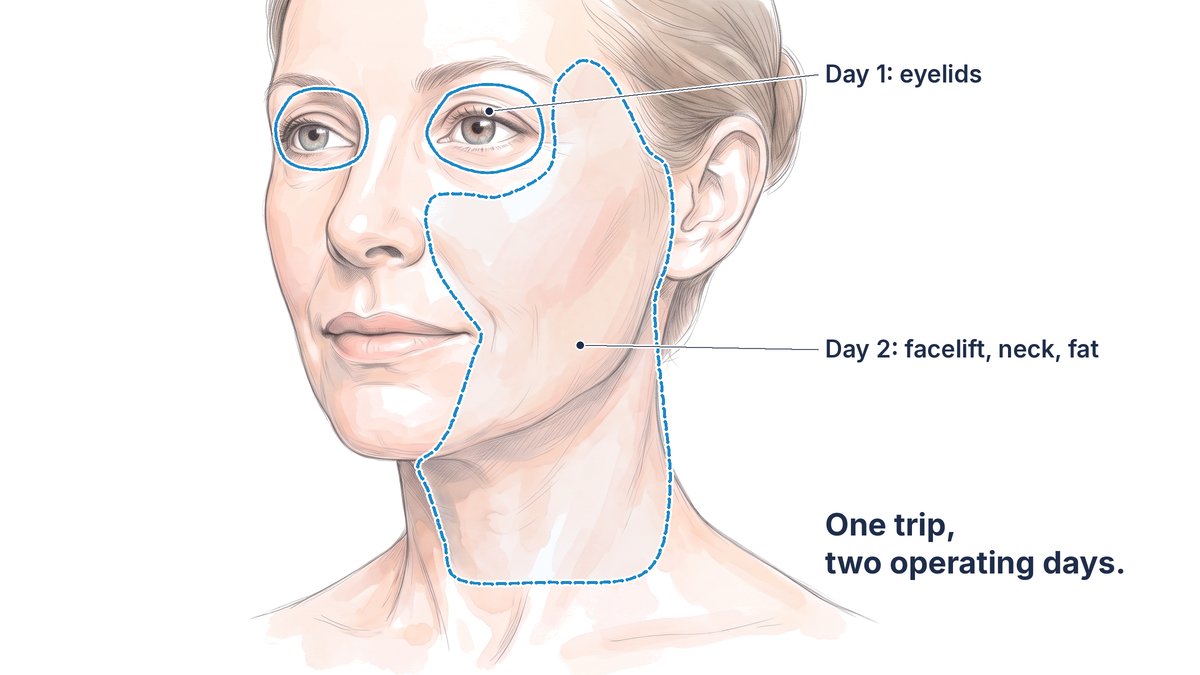
A facelift and eyelid surgery can be done at the same time, with fat grafting as well, and in the large databases most facelifts are combined with something. What decides the safety of the plan is not the number of procedures on the consent form. It is which procedures are combined, how many hours they take under one anesthetic, and who the patient is. In my practice the three fit into one trip but not into one sitting: eyelid surgery first, then the facelift with fat grafting the next day.
Quick answers
- Is it safe to combine a facelift, eyelid surgery and fat grafting? Usually, in a healthy patient. In 11,300 facelifts, major complications ran 1.5 percent for a facelift alone and up to 3.7 percent with added procedures of any kind.
- How long is too long? No number is proven: in 1,753 operations at one center, complication odds rose 21 percent per hour. American office-surgery rules run from an ideal of six hours (ASPS) to a cap of eight (Florida).
- What does Dr. Yongwoo Lee do? Eyelid surgery first under IV sedation, then the facelift the next day under general anesthesia, usually with a neck lift and fat grafting, plus a brow lift when one is needed. His limit is eight hours under one anesthetic.
Can You Have a Facelift, Eyelid Surgery and Fat Grafting at the Same Time?
Yes. It is widely done, and for a healthy patient the added risk measured in large databases is modest. In Dr. Yongwoo Lee’s practice the three are done in one trip but on two consecutive days: eyelid surgery first, then the facelift with fat grafting.
57.4 percent of 11,300 facelifts in a prospective insurance database were combined with another procedure. The average patient among 13,346 facelifts in the TOPS outcomes database had 2.3 procedures in 3.8 hours of operating time, and blepharoplasty, the surgical name for eyelid surgery, was the most common addition.
Does Combining Procedures Raise the Complication Rate?
Yes, modestly, in each of the large databases cited here. In a prospective insurance database of 11,300 facelifts, major complications within 30 days occurred in 1.5 percent of facelifts done alone and in up to 3.7 percent of those combined with other procedures. A major complication meant an emergency visit, a hospital admission or a return to the operating room.
“Combined” there meant any added procedure, body operations included, not only eyelids or fat. And the extra risk was specific: combined procedures carried 3.5 times the risk of infection, and a body mass index of 25 or more carried 2.8 times. For hematoma, bleeding under the lifted skin, the strongest predictor was male sex, at 3.9 times.
In the TOPS database of 13,346 facelifts, adverse events were recorded in 5.1 percent, with higher odds for men, obesity, current smoking, longer operations, combined procedures, general anesthesia and office-based surgery. Its abstract sizes none of these factors but notes that several “can be affected by surgeon choice of surgical venue, additive procedures, duration of operation, and type of anesthetic.”
Across the whole face, more than three procedures at once was an independent risk factor for a major complication among 38,569 facial aesthetic surgery patients, alongside being overweight, a higher anesthesia risk class and an age of 45 or more. That paper states its cutoff inconsistently, so read it as a signal that long lists carry more risk, not a rule about three. Registries show association, not cause.
At a Glance: Single vs Combined Surgery in the Large Databases
| Measure | Single | Combined | Where it comes from |
|---|---|---|---|
| Major complications within 30 days of a facelift | 1.5 percent | Up to 3.7 percent | 11,300 facelifts |
| Infection after a facelift | Reference | 3.5 times the risk | Same database |
| Major complications after eyelid surgery | 0.4 percent | 0.4 percent with a brow lift | 6,126 patients |
| Leg or lung clot, any cosmetic surgery | 0.04 percent | 0.20 percent | 129,007 patients |
| Leg or lung clot by region | Face only: 0.01 percent | Face with body: 0.16 percent | Same cohort |
Which Is Riskier to Combine: Face With Face, or Face With Body?
Face with body, by a wide margin for blood clots. Venous thromboembolism, a clot in the leg veins or the lungs, was confirmed in 0.01 percent of patients after face procedures and in 0.16 percent after combined face and body procedures in a cohort of 129,007 cosmetic surgery patients followed for 30 days.

Across that cohort the rate was 0.09 percent: 0.04 percent after a single procedure and 0.20 percent after combined ones. After adjustment, a body procedure carried 13.47 times the risk and a combined procedure 2.4 times.
A facelift, eyelid surgery and facial fat grafting are all face procedures, the lowest-risk group in that cohort. Adding liposuction of the body or a tummy tuck to the same anesthetic moves a patient into a different group. That combination has its own article, liposuction and a tummy tuck together.
Within the face, one pairing has been checked directly. In 6,126 patients, adding a brow lift to eyelid surgery left the major complication rate at 0.4 percent, the same as eyelid surgery alone. Unadjusted, it still suggests neighboring face operations combine with little penalty.
How Many Hours of Surgery Is Too Long?
No threshold has been proven, and risk appears to climb hour by hour instead of jumping at a line. Each hour of surgery raised the odds of a complication by 21 percent in 1,753 plastic surgery cases at one academic center. Compared with operations under about two hours, the odds were 1.6 times higher after 3.1 hours, 3.1 times after 4.5 hours and 4.7 times after 6.8 hours.

That series mixed many kinds of complex operation, counted minor problems in its 27.8 percent complication rate and is not a facelift study. What it supports is the authors’ own sentence: “operative time should factor into surgical decision making.”
Operations that ran longest for their type carried 1.27 times the odds of a leg or lung clot across 1.43 million operations under general anesthesia, compared with operations of average length. In facelifts, both deep vein clots in a series of 630 facelifts followed a facelift combined with another procedure that lasted longer than five hours. Two events are a signal, not a rate.
Societies and regulators have drawn lines anyway: a 2002 advisory from the American Society of Plastic Surgeons (ASPS) set six hours as the ideal upper limit for office-based surgery. Florida’s office-surgery rule, in its 2022 version, caps the planned duration of all procedures combined at eight hours. Both are American rules for outpatient offices, not Korean law, and neither rests on a trial.
Time also counts toward clot risk. A major operation longer than 45 minutes scores two points on the Caprini clot-risk model, and for the highest scores the ASPS task force lists “limiting OR times” among the measures to consider. How those hours are managed is covered in how facelift anesthesia is run and what makes it safe.
Should Facial Procedures Be Done in One Operation, on Consecutive Days or Months Apart?
Any of the three schedules can be right: one anesthetic, consecutive days, or months apart. Published comparisons between them are lacking, so the choice turns on total hours, the anesthetic each part needs and how far the patient has traveled; when the eyelids need surgery alongside a facelift, Dr. Yongwoo Lee splits the two across consecutive days, eyelids first.
At a Glance: Three Ways to Schedule a Facelift, Eyelid Surgery and Fat Grafting
| One anesthetic | Consecutive days | Months apart | |
|---|---|---|---|
| What happens | Everything in one operation | Eyelids first; facelift with fat grafting the next day | One operation now, the rest after recovery |
| Anesthetics | One, usually general | Two: IV sedation, then general | Two or more |
| Eyelids checked with your eyes open | Not under general anesthesia | Yes, under light sedation | Yes, under light sedation |
| Recovery periods and trips | One | One | Two or more |
| What supports it | Large databases: common, modest added risk | A surgeon’s judgment | A surgeon’s judgment |
| Typical fit | Healthy patient, plan well inside the time limit | Patient who needs both eyelids and a facelift | Recent smokers; high clot or bleeding risk |
Fat grafting is the easiest part to place. A systematic review of 15 studies concluded that fat grafting combined with a facelift is safe and effective for a face that has both descended and lost volume. Its studies were level 3 evidence, and the abstract gives no pooled complication rate.
Inside one operation, published sequences put fat grafting first. A textbook chapter on the high SMAS facelift by Marten, Hamilton and Elyassnia grafts at the beginning, before the face swells, and a 34-patient series injected the fat before raising the facelift flaps. Neither is a safety comparison.
How Does Dr. Yongwoo Lee Combine a Facelift, Eyelid Surgery and Fat Grafting?
I do not perform eyelid surgery and a facelift on the same day. Eyelid surgery comes first, under local anesthesia with IV sedation that I give myself. The facelift follows the next day under general anesthesia given by a board-certified anesthesiologist, usually with a neck lift and fat grafting, and my limit for one anesthetic is eight hours in total. Splitting the two lets me set eyelid height more accurately, shortens each anesthetic and leaves less swelling.

The first day: eyelids, under sedation light enough to open your eyes
Upper and lower eyelids are often done on the same day. For the upper lids I use midazolam and ketamine with local anesthesia; for the lower lids, propofol and ketamine. A dedicated nurse watches the monitors throughout.
The upper-lid sedation is light on purpose. Partway through, I wake you and ask you to open your eyes, so that I can see the crease folding in motion and compare the height of the two lids before I close. If the lid edge itself sits low (ptosis), I usually correct it in the same operation, and then the check matters even more: it is repeated several times, because raising one lid can let the other drop slightly. A patient under general anesthesia cannot open their eyes on request, so inside a facelift anesthetic that check is not available. On the day before, it is.
For the lower lids I choose the route by the skin, through the inside of the lid when little skin is spare and just under the lashes when it is lax, and bulging fat is repositioned over the orbital rim; the details are in under-eye fat repositioning versus removal. Any fat grafted under the eye goes only into the deep layer on the bone.
Patients who have traveled from abroad spend that night in an inpatient room, with the head raised and ointment in the eyes, so the hours in which bleeding behind the eye is most likely are spent under observation. Patients who live in Korea go home the same day, with the warning signs listed below.
The second day: facelift, neck and fat grafting under one general anesthetic
The second operation is a deep plane facelift, usually with a neck lift through a small incision under the chin and with fat grafting, and often with an endoscopic brow and temple lift. All of it runs under one general anesthetic with capnography, BIS depth monitoring and active warming. During it, the day-1 eyelids are protected with eye ointment and a waterproof transparent film dressing (Tegaderm), and I keep blood pressure and vomiting actively under control, because either can start bleeding behind the eye. Pneumatic compression sleeves work on the legs during surgery and through the first night. Tranexamic acid is given in the vein, and I finish with one or two drains and a hemostatic net.
Fat grafting belongs inside this anesthetic. I graft the temples, the forehead, the front and side of the cheeks and the cheekbones, the nasolabial folds and the marionette area; how I harvest, process and dose the fat, and when a second session follows, is set out in facial fat transfer versus filler.
The eight-hour limit
My ceiling is eight hours under one anesthetic; a plan that would run longer is divided across days. That matches Florida’s cap and exceeds the ASPS ideal of six. I treat it as a ceiling, not a target: risk rises with each hour, so the aim is the shortest anesthetic that does the planned work properly.
What waits for another day
Laser resurfacing is not part of either operating day. Most of my facelift patients have one gentle fractional laser session in the second week, between day 7 and day 14, kept off the incision lines. A patient who has only recently stopped smoking has the facelift alone, with fat grafting and eyelid surgery about three months later. And when hyaluronic acid filler remains where fat is planned, I always dissolve it first and wait at least two weeks, usually two to four, before grafting.
A brow lift, when it is needed, goes with the facelift on the second day. Lifting a brow changes how much eyelid skin is truly spare, so before marking any eyelid skin on the first day I lift the brow with a fingertip to see how much of the apparent excess disappears. Removing too much upper-lid skin ahead of a brow lift can leave the eyes unable to close fully, so I remove upper-lid skin conservatively, planned for the brow that will be lifted the next day.
I am not aware of a study that compares eyelid surgery the day before a facelift with eyelid surgery during it, so the split rests on practical reasons, not on a trial.
Which Combined Plan Fits You?
The right plan follows what needs correcting, how many hours the correction takes, and your own bleeding and clot risks.
Jowls, a loose neck and hollow temples or cheeks, with eyelids that are fine. A facelift with a neck lift and fat grafting under one general anesthetic.
Heavy upper lids or lower-lid bags as well as jowls. Eyelid surgery on the first day and the facelift with fat grafting on the second, with one recovery and one trip.
A man, or anyone with a body mass index of 25 or more. In the 11,300-facelift database, men had more hematomas and a higher body mass index more infections. Neither rules out a combined plan; both argue for trimming it to what is needed.
Someone with high blood pressure. It was linked to facelift hematoma in the 630-facelift series and to bleeding behind the eye in the 269,433-operation eyelid survey, so it should be well controlled before either operating day; blood-pressure medicine is managed with the doctor who prescribed it, never stopped on your own.
Someone who stopped smoking only recently. No nicotine in any form (cigarettes, vapes, patches or gum) is allowed for four weeks before and four weeks after a facelift, eyelid surgery or even fat grafting alone, and a patient who cannot stop has the surgery postponed. This patient has the facelift alone, with fat grafting and eyelid surgery about three months later.
Someone who also wants liposuction or a tummy tuck on the same trip. This is the combination to question. Under the same anesthetic it moves you from the 0.01 percent clot group to the 0.16 percent one, and on a separate day a body operation still carries its own clot risk (0.21 percent for body procedures in the same cohort) before the flight home. Whether a body operation shares the trip should be decided on your clot risk, not on the calendar.
Someone with a clot risk of their own. A previous clot, estrogen-containing pills or hormone therapy, or a high body mass index adds Caprini points, and longer operations add clot risk too, so this plan should be the shortest that does the work. Estrogen stops four weeks before surgery, agreed with the prescribing doctor and with other contraception in the meantime; an injected blood thinner is reserved for high-risk patients.
Is Recovery Longer After a Facelift With Eyelid Surgery and Fat Grafting?
Not by much. A combined plan recovers on the clock of its slowest part, the facelift, with eyelid care added. What changes is that more of the face is swollen and bruised at once in the first two weeks.
Eyelids. Eyelid stitches are out on day 7, counting the day after eyelid surgery as day 1, and makeup, contact lenses and light exercise wait two weeks; the day-by-day course, from head elevation and ointment to a crease that looks natural at about three months, is in the blepharoplasty recovery timeline.
Facelift. The fine stitches come out at about day 7 and the scalp staples at about two weeks, with dissolving stitches for patients who fly home sooner, and the final result takes 6 to 12 months; every date in between is in the facelift recovery timeline, week by week.
Flying home. How long you stay is set by the longest procedure, not the sum: ten to fourteen days after the facelift. The ASPS advises waiting seven to 10 days before flying after facial procedures, and notes that travel combined with surgery further increases clot risk.
Surgeon’s Insight: Count Hours, Not Procedures
Patients bring me a list and ask how many items fit into one day. I answer with a different count: the hours under one anesthetic, and what each part of the plan needs from you. An eyelid crease is something I want to see moving while you are awake enough to open your eyes. A facelift needs you asleep, still and watched by an anesthesiologist. Those are two different anesthetics, so they get two consecutive days. Fat grafting needs neither a day nor an anesthetic of its own, so it travels with the facelift. The list still gets done in one trip, not in one sitting.
What Are the Risks of Combined Facial Surgery, and What Should You Watch For?
The risks are those of each operation, concentrated in the first 24 hours after it: bleeding under the facelift flap, bleeding behind the eye after eyelid surgery, and, later, infection and blood clots. Combining stacks those early windows, so for a traveling patient each operation has its own observed night.

Facelift hematoma. Ninety percent of facelift hematomas occur in the first 24 hours. The same review cites a 4.3 times higher hematoma risk when the front of the neck is operated on under the chin, which is the neck lift that usually accompanies my deep plane lift.
Bleeding behind the eye. In a survey covering 269,433 eyelid operations, bleeding behind the eye occurred in about 1 in 2,000, with permanent loss of vision in about 1 in 22,000. Most bleeds began within the first three hours, but some came days later, most often linked to high blood pressure, aspirin, vomiting or strenuous activity. In a separate review, visual loss after blepharoplasty began within 24 hours, with one peak from surgery to the first hour and a second at 6 to 12 hours.
Infection. Combined procedures carried more infection risk in the 11,300-facelift database, and the 2021 complications review states that “the length of operation alone is an indication for the use of preoperative antimicrobial prophylaxis.”
Clots. Face-only surgery sits in the lowest group. In my practice walking starts on the first day and the leg sleeves run through the first night.
Fat grafting. Lumps, oil cysts and the rare vascular events are covered in facial fat grafting complications.
Warning signs. Severe pain or pressure behind an eye, a bulging or tight eye, or any loss of vision after eyelid surgery is an emergency. In the clinic or its accommodation, alert the nurse at once. Anywhere else, call your local emergency number or go to the nearest emergency department first, then contact the clinic. Sudden one-sided facial pain or swelling, a firm bulge or fresh blood through the dressing can mean a hematoma: call the surgical team at once. Neck swelling with difficulty breathing, calf pain or swelling, sudden breathlessness or chest pain, including after the flight home, means calling emergency services first.
Before surgery, some painkillers, supplements and GLP-1 medicines have to stop weeks ahead; the full list, dates and reasons are in what to stop before plastic surgery. A medicine prescribed by another doctor is never stopped without that doctor’s agreement.
What Should You Ask Before Agreeing to a Combined Plan?
Do not ask “How many procedures can you do at once?” Ask how many hours you will be under one anesthetic, who is watching you during those hours and the night after, and which part of the plan the surgeon would move to another day.
Then ask:
- What is your time limit for one anesthetic, and what happens if my plan would pass it?
- Where will I be on the first night after each operation?
- Which is the last appointment only you can do, and on which day can I fly home?
Individual results vary; consultation required.
Written by Dr. Yongwoo Lee, board-certified Korean plastic surgery specialist in facial anatomy and aesthetic procedures at VIP Plastic Surgery, South Korea.
Frequently Asked Questions About Combining a Facelift, Eyelid Surgery and Fat Grafting
Should eyelid surgery be done before or after a facelift?
In Dr. Yongwoo Lee’s practice, the day before: eyelid surgery under IV sedation, then the facelift the next day under general anesthesia. Many surgeons do both in one sitting, and blepharoplasty was the most common procedure added to a facelift among 13,346 patients. Dr. Yongwoo Lee is not aware of a study that compares eyelid surgery the day before a facelift with eyelid surgery during it.
Does fat grafting need its own operation, or can it be done during the facelift?
It goes inside the facelift anesthetic and needs neither a day nor an anesthetic of its own. A systematic review of 15 studies concluded that fat grafting combined with a facelift is safe and effective for a face that has both descended and lost volume, although its studies were level 3 evidence.
Why not do the eyelids under the facelift’s general anesthetic?
Because the eyelid check needs you awake enough to respond. Partway through upper eyelid surgery under light sedation, Dr. Yongwoo Lee asks you to open your eyes so he can see the crease folding in motion and compare the two lids, which a patient under general anesthesia cannot do. Splitting the days also shortens each anesthetic.
Does adding a brow lift to eyelid surgery increase risk?
Not measurably. Among 6,126 patients, major complications occurred in 0.4 percent after eyelid surgery alone and 0.4 percent after eyelid surgery with a brow lift, in a comparison not adjusted for other factors.
Can I combine a facelift with liposuction or a tummy tuck?
It is done, but it is the combination that changes clot risk most. In 129,007 cosmetic surgery patients, leg or lung clots followed 0.01 percent of face procedures and 0.16 percent of combined face and body procedures.
Is fat grafting done before or after the facelift in the same operation?
The two published sequences cited here put it first. One textbook chapter places fat grafting at the beginning of the operation, and a 34-patient series injected the fat and performed the facelift immediately afterward.
Which procedures should wait instead of joining a facelift?
In Dr. Yongwoo Lee’s practice, laser resurfacing is not part of either operating day; most of his facelift patients have one gentle fractional laser session between day 7 and day 14. A patient who stopped smoking only recently has the facelift alone, with fat grafting and eyelid surgery about three months later. Where hyaluronic acid filler remains, it is dissolved first and grafting waits at least two weeks, usually two to four.
Can a brow lift be done on the same day as the facelift?
Yes. In Dr. Yongwoo Lee’s practice a brow lift, when needed, goes with the facelift on the second day, often as an endoscopic brow and temple lift. Because lifting the brow changes how much eyelid skin is truly spare, he removes upper-lid skin conservatively on the first day, planned for the brow that will be lifted.
Does combining procedures raise the risk of a blood clot on the flight home?
Combined procedures carried a clot rate within 30 days of surgery of 0.20 percent against 0.04 percent for single ones, driven mainly by body operations; that study did not measure flights. The ASPS advises waiting seven to 10 days before flying after facial procedures and notes that travel after surgery adds to clot risk; after a facelift Dr. Yongwoo Lee’s patients stay ten to fourteen days.
Do I stay overnight after the eyelid surgery day as well as after the facelift?
After the facelift, yes. After the eyelid surgery day it depends on where you live: in Dr. Yongwoo Lee’s practice, patients who have traveled from abroad stay that night in an inpatient room too, while patients who live in Korea go home the same day, so a traveling patient has an observed night after each operation.
This article is for informational purposes only and does not constitute medical advice. Always consult with a qualified medical professional before making any decisions about surgical or non-surgical procedures.
