
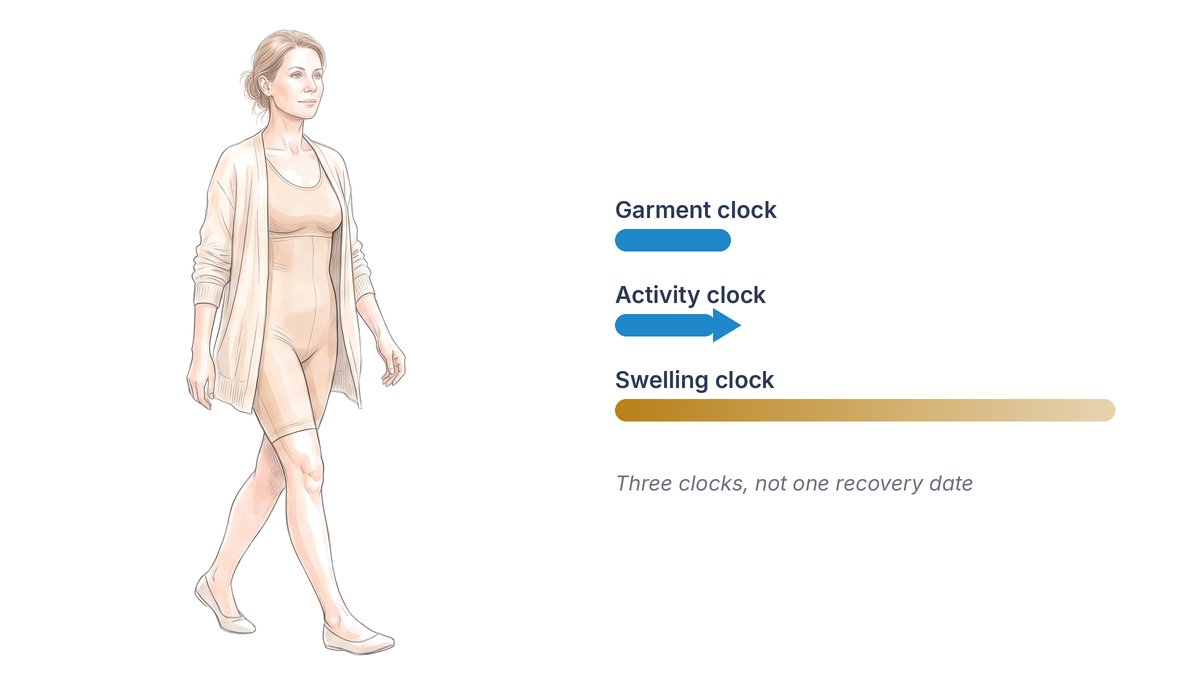
The liposuction recovery timeline runs from a few days off work to a final contour at three to six months, as fluid, bruising, firmness and numbness settle after the fat is suctioned out. It follows three clocks: about six weeks in the compression garment, full activity after six weeks, and swelling that fades over months.
Quick answers
- How long is recovery? A few days to about a week for desk work, about six weeks for the garment and unrestricted exercise, and three to six months for the final contour.
- How long do I wear the compression garment? In Dr. Yongwoo Lee’s protocol, essentially around the clock for two to three weeks, full-time through about six weeks, then tapered.
- When does swelling go down? It peaks at 48 to 72 hours, most is gone in two to three weeks, and the last of it can take up to six months.
- Is it normal for the incisions to leak? Yes, for the first few days: it is mostly the numbing fluid put in during surgery, tinged pink with blood.
- Is it normal for the area to feel hard at 3 to 8 weeks? Yes. Firm, uneven tissue is a normal healing stage and softens over the following months.
- When can I exercise? Walking from the first day, light cardio at three to four weeks, moderate exercise at five to six, and unrestricted training after six.
- When can I go back to work and fly home? Desk work in a few days to a week; a long-haul flight usually at 5 to 7 days after ordinary-volume liposuction and 10 to 14 days after large-volume liposuction or several areas.
- When should I call? At once for a swollen or painful calf, breathlessness, chest pain, confusion, fever with spreading redness, or skin that turns dark.
How Long Is Liposuction Recovery?
Most people are back at a desk within a few days to a week, finish wearing the compression garment and return to unrestricted exercise at about six weeks, and see the final contour at three to six months. An area looks slimmer early, but the shape you keep only appears once the last swelling has gone.
The American Society of Plastic Surgeons describes a return to work at weeks two to three depending on the job, bruising gone by weeks four to five, and a gradual return to exercise from week six, and warns that it may take several months for the swelling to fully dissipate. In The Aesthetic Society’s guidance, swelling peaks at about 48 hours after surgery, most of it gone within two to three weeks, and slight residual swelling for up to four months.
Volume and the number of areas stretch liposuction recovery time more than age does. A single small area recovers on the short end of every range; several areas in one operation, or a large-volume case, sit at the long end and carry a higher risk of blood clots. The stages are the same after ultrasound-assisted (VASER) liposuction, which VASER versus traditional liposuction compares in detail, and keeping the result once recovery ends is covered in does fat come back after liposuction.
Key numbers
- Swelling and bruising peak: the first 48 to 72 hours. Fluid leaking from the entry points: the first few days.
- Compression: around the clock for 2 to 3 weeks, full-time to about 6 weeks, then tapered.
- Light cardio 3 to 4 weeks, moderate exercise 5 to 6 weeks, unrestricted training after 6 weeks.
- Numbness: most sensation back by 6 to 10 weeks.
- In 29,368 liposuction patients: seroma 0.65 percent, hematoma 0.27 percent, infection 0.020 percent, venous thromboembolism 0.017 percent.
- Clot rate within 30 days: 0.21 percent after body procedures against 0.01 percent after facial ones.
- Final contour: 3 to 6 months.

What Happens in the First 48 Hours After Liposuction?
The first two days are the wettest and most swollen: the entry points leak pink fluid, bruising and swelling build toward their peak, and the body feels stiff and sore, like the day after a hard workout. What matters now is a short walk every hour or two while awake, drinking enough fluid, wearing the garment and watching for a short list of warning signs.
A practice advisory from the American Society of Plastic Surgeons tells patients to expect significant bruising and swelling for at least the first 48 to 72 hours. Depending on the volume removed, a patient is monitored for several hours or overnight, and anything above 5,000 mL of total aspirate, fat plus fluid, belongs in an acute-care hospital or accredited facility with overnight monitoring. Someone should stay with you for the first 24 hours, and the first time you stand, sit on the edge of the bed for a minute first, because that is when people feel faint.
Is it normal for liposuction incisions to leak fluid?
Yes. Entry points can leak for the first few days, sometimes enough to soak through pads at night, and the fluid is mostly the tumescent solution, saline with a local anesthetic and adrenaline injected before the fat was removed, tinged pink with blood. The Aesthetic Society notes that the incisions may be leaky or drain fluids for several days.
I put in roughly three to four milliliters of this fluid for every milliliter removed, and what is not suctioned leaves through the small openings or is absorbed. Some surgeons leave an entry point unstitched so it can escape; others close them all. Either way, leakage slows by day two or three and is managed with absorbent pads under the garment. Fluid that turns cloudy or smells, or leakage that starts again after it had stopped, is a reason to call.
What Should I Expect in Week 1 After Liposuction?
Week one is about soreness, bruising and the garment: pain is usually manageable with tablets after the first two or three days, bruising spreads and changes color, and you walk several times a day while avoiding anything strenuous. Small-area patients often return to desk work by the end of the week.
The American Society of Plastic Surgeons’ week-one advice is short: significantly limit your activity and monitor pain, swelling and bruising. Limiting activity does not mean bed rest: those regular walks keep blood moving in the leg veins and are part of the treatment. Bruising drifts with gravity, toward the lower abdomen after flank liposuction and toward the knees after thigh liposuction.
Entry-point stitches, when used, usually come out at about a week, unless they are dissolvable. Sleep in any position that does not press hard on a treated area.
When can I shower after liposuction?
Usually after 24 to 48 hours, once your surgeon lets you take the garment off briefly: NHS guidance notes that the bandage or corset can be taken off while you shower. Pat the entry points dry, put the garment straight back on, and keep baths, pools and saunas for later, after the entry points have sealed.
How Long Should I Wear a Compression Garment After Liposuction?
In Dr. Yongwoo Lee’s protocol the garment is worn essentially around the clock for the first two to three weeks, off only to shower, then full-time through about six weeks, then tapered as swelling settles. Published advice ranges from one to three weeks of day-and-night wear to four to six weeks in total.
That range is real. A guide from the American Society of Plastic Surgeons calls for day-and-night wear, except for showering, for anywhere between one to three weeks, while The Aesthetic Society describes a garment over the treated areas for four to six weeks. Both point to the same purpose: steady pressure limits the fluid that collects in the tunnels left by the cannula and helps the skin lie down evenly on the tissue below.
A good garment is snug without cutting in. Folds and rolled edges matter more than tightness, because a crease that sits in one place for days can leave a groove that takes weeks to fade. Some surgeons add foam pads under the garment at first to spread the pressure; ask whether yours does. A garment that numbs a foot or hand, or makes a limb swell below its edge, should be checked the same day. After neck liposuction the schedule is shorter: a chin strap continuously for several days, then at night for a week or two.
Does the compression garment really change the result?
Probably a little, and less than its reputation suggests. Compression is standard care, but no large trial has tested how long to wear it after liposuction; the nearest systematic review, after tummy tucks, found only 5 trials with 130 patients, a non-significant tendency toward less seroma and less swelling, and weak evidence overall.
That does not make the garment optional. It keeps you comfortable and controls swelling while the tunnels seal. What the evidence does not support is the idea that an extra month in the garment rescues a contour.
When Can I Go Back to Work, Exercise and Fly After Liposuction?
Desk or remote work is usually possible within a few days to a week, light cardio at three to four weeks, moderate exercise at five to six, and unrestricted training after six weeks. A long-haul flight is usually reasonable at 5 to 7 days after ordinary-volume liposuction, and at 10 to 14 days after large-volume liposuction or several areas.
Published guidance on work runs from within a few days to weeks two to three, depending on the job. The Aesthetic Society advises patients to avoid strenuous exercise for four to six weeks because it can trigger fluid retention, and warns that 10 to 15 percent of the swelling can return with exercise for six to nine months. NHS guidance is more conservative still: gentle exercise at around three to four weeks and no strenuous activity for 10 to 12 weeks.
The six-week mark has a reason beyond swelling. In general wound-healing data, a wound has less than 10 percent of its final strength at two weeks, more than half by four weeks, and roughly 80 percent of the strength of unbroken skin by about six weeks. After six weeks, exercise becomes necessary rather than merely allowed: in a randomized trial, women who stayed sedentary after abdominal liposuction gained deep abdominal fat that an exercising group did not.
At a Glance: When Each Activity Returns After Liposuction
| Activity | Dr. Yongwoo Lee’s protocol | Published range | Why the wait |
|---|---|---|---|
| Walking | From the first day, every hour or two while awake | Light walking in week 1 | Moves blood in the leg veins |
| Shower | After 24 to 48 hours, garment off briefly | Garment off for showering | Entry points still open |
| Desk or remote work | A few days to about 1 week | A few days to 3 weeks | Soreness, tiredness, fluid |
| Driving | Off drowsy pain medicine and able to brake hard | Ask your surgeon | Reaction time, seat belt pressure |
| Light cardio | 3 to 4 weeks | 3 to 4 weeks | Pulse and swelling rise gently |
| Moderate exercise | 5 to 6 weeks | 4 to 6 weeks | Swelling flares with effort |
| Unrestricted training | After 6 weeks | 6 to 12 weeks | Tissues near full strength |
| Baths, pools, sauna, sea | About 4 weeks, entry points sealed | Once entry points have sealed | Infection, heat swelling |
| Long-haul flight | 5 to 7 days for ordinary volume; 10 to 14 days after large volume or several areas | After surgeon clearance | Clot risk, fluid, last check |

When can I fly home after liposuction?
At the times given above, and only after your surgeon has examined you, because body liposuction carries a higher clot risk than facial surgery: in 129,007 cosmetic surgery patients, a clinically significant clot within 30 days occurred in 0.21 percent after body procedures against 0.01 percent after facial ones, and 0.20 percent after combined procedures against 0.04 percent after a single one.
A long flight adds to that: clot risk roughly doubles after travel of four hours or more and stays raised for about four weeks. Wear the garment and below-knee compression socks for the flight, take an aisle seat, walk every hour and skip alcohol on board; the evidence behind those precautions and the general rules for planning the trip are in how long to stay in Korea after plastic surgery.
Why Does the Treated Area Feel Hard 3 to 8 Weeks After Liposuction?
Firm, uneven, sometimes lumpy tissue between about weeks three and eight, which surgeons call induration, is a normal healing stage, not the result: the tunnels made by the cannula fill with fluid and then with new healing tissue that binds the skin back down. It usually softens steadily from there and, in most people, feels close to normal by about three months.
Patients often feel worst about the result in this window. Bruising has gone, so the area looks finished, but it feels hard, can look uneven under tight clothing and swells again after a long day. Those changes come from inflammation, fluid and new collagen, the same process that lets the skin re-attach smoothly.
Contour irregularity is the most common complication after liposuction, at 2.35 percent in a meta-analysis of 29,368 patients, but a contour cannot be called irregular in week five, because it is still changing.

When is a lump not part of normal healing?
A lump that is soft and fluid-filled, grows, or sloshes when pressed may be a seroma, a pocket of trapped fluid, and should be checked; a red, hot, painful lump with fever may be an infection. Seroma occurred in 0.65 percent of patients in the same meta-analysis, and in large-volume cases a review of 3,583 patients put it at 5.51 percent. A small seroma is usually drained with a needle in the clinic.
Firmness not improving at all by three months, or a dent, ridge or loose skin still there at six months, is a different problem, covered in lumpy, uneven or loose skin after liposuction.
Does Lymphatic Drainage Massage Help After Liposuction?
It can make the firm, swollen weeks more comfortable, but there is little evidence that it changes the final result. It is offered as a comfort measure, and no trial has established when to start it or how many sessions are needed.
Manual lymphatic drainage is a light, slow massage that moves fluid toward working lymph channels, not deep-tissue massage. The study most often quoted followed 18 women who had 12 sessions of lymphatic drainage combined with therapeutic ultrasound in the later recovery period and reported less pain, swelling and fibrosis. Every patient in it was treated, there was no untreated comparison group, and massage was combined with ultrasound, so the study cannot show how much of the improvement came from the massage and how much from time.
Most surgeons who offer it start once the entry points have sealed. Clinics in Korea also often offer LED light, hyperbaric oxygen or vitamin drips; they are offered for comfort, and evidence that they speed recovery is limited. A cross-procedure look at arnica, bromelain, pumpkin juice and the other remedies patients are handed is in how to reduce swelling after surgery.
How many lymphatic massage sessions do I need?
No number is evidence-based. Clinics often sell courses of several sessions, and the 18-patient study used twelve, but a patient who walks, wears the garment well and exercises on time softens on roughly the same schedule with fewer or none. Do not let anyone dig into a hard area to “break up” lumps in the first weeks.
How Long Do Numbness, Itching and Swelling Last After Liposuction?
Numbness over the treated area is expected and usually fades over six to ten weeks, while visible swelling is mostly gone in two to three weeks with the last of it taking up to six months. Itching, tingling and brief electric zaps as sensation returns are signs of recovery, not damage.
In a study that measured skin sensation before and after surgery in 21 patients, areas treated with conventional liposuction returned to normal by about six weeks, ultrasound-treated areas by about ten, and 89 percent of patients had normal sensation at ten weeks; the amount of fat removed did not predict how numb an area was. Because I use ultrasound assistance in most liposuction cases, the ten-week figure is the more realistic one to plan around. NHS guidance expects numbness to go away in six to eight weeks.
Numb skin cannot judge heat, so no heating pads over treated areas. The entry-point marks stay pink for months and can darken in the sun: hyperpigmentation was the second most common complication in the meta-analysis, at 1.49 percent, so keep them covered or under sunscreen for the first several months.
When Will I See Liposuction Results: 1 Month, 3 Months or 6 Months?
At one month the area is visibly smaller but still swollen and firm, at three months most patients see a result close to final, and at six months the contour has usually settled completely. Judging a result before three months means judging swelling.
The NHS notes that it can take up to 6 months for the area to settle completely. Lower legs, knees and ankles are slowest, because fluid pools there whenever you stand.
Take your own photographs in the same light and pose at two weeks, six weeks, three months and six months. Day-to-day mirrors mislead, because swelling changes with salt, heat and activity; monthly photographs show the trend.
How Does Dr. Yongwoo Lee Plan Liposuction Recovery?
I plan recovery in the operating room: I work in the deep and intermediate fat layers and leave the superficial layer under the skin as undisturbed as I can, I use small cannulas through several entry points, I keep each session within 5,000 mL of total aspirate, and I deliberately leave a small margin of fat rather than chasing the last milliliter. Each of those choices shapes what the patient feels in the weeks after. In most cases I also use ultrasound to loosen the fat before suction; the full method is explained in my article on whether fat comes back after liposuction.
The first days and weeks
Every patient is walking on the day of surgery or the next morning, and I see each one the day after surgery to check the garment fit, the entry points and the legs. Before surgery I assess clot risk from age, weight, hormones, personal history and the length of the operation, and I add measures accordingly: compression on the legs during surgery, early walking for everyone and a blood thinner for patients at higher risk, as the American Society of Plastic Surgeons advisory allows. Aspirin, anti-inflammatory painkillers, fish oil, vitamin E and herbal supplements stop about two weeks before surgery, and a blood thinner prescribed by another doctor is never stopped without that doctor.
The garment and exercise follow the schedules above. Patients from abroad stay in lodging in the same building, so a check on a leaking entry point or a tight garment edge is an elevator ride away, and a long-haul flight waits for an examination, not a date. Lymphatic drainage and LED light are available to patients who want them, on the comfort-only terms set out in the massage section above.
Which Liposuction Recovery Are You?
Everyone follows the same clocks; the size of the operation, the areas and the trip home change how they feel. These profiles are illustrative, not real patients, and describe plans, not results.
A 38-year-old woman, thighs, desk job. Sore and leaking for two days, working by video in four or five days and in the office at about a week; the knees stay puffy longest.
A 47-year-old woman, abdomen and flanks, about 3,000 mL aspirate. Bruising pools low on the abdomen in week one, the firm phase is marked from weeks three to eight, and the waist settles at four to six months.
A patient having neck liposuction only. The shortest version: the chin strap schedule described above, presentable at about a week, contour at two to three months, as set out in neck liposuction and neck lift recovery.
A patient flying 11 hours home. Garment on, compression socks, an aisle seat and a walk every hour. Calf pain or swelling, or breathlessness, in the four weeks after landing is an emergency, not a message to the clinic.
Surgeon’s Insight: The Garment Is What Patients Remember; the Walking Is What Protects Them
Patients ask me more about the garment than anything else: how tight, how long, whether one night without it ruins the result. It matters, but less than they fear. What protects them most in the first two weeks sounds least medical: getting up and walking, every hour or two, from the first evening. After body liposuction the risk I watch hardest is not a lump or a dent but a clot in the leg, and moving prevents it.
At six weeks the emphasis turns around. The garment comes off, and regular training becomes the part of recovery that keeps the result. I would rather a patient forgot the garment for an afternoon in week five than skipped walking in week one or training after week six.
What Is Normal After Liposuction, and When Should I Call the Surgeon?
Leaking pink fluid in the first days, bruising that drifts downward, swelling that comes and goes, numbness and firm, uneven tissue are all expected. Call at once for fever with spreading redness, cloudy or foul-smelling fluid, skin that turns dark or blisters, or a swelling that keeps growing; call an emergency number for a swollen or painful calf, breathlessness, chest pain, confusion, or a new pinpoint rash.
| Sign | Usually normal | Call now |
|---|---|---|
| Fluid from entry points | Pink, watery, slowing by day 2 or 3 | Cloudy, smelly, or starting again after stopping |
| Swelling | Similar on both sides, worse after a long day | One area growing fast, tense, or sloshing like a fluid pocket |
| Bruising | Purple to yellow, drifting downward | An expanding, tense, painful swelling under the bruise |
| Pain | Sore and stiff, easing after day 3 | Rising pain, or pain far out of proportion |
| Skin | Numb, pink entry points | Dark, dusky or blistered skin, often under a garment fold |
| Temperature | No fever | Above 38°C (100.4°F) with redness, heat or spreading pain |
| Legs and breathing | Mild ankle swelling after leg liposuction | One calf swollen, warm or painful; breathlessness or chest pain: emergency |
| Mind and skin rash | Tired, foggy on pain medicine | New confusion, or a pinpoint rash with breathlessness: emergency |
Serious complications are uncommon. In the meta-analysis of 29,368 patients, hematoma occurred in 0.27 percent, skin necrosis in 0.046 percent, infection in 0.020 percent and venous thromboembolism, a deep vein thrombosis (DVT) in the leg or a clot in the lungs, in 0.017 percent. Infections after surgery usually show themselves within 3 to 7 days, often on the trip home if it is booked too early.
Fat embolism, fat droplets reaching the lungs and brain, is rare but an emergency: its classic signs are breathing problems, confusion and a pinpoint (petechial) rash, and its fulminant form appears within the first 24 hours. Mayo Clinic lists fat embolism, seroma and lidocaine toxicity among the risks of liposuction.

What Should I Ask My Surgeon About Liposuction Recovery?
Ask not only “how long is recovery?” but “what is the plan for my legs, my garment and my return to exercise, and who checks me before I travel?” A surgeon who can answer with dates and reasons has thought about the weeks after the operation as well as the operation itself.
Useful questions: how much will be removed and from how many areas, how your clot risk was scored and what will be done about it, whether the entry points will be stitched or left to drain, what the garment schedule is, and when the result will first be judged. If you are traveling, ask which appointment is the last one before the flight. The same dated-steps approach for a face is in facelift recovery week by week.
Individual results vary; consultation required.
Written by Dr. Yongwoo Lee, board-certified Korean plastic surgery specialist in facial anatomy and aesthetic procedures at VIP Plastic Surgery, South Korea.
Frequently Asked Questions About Liposuction Recovery
Why do I weigh more after liposuction than before?
Because of fluid. Tumescent and intravenous fluid go in during surgery, liters of it in a larger case, and swelling holds some of it for weeks. Judge the result by measurements and photographs at three months, not by weight in week one.
Can I take the compression garment off to sleep?
Not in the first two to three weeks, when it is worn essentially around the clock and taken off only to shower. Later, during the taper after about six weeks, many surgeons allow nights or days off as swelling settles. Ask your surgeon before changing the schedule.
When does swelling go down after liposuction?
It peaks in the first 48 to 72 hours and is mostly gone in two to three weeks. Slight swelling can remain for up to four months and flare after exercise; the area settles completely by about six months.
Is it normal for treated areas to feel hard six weeks after liposuction?
Yes. Firm, uneven tissue between weeks three and eight is part of normal healing and softens over the following months. A lump that grows, sloshes when pressed, or comes with redness and fever should be checked.
When can I exercise after liposuction?
Walk from the first day. In Dr. Yongwoo Lee’s protocol light cardio returns at three to four weeks, moderate exercise at five to six, and unrestricted training after six weeks.
When can I go back to work after liposuction?
In Dr. Yongwoo Lee’s protocol, desk or remote work is usually possible within a few days to a week after a small area, and in one to two weeks after larger or multiple areas. Jobs with heavy lifting or long hours on your feet wait longer.
When can I drive after liposuction?
When you are off drowsy pain medicine and can brake hard and turn without pain; in Dr. Yongwoo Lee’s protocol that is usually within about a week.
When can I drink alcohol after liposuction?
Never while taking sedating pain tablets, and ask your surgeon before the first drink. Alcohol adds to swelling and dehydration, so skip it on a flight home as well.
Should I do lymphatic drainage massage after liposuction?
It is optional. It can make the firm weeks more comfortable, but evidence that it changes the final result is limited. If you have it, choose gentle lymphatic drainage, not deep-tissue massage, after the entry points have sealed.
How painful is liposuction recovery?
Most people describe soreness and stiffness rather than sharp pain, worst on day 1 or 2 and steadily better from day 3 or 4. Tablets usually control it after the first two or three days; pain that rises instead of easing should be checked.
What should I avoid after liposuction?
Lying in bed all day, strenuous exercise before about six weeks, soaking or saunas before the entry points seal, heating pads on numb skin, deep massage over hard areas, alcohol with pain tablets, and a garment that folds or rolls.
How long does numbness last after liposuction?
Usually six to ten weeks; in one study 89 percent of patients had normal sensation at ten weeks. Tingling, itching and brief electric zaps are signs that nerves are recovering. Numbness lasting beyond ten weeks is uncommon but possible.
When can I go in a sauna, bath, pool or the sea after liposuction?
After the entry points have fully sealed; in Dr. Yongwoo Lee’s protocol that is usually at about four weeks. Showers are fine from the first day or two, but soaking and heat wait, because open entry points can carry infection and heat increases swelling.
Is recovery from neck liposuction shorter than from body liposuction?
Yes. Most people are presentable at about a week and the contour appears over two to three months. Body liposuction carries more fluid, more soreness and a higher clot risk.
When are liposuction results final?
At three to six months for most areas; lower legs and ankles can take longer because fluid pools there. At one month the area is smaller but still swollen and firm, and by three months most patients see a result close to final.
This article is for informational purposes only and does not constitute medical advice. Always consult with a qualified medical professional before making any decisions about surgical or non-surgical procedures.
