
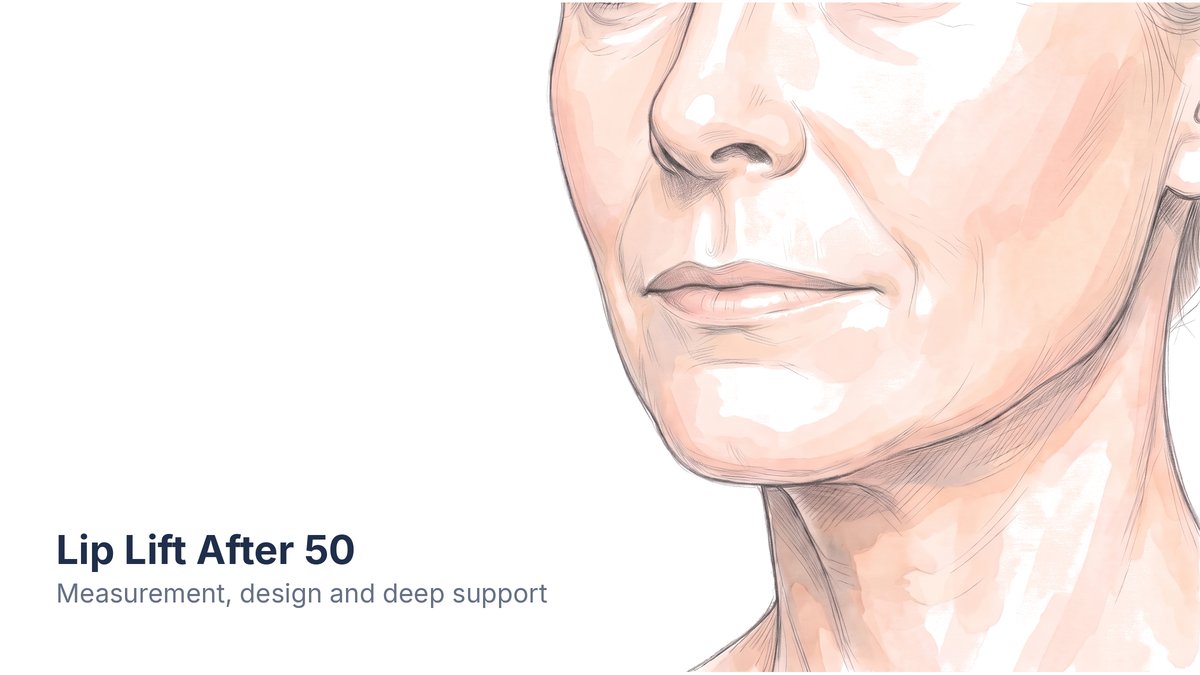
A lip lift, also called an upper lip lift, subnasal lift or bullhorn lip lift, is surgery that shortens a long upper lip by removing a strip of skin and fat just beneath the nose, so the lip sits higher, more vermilion (red lip) turns outward and more upper tooth shows.
Quick answers
- Will it look natural? It can, when the lip is shortened to a height that suits the face.
- Where is the scar? Along the base of the nose, ending a little way up the groove beside each nostril wing.
- Can I talk, smile and work? Yes; wide opening and big laughs are avoided early, and Dr. Yongwoo Lee asks for less talking and fewer big expressions for 3 to 6 months. Stitches come out on day 7.
- Will my nose change? Slightly, in some people: one study measured the nostril base 2.2 percent wider.
- Will my teeth show too much? That is the main risk of over-removal, so tooth show is assessed first.
- Am I too old at 65 or 70? Age alone is not the limit; health, smoking and blood thinners matter more.
Why Does My Upper Lip Get Longer as I Age?
The skin part of the upper lip stretches and thins with age while the red lip, the vermilion, rolls inward, so the distance from nose to mouth grows and the upper teeth disappear. In an MRI study of 200 adults, the upper lip was about 19 percent longer in older women and 18 percent longer in older men, with soft tissue 41 and 33 percent thinner respectively.
In women, the skin height from nose to lip edge averaged 14.3 mm at a mean age of 24 and 19.8 mm over 60, a lengthening of about 5.5 mm. Histology shows why: older lips have thinner skin, a shrunken orbicularis (the ring muscle of the mouth) and degenerated elastic fibers.
What people notice is less tooth. Classic dental data suggest that the upper incisors show about 3.4 mm at rest in women and 1.9 mm in men, falling to almost nothing after 60, though that 1978 paper gave no sample size.
How Do I Know if My Upper Lip (Philtrum) Is Too Long?
Measure from the base of the nose at the midline (the subnasale) down to where the skin meets the red lip at the central dip of the Cupid’s bow, with the face relaxed and the lips gently closed. Dr. Yongwoo Lee generally considers a lip lift at about 18 mm or more, roughly two standard deviations above the young female average but below the average for women over 60, so the number starts the decision rather than settling it.
The lower point is the dip between the two peaks, where the pale ridge of skin called the white roll meets the red lip. On this landmark, young women averaged 14.3 mm and young men 15.7 mm. Many published norms measure to a different point, the stomion, where the lips meet. That number includes the red lip, so it runs several millimeters longer. In a 3D study of Brazilian women, the skin portion of the lip was longer in women aged 41 to 65 than in women aged 20 to 40.
To check at home, face a mirror with the lips lightly touching and hold a millimeter ruler upright from where the column of the nose meets the lip down to where the skin meets the red lip at the central dip of the bow. Then part the lips slightly and note how much upper tooth shows. Expect an error of a millimeter or two.

Could Something Other Than Lip Length Be the Problem?
Sometimes the lip is not the cause at all. Worn or short front teeth, dentures or crowns set high, an upper jaw that sits back, or teeth pulled back by past orthodontics can hide the teeth and make a normal lip look long, so the teeth and jaw are checked before any measurement becomes a surgical plan.
In a 202-case series, a long philtrum in Asian patients mainly followed bone retraction after jaw surgery or orthodontics, while in Western patients it mainly reflected aging.
Gum show matters too. One study excluded patients showing more than 3 mm of gum, since shortening the lip over a gummy smile makes it gummier. In an 823-patient deep plane series, patients with excess tooth show, a poor bite or poor teeth received a conservative 3 to 5 mm excision or a dental or jaw referral instead. Tooth show decides it: a patient whose teeth already show at rest has less to gain and more to lose.
What Is a Lip Lift? Bullhorn, Subnasal and Deep Plane Lip Lifts
A lip lift removes a strip of skin and fat from just under the nose and closes the gap, so the lip sits higher and more red lip turns outward. A deep plane lip lift adds a release beneath a thin fibrous layer of the lip, the lip SMAS, so that deep anchoring stitches rather than the skin closure hold the lip up.
The most common subnasal design is the bullhorn, a curved strip along the nose base with a horn at each end. A review of 17 studies and 2,265 patients found the bull’s horn design used in 71.7 percent of cases. A 2026 evidence review describes deep plane versions as combining a limited dissection beneath the lip SMAS with muscular suspension. Some surgeons remove part of the orbicularis oris; others, Dr. Yongwoo Lee among them, leave it intact.
For the technically curious
From the surface inward: skin; thin fat; the labial SMAS, a dense fibromuscular sheet attached to the underside of the skin; a thin, glossy layer carrying most of the vessels; then the orbicularis oris. A 1985 cadaver study found a SMAS layer in the upper lip attached to the dermis, and that pulling it upward raised the line where the lips meet and restored the curve of the outer red lip. In the same 823-patient series, the flap was released beneath the SMAS about halfway down the central philtrum, and full central dissection was avoided because it can flatten the Cupid’s bow.
Lip Lift vs Filler: Which Is Better After 50?
Neither is better overall; each fits a different problem. A lift fits a long lip, because it shortens the skin above the lip but adds no volume, while filler fits a thin lip of normal length, because it adds volume but cannot shorten anything, and after 50 some lips need both in sequence.
Filler in a long lip adds weight beneath skin that stays the same length and can spread past the border, as described in lip filler migration and duck lips. A 2025 systematic review found that the botulinum toxin lip flip lasts about 3 to 4 months, rests on weak evidence and does not shorten the philtrum. A corner lip lift raises downturned corners and is a complement to philtrum shortening, not a substitute. A lift leaves vertical smoker’s lines and lost volume unchanged.
At a Glance: Bullhorn Lip Lift vs Corner Lip Lift vs Filler
| Option | Changes length | Adds volume | Scar | How long it lasts | Tooth show | Typically suited to |
|---|---|---|---|---|---|---|
| Bullhorn lip lift | Yes, center and sides | No, but turns more red lip outward | Nose base and beside each nostril wing | Long-lasting; small early rebound; long-term data limited | Increases; the main thing to plan | A lip of about 18 mm or more with little tooth show |
| Corner lip lift | No, corners only | No | At each mouth corner | Weak objective data | No direct effect | Downturned corners, alongside a lift |
| Filler | No | Yes | None | Temporary; repeat treatment | No direct effect | A thin lip of normal length |
| No treatment | No | No | None | Not applicable | Keeps falling with age | A lip under about 18 mm that looks in proportion |
How Much Should a Lip Lift Remove?
Only enough to bring the center of the lip to a height that suits your face, planned around how much tooth will show. Dr. Yongwoo Lee aims for a final central height of about 14 mm in women and 15 to 16 mm in men, with the sides left gradually longer, about 15 to 17 mm, reaching about 16 to 17 mm at the outer end near the nostril base.
Key numbers
- Average skin height from nose to lip edge: young women 14.3 mm, women over 60 19.8 mm, young men 15.7 mm.
- Dr. Yongwoo Lee operates at about 18 mm or more and aims for about 14 mm in women, 15 to 16 mm in men, and about 15 to 17 mm at the sides.
- Typical excision: 5 to 7 mm; more than 11 mm is not advised.
- Cadaver data: a 5 mm strip shortened the lip by 7.23 mm and added 4.09 mm of tooth show.
- Nostril base after surgery: about 2.2 percent wider on average.
- Early rebound: about 1.3 mm.
Two numbers matter: the strip cut out and the height left behind. In cadavers, a 2.5 mm excision shortened the philtrum by 3.37 mm and a 5 mm excision by 7.23 mm, while incisor show rose by 1.9 and 4.09 mm. In cadaver data the lip shortened by more than the strip removed, so the excision is planned smaller than the intended height reduction.

The 823-patient series describes most excisions as 5 to 7 mm, advises against more than 11 mm, and recommends leaving at least about 11 mm from the bow peak with the lip stretched. That 11 mm is measured from the bow peak with the lip stretched, so it is not comparable to a 14 mm resting central height.
Why 14 mm for women? It sits near the young female average of 14.3 mm, which a 2024 study proposed as a target while warning against over-shortening. Young men average roughly 15.5 to 16 mm and show less tooth, so the male plan is longer.
A 2022 commentary notes that the outer lip descends more than the central lip with aging, and that one published design aims for a 1 to 2 mm slope between reference lines. If only the center is lifted, the outer lip can look hooded. The outer lip has dropped more, so the strip removed there can be slightly taller even though more final height is left.
One study recorded a rebound of about 1.3 mm between the first week and six months, and in a 30-patient series, half lip lifts and half vermilion advancements, improvement was sustained over a mean of 5 years.
How Much Tooth Should Show After a Lip Lift?
Usually just a little: at about 14 mm, in Dr. Yongwoo Lee’s experience, the upper teeth just barely show at rest. Published preference data point the same way.
Raters of AI-generated female faces preferred about 0.5 mm of incisor show in Caucasian and Latino faces and about 1 mm in Asian and African faces, and liked 4 mm least. The author of the 823-patient series estimates 1 to 2 mm of tooth show after a 5 mm excision, one surgeon’s estimate rather than a guarantee.

How Does Dr. Yongwoo Lee Plan, Anchor and Close a Bullhorn Lip Lift?
I design a bullhorn that leaves the center at about 14 mm and lets the sides rise toward the nostril wings, remove skin and fat down to just above the lip muscle without cutting it, and free the lower flap beneath the SMAS-like layer. I then hang that layer on three PDS 4-0 anchor stitches, one at the center and one beside each nostril, tied to firm deep tissue, so the deep layer carries the load and the skin closes with less tension.
Measuring and marking
I perform lip lifts myself, and my impression is that demand is rising, especially among older patients. I measure from the base of the nose at the midline, with the lips gently closed and the face at rest, to the exact central point where the skin meets the red lip in the dip of the Cupid’s bow. The patients I operate on are usually at 18 mm or more, typically 18 to 22 mm, and I bring 21 or 22 mm lips to 14 mm as well; below 18 mm I usually do not operate. I operate on men when the lip is clearly long, with a similar threshold, and leave them at about 15 to 16 mm.
My upper line follows the nostril sill and the base of each nostril wing. Each vertical limb follows the crease and shape of the nostril wing and runs a little higher, up the groove where the wing meets the cheek; an 87-patient Korean series likewise carried the lateral tips to the uppermost point of the alar-facial groove. My lower line is a gull wing mirroring the Cupid’s bow, dipping at the midline and rising over the philtral columns. Planned final height is 14 mm at the center, and the sides are left gradually longer, about 15 to 17 mm, reaching about 16 to 17 mm at the outer end near the nostril base. I cannot make everything 14 mm. I aim for maximum symmetry at every mark, as a goal rather than a guarantee.
Depth and undermining
I excise the strip of skin and fat down to just above the orbicularis oris, and I do not cut the muscle. I then free the lower flap beneath the SMAS-like layer, so that the firm SMAS-like tissue is there to be caught with the suture. Centrally I go about half the philtrum height, and I release laterally as well, only as far as the flap needs to rise without tension on the skin.
Three deep anchors
Three PDS 4-0 sutures carry the lift. My central suture takes the SMAS-like layer to the deep firm tissue over the anterior nasal spine, the small point of bone beneath the nose. The two lateral ones go to the pyriform ligament region at each alar base, a dense fibrous system arising from the bony rim of the nasal opening that supports the alar base. A 2025 description of a similar three-point technique anchored to the anterior nasal spine and pyriform aperture while avoiding the alar dermis. No study has compared the holding strength of these anchor points.
Layered closure
I close the deep layers, all with PDS: 5-0 sutures bring the SMAS-like layer up into the deep subcutaneous layer, and 5-0 and 6-0 sutures close the subcutaneous layer as densely as I can. I close the skin with 7-0 nylon horizontal or vertical mattress stitches to evert the edges, and they come out on day 7, within the day 5 to 7 window a 2026 review recommends to minimize track marks. This deep support aims to reduce tension on the skin closure, because scar widening is the main thing I am trying to prevent.
What I ask of patients afterward
For about 3 to 6 months I ask patients to avoid a lot of talking and exaggerated expressions that strain the upper lip. That is my own precaution, longer than published protocols, which typically restrict wide opening and big laughs for the first 1 to 4 weeks. It is not a request for silence, only for less talking and fewer big expressions while the scar remodels.

Am I a Good Candidate for a Lip Lift After 50, 60 or 70?
Often yes, if the lip measures about 18 mm or more at rest, the upper teeth barely show, and length rather than thinness is what bothers you. Age itself is not the barrier; the usual reasons to choose something else are a lip that is not truly long, filler distorting it, or teeth and jaw that are the real cause.
The profiles below are illustrative examples, not real patients, and describe decisions, not results.
A 55-year-old woman with a 20 mm lip and no tooth show at rest. A typical candidate.
A 62-year-old man with a 21 mm lip. A candidate, planned longer at about 15 to 16 mm. No published data describe how the scar behaves under a moustache or beard, so his facial hair plans are discussed before surgery.
A 58-year-old woman at 15 mm whose lip has thinned. Not a lift candidate. Her length is within the youthful range; the options are careful filler or nothing.
A 52-year-old woman whose lip looks long and heavy after years of filler. Dissolve first, let the lip settle, then measure again, the same logic as dissolving versus lifting an overfilled face.
A 60-year-old woman with a long lip whose teeth already show, or who has a gummy smile. Dental, orthodontic or jaw assessment comes first.
When the lip is one part of broader aging, the sequence is covered in what ages at 40, 50, 60 and 70.
What Is Lip Lift Recovery Like, and How Is the Lip Lift Scar Cared For?
Skin sutures come out on day 7, the most visible swelling settles over the first few weeks, and stiffness can last about 3 months while the scar matures for about a year. Scar care comes down to three things: keeping tension off the lip, silicone, and strict sun protection for at least 3 months.
A 2026 review recommends head elevation and cold compresses for 48 to 72 hours and avoiding excessive upper-lip movement such as laughing and wide opening. In general wound-healing data, not lip-lift data, a wound has under 10 percent of its final strength at 2 weeks, over half by 4 weeks, and approaches 80 percent of intact skin by about 6 weeks. That is why the strictest limits come early.
Once the incision has sealed, international recommendations name silicone gel or sheeting as first-line scar prevention. The 823-patient series used low-setting fractional CO2 routinely at 60 and 120 days, and a systematic review found early laser may reduce scar formation, in studies with a high risk of bias.
Smoking stops before surgery, for the reasons in how smoking affects healing skin, and blood thinners are reviewed with the prescribing doctor. Patients flying in should stay in Jeju at least 7 days, until the skin sutures come out; see how long to stay in Korea after surgery.

Surgeon’s Insight: Why I Aim for 14 mm and Anchor Deep
I always like to aim for about 14 mm at the center in women. At that height the upper teeth usually just show, there is a modest overcorrection for early settling, and the lip can still look natural. I cannot make everything 14 mm, though: the sides are left longer, and for men I leave the center a little longer.
Scar widening is the main thing I am trying to prevent, and I have two tools against it. One is technique: hanging the lift on the SMAS-like layer with three deep anchors, which aims to reduce tension on the skin closure. The other is education: months of restraint with big expressions, to keep tension off the healing scar.
What Are the Risks of a Lip Lift?
The most common problems involve the scar, which can widen, thicken or stay pink, and the base of the nose, which can widen slightly or change angle. Over- or undercorrection, asymmetry, a flattened Cupid’s bow and partial relapse are the other main risks, and no technique rules any of them out.
Published rates are few and hard to compare. A review of 17 studies found an unappealing result or adverse scarring in a mean of 7.23 percent, with high-quality data scarce. Revision rates in tabulated subnasal series ranged from 0.6 percent in 823 patients to 6.7 percent in 30. Among 25 dissatisfied online reviews, scar concerns appeared in 15, nasal or alar distortion in 6 and asymmetry in 5; those are selected complaints, not incidence rates.
- Wide or thickened scar. In the 823-patient series, scarring and nasal base widening were the most common after-effects.
- Prolonged redness and small wound separations, minimal in 12 of 87 patients in a Korean series.
- A visible lateral scar if the vertical limb sits outside the nostril crease.
- Over- or undercorrection. A commentary warned that the over-everted “whistler” lip is extremely easy to create, and great caution is needed when chasing tooth show. In the Korean series, 25 of 87 had partial upper-tooth exposure that may affect satisfaction.
- Asymmetry, a flattened Cupid’s bow from too much central dissection, or flap inrolling from overtightened deep sutures.
- Partial relapse as the lip settles and ages.
- Numbness, stiffness or a changed smile, usually easing over months.
- Hematoma, 2 cases in the 823-patient series.
- Infection, suture or stitch problems. Among 92 no-incision suspensions to the anterior nasal spine, done through the nostril, two suture abscesses and one unravelled suture occurred; buried stitches can surface.
- A moustache-area scar in men, for which no data exist.
- Revision, dissatisfaction and the general risks of anesthesia.
Will a Lip Lift Make My Nostrils Wider or Change My Nose?
It can, slightly: the nostril base can widen and the angle between nose and lip can close. In 55 women followed for a mean of 14 months, alar width rose 2.2 percent, the nasolabial angle closed 4.56 degrees and measured nasal projection rose 26.3 percent, with a risk of the tip looking over-projected.
Precise alignment at the alar base matters, because misaligned edges can notch the nostril sill.
What Should I Ask Before Deciding on a Lip Lift?
Ask where your lip will be measured, what final height is planned at the center and the sides, and how much upper tooth should show at rest afterward. A plan stated in landmarks, millimeters and tooth show, made after your teeth and jaw are checked, is a plan made for your lip, not a formula.
Then ask yourself whether it is the length that bothers you, the thinness, or the lines; a lift answers only the first. If aging extends beyond the lip, how deep plane and SMAS facelifts differ covers the larger operation. A natural result, in the sense of what natural means in plastic surgery, looks like your own lip from years ago, not a treated one.
Individual results vary; consultation required.
Written by Dr. Yongwoo Lee, board-certified Korean plastic surgery specialist in facial anatomy and aesthetic procedures at VIP Plastic Surgery, South Korea.
Frequently Asked Questions About Lip Lifts After 50
Am I too old for a lip lift at 60 or 70?
No. There is no published age limit, and health, smoking and blood thinners matter more than age. Lips lengthen with age, to an average of 19.8 mm in women over 60 in one study, so older patients are often clear candidates.
Who is not a good candidate for a lip lift?
Someone whose lip measures under about 18 mm, whose upper teeth already show at rest, or who shows more than 3 mm of gum is usually better served another way. A jaw or orthodontic cause needs dental or jaw assessment first, and a poor bite or poor teeth calls for a conservative 3 to 5 mm excision or a referral.
What is a normal philtrum length?
Measured from the base of the nose to the lip edge at the center, young women averaged 14.3 mm and young men 15.7 mm in caliper studies, while women over 60 averaged 19.8 mm. Measurements taken to the stomion, where the lips meet, are not comparable.
How much skin is removed, and can a lip lift remove too much?
Usually a strip of 5 to 7 mm, the most common range in an 823-patient deep plane series, with more than 11 mm not advised. Too much can show excess tooth, roll the lip into a “whistler” shape, or leave the lips unable to close comfortably at rest, which is why the plan is built around final height.
How much tooth should show after a lip lift?
Usually a little, which is often the point, since classic data suggest almost no incisor shows at rest after 60. At about 14 mm, in Dr. Yongwoo Lee’s experience, the teeth just barely show, and raters of AI-generated faces liked about 0.5 to 1 mm best and 4 mm least.
Will a lip lift make my lips look fuller?
It can make the red lip look fuller without adding volume, because more of the vermilion turns outward. In a 202-case series the lift made the vermilion significantly more visible, and in cadavers lifting the lip SMAS restored the curve of the outer red lip. Lost volume itself still needs filler.
Is a lip lift or filler better after 50?
Each fits a different problem: a lift for a long lip, filler for a thin lip of normal length. Some lips after 50 need both.
Should I get a lip flip or a lip lift?
A lip flip uses about 4 to 6 units of botulinum toxin at the lip border, lasts about 3 to 4 months, can briefly affect straw use, whistling and speech, and rests on weak evidence. It does not shorten the philtrum, so it cannot do what a lift does for a long lip.
What is the difference between a bullhorn lip lift and a corner lift?
A bullhorn lift removes a strip under the nose and shortens the whole upper lip. A corner lift raises downturned mouth corners and complements, rather than replaces, philtrum shortening.
What is a deep plane lip lift?
A lip lift that frees the lip beneath a thin fibrous layer, the lip SMAS, and stitches that layer to firm tissue at the base of the nose, so deep stitches rather than the skin carry the lift.
Are lip lift results permanent?
No, though a lift is long-lasting. One study measured about 1.3 mm of rebound in the first six months, a 30-patient series found improvement sustained over a mean of five years, and a 2026 review judged long-term stability not yet well characterized.
Where is the lip lift scar, and how long does it take to fade?
It sits where the nose meets the lip and beside each nostril wing, but it is a real scar that can widen, thicken or stay pink. It remodels for about a year; the usual tools are silicone, strict sun protection for at least 3 months and, if needed, fractional laser, which one large series used at about 2 and 4 months.
Will a lip lift make my nostrils wider or change my nose?
It can, slightly. In 55 women the nostril base widened by an average of 2.2 percent and the angle between nose and lip closed by about 4.6 degrees, so the tip can look more projected.
Can men have a lip lift, and what about a moustache?
Yes, when the lip is clearly long. Dr. Yongwoo Lee usually leaves men at about 15 to 16 mm, close to young male averages. No published data describe the scar under a moustache, so facial hair plans are discussed beforehand.
Can a lip lift be done with a facelift?
They can be considered together, and whether to combine them is decided at consultation. A facelift does not shorten the philtrum, so a long lip needs its own operation at the base of the nose.
How soon can I talk, smile and go out in public after a lip lift?
Talking and eating continue from the start, while wide opening and big laughs are restricted in the first weeks; Dr. Yongwoo Lee also asks for less talking and fewer big expressions for 3 to 6 months as his own precaution. Skin sutures come out on day 7, so plan on about a week before going out, and makeup can cover the pink scar once the incision has fully sealed.
This article is for informational purposes only and does not constitute medical advice. Always consult with a qualified medical professional before making any decisions about surgical or non-surgical procedures.
