
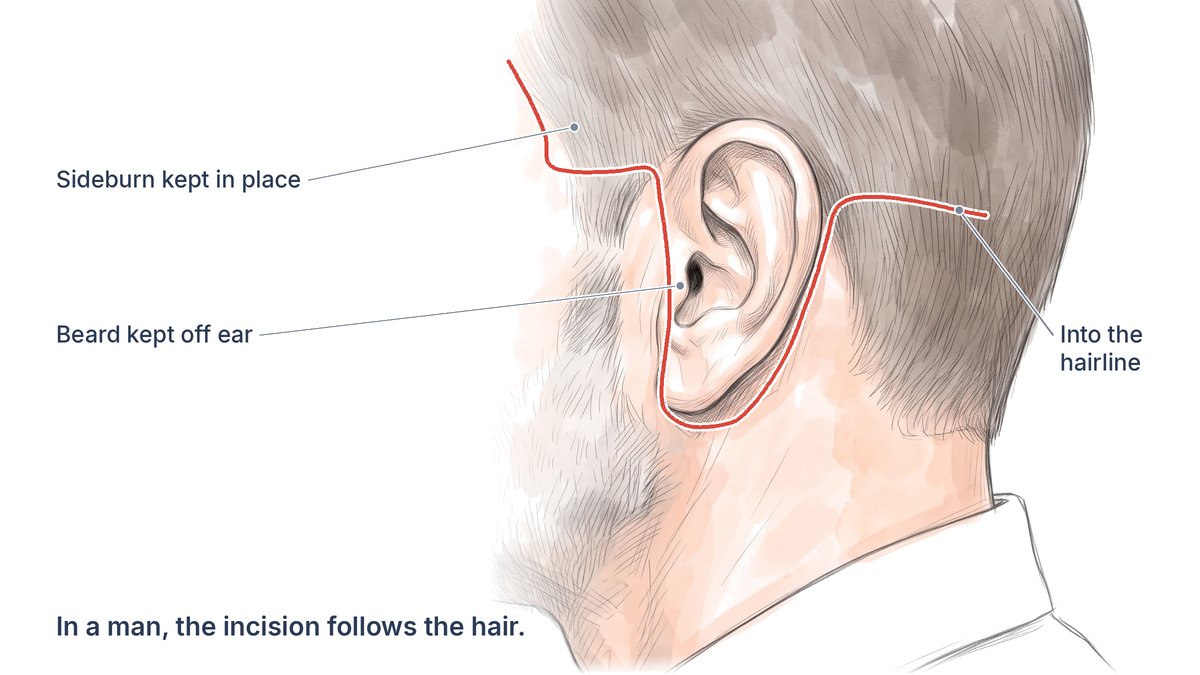
A male facelift, or male rhytidectomy, repositions the same deep layers of the face and neck as a woman’s facelift. It is planned around three things that differ in a man: hair-bearing skin that moves when the face is lifted, a higher risk of bleeding under the skin (a hematoma), and a goal of a rested, masculine face rather than a tighter or softer one.
Quick answers
- Is it a different operation? No; the deep release is the same, while the incisions, the bleeding protocol, the neck work and the goal change.
- Where are the scars? Along the front edge of the sideburn, around the ear in the natural crease just in front of the tragus, behind the ear into the hairline, and a short one under the chin.
- Will beard grow on my ear? Rarely, when the line runs in front of the tragus, as Dr. Yongwoo Lee places it in men, because bearded skin then stays on the cheek and off the ear cartilage.
- Will I have to shave behind my ear? Often a small area, because the lift carries beard skin up and back behind the earlobe.
- Do men bleed more? In most published series, yes: 3.9 times the female hematoma risk in one 11,300-patient database.
- Can I have a facelift with high blood pressure? Yes, once it is controlled; nearly half of American men with high blood pressure do not know they have it, so it is checked first.
- Will I look feminine or pulled? That look usually comes from a sideways pull, high cheek volume and a raised brow, which a plan for a man avoids.
- When can I shave? With an electric razor, gently and around the incision lines, once the face stitches are out at day 7; a blade waits until the incisions have healed.
Is a Male Facelift Different From a Woman’s?
The deep part of the operation is the same: the retaining ligaments that tether the cheek and jaw are released, and the SMAS (the fibrous layer over the facial muscles) and the platysma (the thin neck muscle) are moved as one layer. What differs in a man is the plan around that core: incisions that respect the beard, a stricter bleeding protocol, more neck work, and a goal of definition rather than youth.
A 2022 review notes that masculine attractiveness depends less on youthfulness than feminine attractiveness, and that techniques developed for women are being reconsidered so men keep a natural, masculine face without signs of surgery. A 2025 technique paper describes the male face as having denser tissue under the skin, greater vascularity and more prominent structures beneath the platysma.
Men are a small but growing group. US plastic surgeons reported 5,077 facelifts in men in 2025, about 6.5 percent of all facelifts and 17 percent more than in 2024, and face and neck lifts in men rose 26 percent in the UK in 2024.
Choosing the deep technique is the same question in men, covered in how deep plane and SMAS facelifts differ. Early jowls may not need surgery yet; see options for jowls before and after a facelift.
Why Do Men Bleed More After a Facelift?
Men have had a higher rate of hematoma, a collection of blood under the lifted skin, than women in most published facelift series: about 2.8 to 3.9 times higher in the two largest studies that give a ratio. The usual explanations are thicker, more vascular beard-bearing skin, more neck work, and blood pressure that runs higher and is more often undiagnosed.
Key numbers
- Hematoma risk in men compared with women: 3.9 times in an 11,300-patient database; 2.8 times in 1,078 consecutive facelifts.
- About 90 percent of facelift hematomas appear within the first 24 hours.
- Men needing a hematoma drained in surgery, one long series: 8.70 percent in 1966 to 1976, 3.97 percent in 1995 to 2002.
- American men with high blood pressure who do not know it: about 45 percent.
- Men in US facelift statistics, 2025: about 6.5 percent of facelifts.
The pattern has held for decades. In 1,078 consecutive facelifts, men carried a relative risk of 2.8, meaning 2.8 times the women’s risk, and across facelift series about 90 percent of hematomas appear within the first 24 hours. In an insurance database of 11,300 patients, male sex carried 3.9 times the risk.
Why men? These are reasons surgeons give, not proven mechanisms. Male skin is thicker: ultrasound of 118 adults found a thicker epidermis and dermis in men at most facial sites, except the cheekbone epidermis and the neck dermis. Beard follicles carry a dense blood supply, and surgeons describe the male neck as more often needing the midline muscle repair. In the 1,078-facelift series, male sex, systolic pressure, anterior platysmaplasty (that midline repair), aspirin or anti-inflammatory use and smoking were each linked to hematoma.

How the hemostatic net, drains and tranexamic acid prevent bleeding, and what is done if a hematoma forms, is explained in how surgeons prevent facelift hematoma.
Is the extra risk still there with modern protocols?
Smaller, yes; gone, not proven. In 985 male facelifts, hematomas needing surgical drainage fell from 8.70 percent in 1966 to 1976 to 3.97 percent in 1995 to 2002, a fall attributed to strict blood pressure control, against under 1 to 2 percent in women. Even under a protocol that kept the systolic pressure (the top number) at 140 or lower, male sex remained a significant risk factor in 1,089 facelifts, and a 2021 review concludes that rates remain higher in men than in women even with blood pressure control regimens.
The newest counterpoint is a 2026 single-surgeon study matching 34 men with 34 women for age, body mass index, a diagnosis of high blood pressure, smoking and other factors. None of the men and 1 of the 34 women (2.9 percent) had a hematoma, although the men’s operations ran longer and, among patients whose blood loss was recorded, more men than women lost 100 mL or more (34.8 against 6.9 percent). That one hematoma was minor, and 34 men at one center cannot show that the extra risk has gone. The excess risk is real, a strict protocol reduces it, and how much remains is not settled.
Can a Man With High Blood Pressure Have a Facelift?
Yes, when his blood pressure is controlled on a stable regimen before surgery and kept down during and after the operation. Pressure is the most important hematoma risk factor a patient can change, alongside aspirin, anti-inflammatory painkillers and smoking, and the one most often tied to bleeding in published series.
In the 985-case male series, a third of the men who needed a hematoma drained had blood pressure above 150/90 before, during and after surgery. In the 1,078-facelift series, as a 2024 review reports, a systolic pressure above 150 mmHg carried an odds ratio of 3.6 for hematoma, and the review’s authors advocate preventive blood pressure medication with a systolic goal below 140. An odds ratio of 3.6 means the odds of a hematoma were about three and a half times higher.
The opposite extreme matters too: the 83-man series recommends avoiding hypotensive anesthesia, surgery under deliberately very low pressure. Vessels that stay quiet at a very low pressure can be missed when bleeding points are sealed, then open once normal pressure returns.
Many men do not know their number. In US survey data from 2021 to 2023, 50.8 percent of men and 44.6 percent of women had high blood pressure, and only 55.2 percent of affected men knew it, so nearly half did not. These are US figures, using the 130/80 threshold of current American guidelines, lower than the 140 to 150 levels used in the facelift studies.
I measure blood pressure at consultation and again before surgery, and a man whose pressure is not controlled on a stable regimen is not scheduled until it is. Blood pressure medicines are usually continued, with any morning-of-surgery change made by the anesthesiologist. Aspirin, anti-inflammatory painkillers such as ibuprofen, and blood-thinning supplements are stopped on a set schedule, and prescription blood thinners or heart medicines only with the doctor who prescribed them. Sleep apnea, which drives night-time pressure surges and affects breathing under anesthesia, is screened too and assessed by the anesthesiologist.
Where Do the Incisions Go in a Male Facelift?
In a man the incisions follow the hair: along the front edge of the sideburn at the temple, around the ear, into the hairline behind the ear, and a short incision under the chin. Each line is placed so that the lift does not move the sideburn, carry beard onto the ear or notch the hairline.
A 2003 paper on facelift scars lists the telltale signs of poorly placed incisions as conspicuous scars, temporal hair loss, an unnatural tragus and distortion of the hairline behind the ear, with special consideration for men. Each shows more in a man, whose short hair and beard hide less.

At the temple: keeping the sideburn where it is
An incision inside the temporal hair hides the scar, but the lift then pulls the sideburn up and back, so it rises and a bare strip can open between the sideburn and the ear. In a man the sideburn is part of the beard frame, and a moved sideburn is one of the clearest signs of a facelift. In men, and especially when the skin shift is large, the incision runs along the front edge of the sideburn and temporal hairline instead, so the sideburn stays where it grew; the scar then follows the hair edge, which short hair covers less.
In front of the ear: in front of or behind the tragus?
Surgeons genuinely divide on this, and each choice gives something up. The tragus is the small cartilage flap in front of the ear canal. An incision in the natural crease in front of it (pretragal) keeps beard skin and ear skin separate, so no hair is carried onto the ear, but the line sits on the cheek and is easier to see. An incision along the inner rim of the tragus (retrotragal) hides the line in the shadow of the ear and matches skin color better, but the skin that will cover the tragus now comes from the beard area. Surgeons who use it remove the follicles on the underside of that skin before setting it in place, and treat any later regrowth with laser once healed.
The 83-man series concluded that incisions in men should be designed around hair growth patterns, avoiding damage to the follicles, and in a society video for patients a surgeon explains that in men the incision usually sits right in front of the tragus, because skin moved behind it can grow hair. In men I use the line in front of the tragus, because it keeps beard off the ear cartilage. I place it exactly in the natural crease at the edge of the tragus, so that once healed it reads like the edge of a shaving line rather than a scar. The trade-off is honest: a line in front of the tragus can be more visible than one hidden behind it, which is why placing it along the natural skin crease matters.
Behind the ear: lining up the hairline
Behind the ear the incision runs up the crease where the ear meets the head to about the upper third of the ear, then turns back into the hairline at the back of the head (the occipital hairline). With short hair this line shows as a step or notch if the hair-bearing edges are not lined up, so they are matched at closure.
Under the chin
A short incision in or near the crease under the chin gives access to the neck muscle and what lies beneath it, which most men need. How these scars mature month by month is the subject of how facelift scars heal.
What Happens to My Beard and Sideburns After a Facelift?
A facelift moves cheek and neck skin up and back, and in a man that skin carries beard. Most stays on the cheek and jaw, but some ends up behind the earlobe, where many men then shave a small area, and if bearded skin came to cover the tragus it would grow hair there, which is why the line in front of the tragus matters in men.

Skin that grew beard on the upper neck now sits behind the ear, so before surgery I tell men they will likely shave a small area there; it is expected, not a complication. In front of the ear, the beard edge should look like a natural boundary between beard and cheek, not a straight surgical line.
How Is a Male Facelift Planned Differently?
Most of the differences are in the planning rather than in the deep repair. The table sets out what is typically different in a man and what it changes.
At a Glance: Male vs Female Facelift
| What is planned | Typical in women | Typical in men | What it changes |
|---|---|---|---|
| Temple incision | Often inside the temporal hair | Along the front edge of the sideburn | Sideburn stays; scar sits at the hair edge |
| In front of the ear | In front of the ear, following the natural crease where the line hides best | In the natural crease in front of the tragus | Beard stays off the ear cartilage; the line can show more, so it follows the crease |
| Behind the ear | Up the crease, then into the occipital hairline | Same route; with short hair the hair-bearing edges are lined up exactly | No notch; a small area to shave behind the earlobe |
| Skin and fat | Thinner dermis at most facial sites | Thicker dermis at most sites; denser tissue under the skin, a more vascular face | More bleeding points to control |
| Hematoma risk | Baseline | 3.9 times higher in one 11,300-patient database | Stricter pressure control and monitoring |
| Blood pressure | High in 44.6 percent of US women | High in 50.8 percent of US men, only 55.2 percent of them aware of it | Checked at consultation and before surgery |
| Neck | Skin and platysma laxity common | Often also fat beneath the muscle, digastric and gland fullness | Access under the chin; platysma repair down to the hyoid |
| Target look | A softer contour often welcome | A defined jaw and neck, no high cheek fullness, little brow change | Direction of lift and use of volume |
| Grooming in recovery | Makeup and longer hair cover early signs | Electric razor first; short hair shows scars and staples | When to go back to work |
What Does the Neck Need in a Man?
In many men the neck, not the cheek, is the main problem, and it is often full from beneath the muscle as well as loose: fat under the platysma, bulging digastric muscles and low or visible submandibular glands blunt the angle under the jaw. Tightening skin or suctioning the fat above the muscle leaves those in place.
In men, hypertrophic digastric muscles and visible submandibular glands often blunt the angle between chin and neck. Under the chin, what shows are the anterior bellies of the digastric muscles, two small strips running from the inner chin back toward the hyoid, the small bone at the top of the throat; the submandibular glands are salivary glands under each side of the jaw. The same 2025 paper pairs a deep plane lift with work through a short incision under the chin: removing some fat beneath the muscle, trimming the digastrics, reducing the glands when needed and repairing the muscle in the midline.
Deep neck work carries its own risk. In a 504-patient series in which 307 had gland reduction, 5.8 percent had a temporary weakness of the lower lip and 0.4 percent a collection of saliva.
The aim in a man is a defined angle, not a hollowed one: over-resection leaves a gutter with the muscle edges showing, and the Adam’s apple, which can look more prominent once fat is removed, is left as a natural male landmark.

The bedside tests that tell skin, fat, muscle and deep fullness apart are set out in neck liposuction vs neck lift.
How Do You Avoid a Feminized or Overdone Look in a Man?
By lifting the deep layer upward toward a defined jaw and neck instead of pulling skin sideways, by not adding high, rounded cheek volume, and by leaving the brow and the square of the jaw alone. In a 3D simulation study, a standard lift made faces read as more feminine and a lift designed for men made them read as more masculine.
That study used computer simulations of 20 faces judged by 262 raters, in which the standard lift increased perceived femininity and the male-specific lift increased masculinity regardless of the subject’s sex; no patients were operated.
What makes a lower face read as male is structure: wider, squarer jaw angles, a broad and taller chin, and flatter cheekbones. A lift for a man protects them: the jaw angle stays square, the cheek is lifted without being made high and round, and the brow is changed little. When a man’s forehead does need lifting, I do it endoscopically and fix it with a deep-tissue suture or cortical bone tunnels, small tunnels made in the outer layer of the skull, depending on the case. Male forehead tissue is thick and firm and needs a firm hold, which often favors bone tunnels; the fixation options are compared in forehead lift fixation: Endotine, bone tunnel or suture.
Tension is the other side of an overdone look: a sideways pull, skin closed under strain and an earlobe dragged forward produce the operated look described in what causes the windblown look. If the chin is short or set back, no facelift draws a strong jawline; see genioplasty vs chin implant vs chin filler.
How Does Dr. Yongwoo Lee Perform a Male Deep Plane Facelift?
I perform the same deep plane release in men, under general anesthesia with an anesthesiologist, and I change three things: incisions that follow the hair, a bleeding protocol that starts before surgery and runs through the first days, and direct work beneath the platysma in the neck. Patients are usually admitted after surgery, which in a man is part of the bleeding protocol.
The incisions I use in men
In front of the ear, I place the incision in men in the natural crease in front of the tragus, so the beard stays on the cheek and off the ear cartilage and the healed line reads like the edge of a shaving line. In women the temple incision usually runs inside the hair, but in men it follows the hairline, along the front edge of the sideburn, so that the sideburn is not lifted away. Behind the ear the incision runs up the crease to about the upper third of the ear and then turns back into the occipital hairline. A short incision under the chin gives access to the neck in most men.
How I control bleeding
Before surgery, pressure is measured and controlled, and blood thinners are stopped with the prescribing doctor’s agreement. During surgery the anesthesiologist keeps the systolic pressure under 140, and I do not let it fall very low, because a vessel that is not bleeding at a very low pressure can be missed; the aim is a calm pressure through waking and the first night. Tranexamic acid, a drug that reduces bleeding, is given by IV from the day of surgery through day 3 or 4. At closure I place a hemostatic net, non-absorbable stitches that tack the lifted skin to the tissue beneath so no pocket remains for blood. I use one or two drains, depending on how much it bled during surgery: one behind the ear in the hairline, and a second behind the temple incision when bleeding was heavier. The meticulously placed net does the rest of the work.
After surgery, blood pressure stays tightly controlled. When it does not settle, an IV blood pressure drip is started and adjusted; if the pressure stays unreliable, the drip continues for the first four to five days. Pain relief is tramadol-based rather than anti-inflammatory painkillers, which affect clotting. Nausea, vomiting, coughing and straining also push pressure up, so they are prevented and treated early. The net comes out at day 3 to 4.
What I do in the neck
When the neck is full beneath the muscle, I work through the incision under the chin in order. I remove fat beneath the platysma, partly resect a digastric muscle that bulges, and then sew the inner edges of the platysma together in the midline, anchoring the repair near the hyoid so the angle under the jaw is defined. When a low or prominent submandibular gland is part of the fullness, I reduce it; when it is not, I leave it alone.
Stitches and staples
Stitches and staples follow the same schedule as in women, set out in the facelift recovery timeline week by week: face stitches out at day 7 and scalp staples at about two weeks. For a man leaving Korea before two weeks, I use dissolving Vicryl Rapide stitches instead of staples and nylon, 4-0 in the scalp and 5-0 in the skin, so nothing needs removing after he flies. What differs in a man is visibility: with short hair the staples show for those two weeks.
If you smoke
I require zero nicotine for 4 weeks before and 4 weeks after surgery, and in a smoker I narrow the area where skin alone is lifted. The reasons are in what changes surgically for a smoker.
What I do not do
I do not operate on a man whose blood pressure is not controlled. I do not choose a short-scar lift in a man because it is quicker when his neck needs work. And I do not try to make a man look younger at the expense of looking like himself.
Which Male Facelift Patient Are You?
Most men fit one of a few patterns, and the pattern decides the plan more than age. These profiles are illustrative examples, not real patients, and describe decisions, not results.
A lean man in his late 40s or 50s, full under the chin, with early jowls. The fullness is often deep, so neck work matters more than the cheek. See the best age for a facelift.
A man in his 60s with loose neck skin and visible bands. A full face and neck lift with platysma repair.
A man on blood pressure medication, or with sleep apnea. Eligible once his pressure is controlled and his sleep apnea has been assessed by the anesthesiologist, with closer monitoring and admission.
A man with a heavy, dark beard. The line in front of the tragus keeps that beard off the ear, and he should expect to shave a small area behind the earlobe.
A man with short hair, thinning temples or a bald crown. The temple incision follows the edge of the sideburn, the hairline behind the ear is lined up carefully, and early scars and staples show, so time off is planned.
A man with an early jowl, a clean neck and a wish for the shortest scar. Possibly a short-scar lift; see mini facelift vs full facelift.
What Is Recovery Like for Men? Shaving, Beard, Hair and Work
The healing itself follows the same timeline as in women; what differs for men is grooming and visibility. Shaving waits for the stitches and needs care over numb skin, and short hair hides less of the incisions and staples.
Shaving. For the first week stubble simply grows over the swelling. Once the face stitches are out at day 7, I ask men to use an electric razor, gently and around rather than over the incision lines, and to keep a blade away until they have fully healed. Cheek and neck skin is often numb for weeks to months, so a cut is easy to miss; shave slowly, at a mirror.
Beard and hair. Letting the beard grow is fine at any point; trimming it near the incisions waits until they have healed. Clippers and haircuts near the incisions wait until the staples are out and the incisions have healed, and hair color follows the same timing as for women, covered in the recovery timeline.
Work and exercise. The week-by-week schedule is the same as for women. For men the point is blood pressure: heavy lifting and straining raise it, so physical work returns later than desk work.
Travel. See how long to stay in Korea after surgery.
Surgeon’s Insight: In a Man, the Plan Starts With the Hair and the Pressure
In a woman, most of my incision planning is about where the scar will hide. In a man, the bigger question is what the lift will carry with it: the sideburn, the beard, the skin over the tragus, the hair behind the ear. I draw the lines around the hair first and the ear second, and I tell a man beforehand where his beard will end and what he will shave.
The other half of a man’s result is decided before the operation, by whether his blood pressure is controlled. Most hematomas happen in the first night, and that night is shaped weeks earlier, at the consultation where the pressure is measured. A man who waits a few weeks for his pressure to settle has lost nothing.
What Are the Risks Specific to Men, and What Is Not Known?
The risk that is clearly higher in men is hematoma, a collection of blood under the lifted skin, usually in the first day: swelling on one side, rising pain or tightness, a firm bulge or blood soaking through the dressing needs to be seen at once, and swelling in the neck with any difficulty breathing or swallowing is an emergency. Beyond that, the male-specific problems are cosmetic and mostly preventable by design: hair on the tragus, a raised or lost sideburn, a notch in the hairline behind the ear, and a visible line in front of the ear.
Other risks are shared with women. Facial nerve injury is uncommon; see which facial nerve branch is at risk in a facelift. Skin loss is uncommon and most strongly linked to smoking and to an untreated hematoma, and numbness, asymmetry, widened scars and anesthesia risks apply to every facelift.
What is not established
- No randomized trial has compared protocols in men.
- Male samples are small: apart from one 985-case series spanning decades, published studies that report men separately mostly include 34 to 115 men.
- Studies define hematoma differently, some counting only those drained in surgery, others any collection.
- No published study gives a success rate for removing follicles on the tragal skin, or for laser hair removal on the tragus after a facelift.
- No study measures how long a facelift lasts in men specifically.
- US procedure counts are surveys of member surgeons, not a registry.
What Should a Man Ask Before a Facelift?
The best question for a man to bring to a consultation is not “how tight” but “what moves”: where will my sideburn sit, where will the beard end in front of my ear, what happens behind my earlobe, and what is the plan for my blood pressure the first night. A surgeon who answers those in specifics has planned for a man’s face.
Then ask what the result is meant to look like. For most men the honest goal is the same face, rested and defined, not a younger or softer version of it. That is what natural means in plastic surgery: a face that looks like its owner on a good year, not like an operation.
Individual results vary; consultation required.
Written by Dr. Yongwoo Lee, board-certified Korean plastic surgery specialist in facial anatomy and aesthetic procedures at VIP Plastic Surgery, South Korea.
Frequently Asked Questions About Male Facelifts
What is the best age for a man to get a facelift?
There is no set age; the layers that have changed decide, not the birthday. In the later eras of the 985-case male series the mean age was 61, and a lean man in his late 40s or 50s with deep fullness under the chin may be a candidate earlier, because his neck, not his cheek, is often the main problem.
How long does a male facelift last?
No study has measured how long a facelift lasts in men specifically, and male series are small. Aging continues after any facelift: the deep repositioning of the SMAS and platysma is the part designed to hold, while skin quality, weight and sun keep shaping the face, as they do in women.
Are men more likely to have complications after a facelift?
Hematoma is the complication that is clearly higher in men: about 3.9 times the female risk in one 11,300-patient database and 2.8 times in 1,078 consecutive facelifts. Strict blood pressure control has lowered the male rate, but it has not been shown to remove the difference. Other risks, such as nerve injury, are shared with women.
Can I grow a beard to hide facelift scars?
Partly, once healed. A beard softens the line in front of the ear and the scar under the chin, but not the incision behind the ear, which runs up the crease and into the occipital hairline. The beard can grow from the start, while trimming and clippers near the incisions wait until the staples are out and the incisions have healed.
Will my sideburns be shorter or higher after a facelift?
They should not be. In men the temple incision usually runs along the front edge of the sideburn, especially when the skin shift is large, so the sideburn stays where it grew. An incision inside the hair lets the lift raise the sideburn and open a bare strip in front of the ear, which is why it is usually avoided in men.
Will hair grow on my ear after a facelift?
It can, when bearded skin ends up covering the tragus, which happens mainly when the incision runs behind it. Dr. Yongwoo Lee places the line in men in the natural crease in front of the tragus, so beard skin stays on the cheek and off the ear cartilage. Surgeons who go behind the tragus remove the follicles on the covering skin and treat regrowth with laser. Many men still shave a small area behind the earlobe.
Can a man with short hair or a receding hairline have a facelift?
Yes. The incisions follow whatever hairline remains, along the front edge of the sideburn at the temple and into the occipital hairline behind the ear, with the hair-bearing edges lined up at closure so no step or notch shows. Short hair hides less, so the scars and the scalp staples, out at about two weeks, show at first.
Is a neck lift alone enough for a man?
Sometimes, when the jowl and cheek are still holding and the problem is confined to the neck, such as fat beneath the muscle or bulging digastric muscles. When the jowl has also fallen, a neck lift alone leaves the jawline blurred, and the face and neck are lifted together, with the platysma repaired down to the hyoid.
Can a facelift fix a turkey neck in men?
Often, when the facelift includes work beneath the neck muscle. In many men the neck is full from below as well as loose, with fat under the platysma, bulging digastric muscles or low submandibular glands, so tightening skin or suctioning the fat above the muscle leaves them in place. Through a short incision under the chin the deep fat and digastrics are reduced and the platysma is joined down to the hyoid.
Is a mini facelift a good option for men?
It can be, for an early jowl with a clean neck and a wish for the shortest scar. It is not a shortcut when the neck needs work, because a short-scar lift reaches less of the neck, and in many men the neck, not the cheek, is the main problem. Choosing it only because it is quicker is the mistake to avoid.
Deep plane or SMAS facelift: which is better for a man?
The same logic applies as in women: what needs releasing and how far the tissue must move. Thicker male skin is no reason for a skin-only lift, and techniques described for men lift the deep layer with minimal skin-only dissection. How the two techniques differ is covered in this site’s deep plane versus SMAS comparison.
How many men get facelifts?
US plastic surgeons reported 5,077 facelifts in men in 2025, about 6.5 percent of all facelifts, or roughly 1 in 15, and 17 percent more than in 2024. In the UK, face and neck lifts in men rose 26 percent in 2024. The numbers are still small but rising on both sides of the Atlantic.
Should I stop my blood pressure pills before a facelift?
Usually not. Blood pressure medicines are generally continued, with any morning-of-surgery change made by the anesthesiologist, and pressure is measured at consultation and again before surgery. Aspirin, anti-inflammatory painkillers and blood-thinning supplements are stopped as instructed; prescription blood thinners are changed only by the prescribing doctor.
What does a hematoma feel like after a facelift, and when should I call?
Swelling on one side that keeps growing, pain or tightness that rises instead of easing, a firm bulge, or fresh blood through the dressing. About 90 percent appear within the first 24 hours. Any of these signs means calling the surgical team immediately, and neck swelling with difficulty breathing or swallowing means emergency help at once.
Is a facelift more painful for men?
There are no good data showing that it is. Pain is controlled with tramadol-based medicine rather than anti-inflammatory painkillers in the first days, because those drugs affect clotting, and keeping pain down also keeps blood pressure down. Numbness of the cheek and neck skin for weeks to months is expected and makes careful shaving important.
When can I go back to work after a male facelift?
Most men return to desk or remote work at about two weeks and to face-to-face work at about three to four. Physical work and heavy lifting come back later, because straining raises blood pressure while small vessels are still sealing. Short hair shows the scalp staples until they come out at about two weeks, so time off is often planned around that.
This article is for informational purposes only and does not constitute medical advice. Always consult with a qualified medical professional before making any decisions about surgical or non-surgical procedures.
