
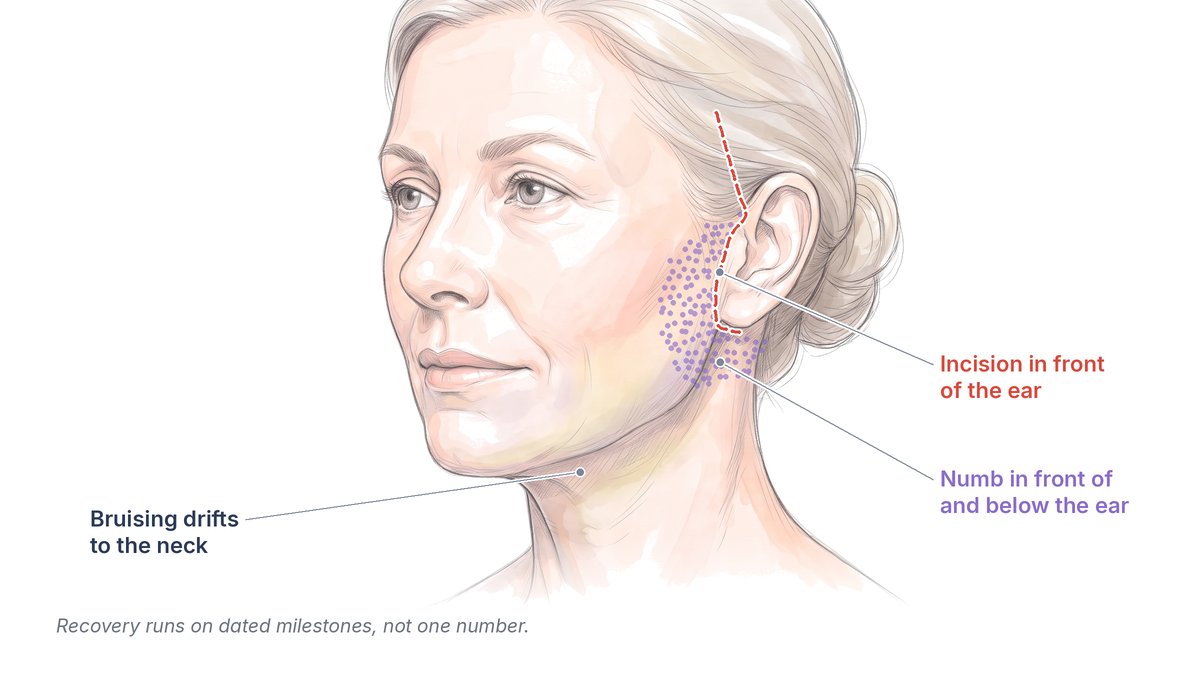
Facelift recovery is the 10 to 12 months over which swelling, bruising, numbness and scars settle after a facelift. Most of the visible part is over in two to three months, and every scheduled step that needs the surgeon’s hands happens in the first two weeks.
Quick answers
- How long is recovery? About 2 weeks to be presentable, 2 to 3 months to look recovered to others, and 10 to 12 months until the result is final.
- When is swelling worst? Around day 3; most bruising has faded by the end of week 2.
- When do stitches come out? Face stitches at day 7, scalp staples at about 2 weeks; patients leaving sooner get dissolving stitches only, with nothing to remove.
- When can I fly home? Usually at about 2 weeks, after the surgeon clears you.
- When can I go back to work? Desk or remote work at about 2 weeks; face-to-face work at 3 to 4.
- When can I exercise? Walking from the first day, light cardio at 2 to 3 weeks, nothing strenuous for 4 to 6 weeks, full workouts by about 6.
- How long does numbness last? Weeks to months; most of it resolves within a year.
- When should I call? At once if one side becomes clearly larger, tighter or more painful, above all in the first 24 hours, or for darkening skin, fever, an eye that will not close, or neck swelling with trouble breathing.
How Long Does Facelift Recovery Take?
Plan around three dates rather than one number: about two weeks to be presentable and cleared to fly, two to three months until other people see a recovered face, and about ten to twelve months for the final result. The arc is the same after a deep plane facelift and a smaller lift; what stretches it is how much else is done in the same operation.
NHS guidance gives about two to four weeks to recover, with the full effect taking up to six to nine months, and the American Society of Plastic Surgeons notes that minor swelling, tightness and numbness can take up to one year to resolve.
A facelift is often combined with a neck lift, fat grafting or an endoscopic forehead and temple lift, and the whole face then recovers on the clock of its slowest part. In 11,300 facelifts, combined procedures had a major complication rate of up to 3.7 percent, against 1.5 percent for a facelift alone. Age changes the dates of the steps very little, though older skin can take longer to settle; the reasons are in what ages in a face at 40, 50, 60 and 70.
Key numbers
- Swelling peak: about day 3; most bruising gone by the end of week 2.
- Dressing off: day 2. Drains out: first couple of days. Hemostatic net out: day 3 to 4.
- Face stitches out: day 7. Scalp staples out: about day 14.
- Desk work and flight home: about 2 weeks. Out in public with makeup: 2 to 3 weeks. Strenuous exercise: 4 to 6 weeks.
- Hematoma needing an emergency visit, admission or reoperation: 1.1 percent of 11,300 facelifts; a deep plane review puts all hematomas under 2 percent. Most appear in the first 24 hours.
- Final result: 6 to 12 months in published guidance; Dr. Yongwoo Lee judges it at about 10 to 12.

What Happens in the First 48 Hours After a Facelift?
The face and neck are wrapped in a compression dressing, small drains carry fluid away from under the skin, and the priority is calm blood pressure, because this is when bleeding under the skin (a hematoma) is most likely. Expect tightness, numbness and moderate pain controlled with tablets; the dressing usually comes off in full on day 2.
Hematoma means blood collecting under the lifted skin. It is the most common serious complication, 1.1 percent of 11,300 facelifts (counting only those that led to an emergency visit, admission or reoperation within 30 days), and most often forms within 24 hours of surgery. A deep plane review puts hematoma under 2 percent and links keeping the top blood pressure number (systolic) under 140 mmHg after surgery to a lower risk.
At the bedside that means resting on your back with the head raised, no straining or bending forward, and pain and anti-nausea medicine taken on schedule. Pain is worst in the first days, and most patients stop prescription pain medicine by days 4 to 6. Cool compresses around the face can ease swelling; ice never goes directly on numb skin.
Why is hematoma the thing everyone watches on night one?
Because it can be caught and fixed early, before it harms the result, so each morning both sides are compared and the drain output checked. How it is prevented in the operating room is covered in why facelift hematoma happens and how it is prevented.
What Should I Expect in Days 3 to 7 After a Facelift?
Swelling usually peaks around day 3 and then starts to fall, while bruising drifts down toward the jaw and neck. On day 3 or 4 the hemostatic net, temporary stitches that hold the lifted skin down so blood cannot pool, comes out, and the main thing to report at once is swelling that is clearly bigger on one side.
Bruising moves with gravity, and Mass Eye and Ear describes swelling peaking in days 1 to 3 and bruising peaking within 3 to 5 days. After the net comes out, the skin can look slightly dimpled where it sat, fading over days to a few weeks.
A small soft swelling on one side is checked for a seroma (trapped clear fluid) or a hematoma (trapped blood). Seroma occurs in about 4 percent of deep plane cases, and a mild one usually resolves within one to three days under light gauze pressure, and one that persists is drained with a needle. A true hematoma is treated straight away: usually a small part of the incision is opened under local anesthesia, the blood is cleared and the wound is closed again, and a larger one is cleared in the operating room.
What Happens in Week 2: Stitches, Makeup and the Flight Home?
Face stitches come out on day 7 and scalp staples at about two weeks, and by the end of the second week most remaining bruising can be covered with makeup. International patients are usually cleared to fly at about the same point.
British guidance gives stitches out at 7 to 8 days; in Dr. Yongwoo Lee’s protocol, fine nylon stitches in front of the ear come out on day 7 and staples in the hair-bearing scalp at about two weeks. Patients who must leave Korea sooner get no staples: the scalp and the skin of the face and neck are closed with a fast-dissolving stitch, which loses its holding strength between days 10 and 14 and is fully absorbed by day 42, so nothing needs removing at home.
Makeup can go on the bruises once the stitches are out, but not on the incisions until they have fully sealed.
Most of Dr. Yongwoo Lee’s patients also have one gentle fractional laser session in the second week, a laser that treats tiny columns of skin to refresh texture, kept off the incision lines; smokers wait longer. The timing is explained in CO2 laser after a facelift and why blood supply sets the timing.
When can I fly home after a facelift?
Usually at about two weeks, once the last step that needs the surgeon is done and both sides are soft and settling. Safe-flight conditions and clot risk are covered in how long to stay in Korea after plastic surgery.
When Can I Go Back to Work, Exercise and Socialize After a Facelift?
Desk or remote work is usually possible at about two weeks, going out in public with makeup at two to three and face-to-face work at three to four; light cardio returns at two to three weeks, while hard exercise, heavy lifting and bending or straining wait four to six, with full workouts by about six. Each rule serves one of two aims: low blood pressure while small vessels seal, and no tension on incisions that are still weak.
In general wound-healing data, not facelift data, a wound has less than 10 percent of its final strength at two weeks, more than half by four weeks, and reaches roughly 80 percent of the strength of unbroken skin by about six weeks. So the strictest limits come first, and the last ones lift around week six.
Published advice ranges up to no swimming or strenuous sport for a month and full fitness at about two months; the most common pattern is light cardio in weeks 2 to 3 and rigorous exercise in weeks 4 to 6. Dr. Yongwoo Lee is more cautious still: hot tubs, swimming pools, hot springs, the sea, saunas and Korean bathhouses (jjimjilbang) wait four to six weeks, because heat swells the face and shared or open water can carry infection into incisions that have not sealed.
Most people are comfortable out in public with makeup at two to three weeks; for photographs or a major event, plan on four to six.
At a Glance: When Each Activity Returns After a Facelift
| Activity | Dr. Yongwoo Lee’s protocol | Published range | Why the wait |
|---|---|---|---|
| Walking | From the first day | Light walking in week 1 | Moves blood in the legs |
| Light cardio | About 2 to 3 weeks | Weeks 2 to 3 | Pulse and pressure rise gently |
| Hair wash and shower | Washed for you for a week; shower when cleared | Day 2 to day 3 | Keeps incisions and staples clean and dry |
| Makeup | On bruises once stitches are out; not on incisions | Day 7 to about 3 weeks | Open incisions |
| Desk or remote work | About 2 weeks | 2 to 4 weeks | Visible bruising, tiredness |
| Out in public; photos or major events | 2 to 3 weeks with makeup; 4 to 6 weeks | 2 to 4 weeks | Fading bruising and swelling |
| Strenuous exercise, heavy lifting, bending or straining | About 4 to 6 weeks | 2 to 6 weeks | Blood pressure and bleeding |
| Full workouts | About 6 weeks | Up to 2 months | Incisions near full strength |
| Baths, pools, hot springs, sauna | About 4 to 6 weeks | 2 weeks to 1 month | Heat, infection risk |
| Hair color | About 6 weeks | 4 to 6 weeks or more | Chemicals on healing scalp incisions |
| Long-haul flight | About 2 weeks, after clearance | 1 to 2 weeks once drains are out | Last surgeon step done |

Sex follows the same rule as strenuous exercise. An immature scar exposed to sun can darken for good, so high-factor sunscreen, a hat and sunglasses stay for months; one handout asks patients to keep sun off the scars for at least 12 months.
Weeks 3 to 6: Why Does My Face Still Feel Firm, Lumpy or Tight?
Between weeks 3 and 6 most bruising is gone, but the face can still feel firm, lumpy or tight, especially under the jaw after a neck lift; that is fluid and new healing tissue, not the shape you will keep. Tightness usually eases by about six weeks.
Firmness comes from new collagen where the layers were lifted and from fluid that the disrupted lymph channels clear slowly. The British association expects tightness to ease within about six weeks. It can last longer under the chin, as set out in neck lift recovery and how it compares with liposuction.
Is it normal to be still swollen 4 weeks after a facelift?
Yes. Swelling at four weeks is expected and can make the face look fuller or more pulled than it will be; a true pulled look is judged months later, as explained in the windblown facelift and what can be fixed. Do not judge the result before about three months.
How Long Does Swelling Last, and When Are Facelift Results Final?
Visible swelling is mostly gone by two to three months, the last subtle swelling and deep firmness by six to twelve, and Dr. Yongwoo Lee judges the final result at about ten to twelve months. Published guidance gives six to twelve months, so a face assessed at one month is mostly swelling.
British guidance says the result cannot be judged for about six to nine months, and deep plane surgeons photograph the result at 6 to 12 months. A deep plane lift releases and lifts the deeper layer under the skin, not the skin alone, and that wider dissection usually swells more early than a smaller lift; how deep plane and SMAS facelifts differ explains why. Even, two-sided early swelling does not predict the final shape.
Scars follow their own year: pink in the first one to three months, usually fine, pale lines by about twelve, with silicone gel once the incisions have sealed. The phases, and how incision placement affects them, are in how facelift scars heal.
Does fat grafting or a brow lift change the timeline?
A little. Fat grafting adds swelling, and some transferred fat is lost over the first three months before the rest settles, as described in how much transplanted fat lasts. An endoscopic forehead lift adds forehead tightness for a week or two and scalp numbness that fades over the following weeks, covered in how a lifted forehead is held and heals.
How Long Does Numbness Last After a Facelift?
Numbness in front of and below the ear, the earlobe and the cheek is expected after every facelift and usually improves over weeks to months; most of it resolves within a year, though British consent guidance allows 12 to 18 months. It comes mainly from lifting the skin and from stretch on the great auricular nerve, which supplies feeling to the lower ear.
Injury to the great auricular nerve is the nerve most often injured in facelift surgery, in 6 to 7 percent, and the earlobe numbness it causes usually resolves over weeks to months, though some cases are permanent. Lasting nerve damage is rarely recorded: under 1 in 2,000 patients in a meta-analysis of 15,404, for sensory and for motor nerves. That counts reported injuries, not the ordinary numbness that lasts months.
Numb skin cannot judge heat, so use lukewarm water and a cool hairdryer setting.
Weakness of a lip, brow or eyelid is different: if it lasts beyond the first hours, report it, and an eye that will not close needs to be seen the same day; the branches and their recovery are explained in facial nerve injury after a deep plane facelift.

How Does Dr. Yongwoo Lee Run the First Two Weeks After a Facelift?
I operate under general anesthesia with a board-certified anesthesiologist, usually keep facelift patients admitted for the first nights, keep blood pressure tightly controlled, place a hemostatic net in every case with one or two small drains, and change the dressings myself. The net comes out on day 3 or 4, face stitches on day 7 and scalp staples at about two weeks.
Before surgery
Every patient has a preoperative medical check. Smokers stop all nicotine for four weeks before and four weeks after surgery, including patches and vaping, for the reasons in what smoking does to a lifted skin flap. I ask patients to stop aspirin, anti-inflammatory painkillers such as ibuprofen, fish oil, vitamin E and herbal supplements about two weeks before surgery, until I restart them; a blood thinner prescribed by another doctor is never stopped on the patient’s own, and we plan it together with that doctor. The full list, with GLP-1 drugs and hormones, is in what to stop before plastic surgery.
The operation and the first night
The incisions run from the temple inside the hairline, down in front of the ear, around the earlobe, up the crease behind the ear to about the upper third of the ear, and then back into the hairline, and those lines mark where tightness and numbness are felt later. Blood pressure is kept tightly controlled for the first days, with an IV blood pressure drip when it does not settle, and a drug that reduces bleeding, tranexamic acid, is given for the first three or four days. Pain relief is tramadol-based.
Days 1 to 4
I change the dressings myself each morning, so the compression stays right and any difference between the sides is caught early. I place one or two small drains depending on how much the area bleeds: one behind the ear in the hairline and, when bleeding is heavier, a second just behind the temple incision so the front of the lift drains too. The full dressing usually comes off on day 2, slightly later if I am watching one side, and the drains usually come out within the first couple of days. On day 3 or 4 I remove the net. A caretaker shampoos the patient’s hair through the first week, to keep the incisions and staples clean and dry and protect the hairline incisions.
Days 7 to 14
A patient who must leave before day 14 has no staples and only dissolving stitches, so nothing is removed. In the second week, while the patient is still nearby, I usually do a single gentle fractional laser session over the face, never over the incision lines (later in smokers), and from then on sun protection is enforced. Clearance to fly comes from an examination, not a date: stitches and staples out or dissolving, both sides soft, and blood pressure steady without a drip.
Where patients stay
After the first nights in the hospital, patients from abroad stay in lodging in the same building, so dressing changes and checks are an elevator ride away. A nurse is on call in both, and I live next to the hospital and can be reached at night.
What I offer, and what the evidence says about it
During this fortnight I also offer hyperbaric oxygen, LED light and a vitamin drip, and from about one month lymphatic drainage, a light massage that moves trapped fluid toward working lymph channels, which waits until then because the tissues are fragile earlier. They are offered for comfort, and the evidence that they speed recovery is limited. The one hyperbaric oxygen study I know of compared 20 women in one practice after the fact, without measuring bruising or swelling, and I know of no facelift trial for the others. Better, though still imperfect, evidence sits behind blood pressure control, the net and tranexamic acid, and those are the parts I do not leave out.

Which Facelift Recovery Are You?
Everyone follows the same dated steps; added procedures, sex, smoking and travel change how they feel. These profiles are illustrative, not real patients, and describe plans, not results.
A 52-year-old woman, deep plane facelift alone, desk job. Presentable with makeup and working by video at about two weeks, in the office at three to four.
A 63-year-old woman, facelift with a neck lift, fat grafting and an endoscopic brow lift. The same steps on the clock of the slowest part: tightness under the chin for weeks, a graft that settles over months, and first days watched more closely.
A 58-year-old man. A higher hematoma risk and beard-bearing skin near the incisions; how both change the plan is in what is different about a facelift in men.
A smoker who has stopped for the operation. The four nicotine-free weeks after surgery run past the flight home, the skin in front of and behind the ear is checked at every early visit for color, and the second-week laser waits.
A patient flying 12 hours home at two weeks. Walk the aisle every hour, skip alcohol on board, and if one side swells or hurts more after landing, call the surgeon and see a local doctor the same day. Calf pain or swelling, or breathlessness, in the weeks after landing is an emergency.
Surgeon’s Insight: The First Fourteen Days Are Still Part of the Operation
The operation itself takes one day. For the next fourteen, the decisions that protect the result are still mine to make each morning: whether the drains can come out, whether one side is fuller than the other, whether the skin in front of the ear is pink, whether the blood pressure needs the drip. That is why I want patients where I can see them every day, and why the date of the flight is set by the last of those checks rather than booked first.
After two weeks the work passes to time and to the patient: calm blood pressure, no strain, sun protection, and patience until the tenth month.
What Is Normal After a Facelift, and When Should I Call the Surgeon?
Even swelling on both sides, bruising that drifts down the neck, numbness, tightness and a firm, lumpy feel are expected. Call at once if one side becomes clearly larger, tense or more painful, above all in the first 24 hours, or if skin at the edge of the lift turns dark, does not regain color when pressed, or blisters, a fever passes 38°C (100.4°F) or an eye will not close; call an ambulance for swelling of the neck with difficulty breathing or swallowing, for breathlessness or chest pain, or for a swollen, painful calf.
| Sign | Usually normal | Call now |
|---|---|---|
| Swelling | Similar on both sides, peaking around day 3 | One side clearly bigger, tense or shiny |
| Pain | Easing after day 3, controlled with tablets | Rising, or much worse on one side |
| Bruising | Yellow or purple, drifting down to the neck | An expanding, tense swelling under the bruise |
| Skin at the edge of the lift | Pink, color comes back when pressed | Dark or dusky skin whose color does not come back when pressed, mottling or blisters, usually in front of or behind the ear |
| Temperature and wound | No fever, incisions dry after the first day or two | Above 38°C (100.4°F), pus or spreading redness |
| Movement | Numb but moving | An eye that will not close, a lip that will not move |
| Neck | Tight, numb, evenly swollen | Neck swelling growing fast, with trouble breathing or swallowing: emergency |
| Breathing and legs | Not affected | Breathlessness, chest pain, a swollen or painful calf: emergency |
Mayo Clinic lists severe one-sided face or neck pain within 24 hours, shortness of breath, chest pain and an irregular heartbeat as reasons to call. A hospital handout adds a temperature above 100.4°F and swelling or bruising that keeps increasing. Skin that dies at the edge of the lift is uncommon after a deep plane lift, under 1 percent, mostly in front of the ear.

What Should I Ask My Surgeon About Facelift Recovery?
Ask not “how long is recovery?” but “what has to happen in each week, and who does it?” Some steps need the surgeon’s hands, some need your blood pressure and patience, and some only need time.
A plan that names its dates, dressing off at day 2, net out at day 3 or 4, stitches out at day 7, staples out at about day 14, is a plan you can build a trip around, with the flight booked after the last check. Still deciding whether to have a facelift? Options for a softening jawline are compared in jowl treatments from fillers and threads to a facelift.
Individual results vary; consultation required.
Written by Dr. Yongwoo Lee, board-certified Korean plastic surgery specialist in facial anatomy and aesthetic procedures at VIP Plastic Surgery, South Korea.
Frequently Asked Questions About Facelift Recovery
What is the hardest day after a facelift?
For most people day 2 or day 3, when swelling builds toward its peak and the face feels tightest. Pain is usually easing by then, and most patients stop prescription pain medicine by days 4 to 6. From day 4 most people feel steadily better.
When will I look normal after a facelift?
Most people look presentable with makeup at about two weeks and are comfortable out in public at two to three; for photographs or a major event, plan on four to six weeks. Most look recovered to others at two to three months, and the final result is judged at about 10 to 12 months.
How painful is facelift recovery?
Usually less than people expect; tightness bothers most patients more than sharp pain. Incision pain mostly lasts three to four days and is controlled with tablets. Pain that rises instead of easing, especially on one side, is a reason to call.
When can I sleep on my side after a facelift?
Usually at about two weeks, once swelling has settled and lying on the side is comfortable. Until then, sleep on your back with the head raised on two or more pillows or in a recliner. Head-up rest keeps the face above the heart.
What happens if I accidentally bend over after a facelift?
One brief bend is very unlikely to cause harm. Bending the head below the heart raises pressure in the face, which is why it is avoided for four to six weeks. Watch for swelling or pain growing on one side over the next few hours, and if either appears, call the surgeon at once.
How long do I wear the compression dressing after a facelift?
The full compression dressing usually comes off on day 2, slightly later if the surgeon is watching one side more closely. Some surgeons then add a lighter elastic chin wrap for a short time, particularly after a neck lift, and will tell you whether you need one and for how long.
When can I wash my hair and shower after a facelift?
In Dr. Yongwoo Lee’s protocol, a caretaker washes your hair for about the first week, to keep the incisions and staples clean and dry. Gentle showering starts once the incisions are sealed enough, usually after about a week. Use lukewarm water and a cool hairdryer setting, because numb skin cannot judge heat.
When can I wear makeup after a facelift?
Makeup can cover bruises once the stitches are out, around day 7, but not the incision lines until they have fully sealed. By the end of week two most bruising can be covered. High-factor sunscreen goes on every day as well, because an immature scar exposed to sun can darken for good.
When can I drive after a facelift?
When you are off opioid or other drowsy-making pain medicine, including tramadol, and can turn your head freely to check a blind spot, usually one to two weeks after surgery. Neck tightness, especially after a neck lift, can limit turning for longer, and that, not the calendar, sets the date.
When can I drink alcohol after a facelift?
Wait about two weeks. Alcohol raises blood pressure and adds to swelling while small vessels are still sealing, and it should not be mixed with pain medicine. Patients flying home are also advised to skip alcohol on board, because a long flight already adds to the risk of blood clots.
Is it normal for one side to be more swollen than the other?
Mild differences are common. What matters is speed: a side that is visibly growing over hours, tense to the touch or more painful than the other, especially in the first 24 hours, can be a hematoma and needs a call to the surgeon at once, not in the morning.
Why does my face feel hard and lumpy weeks after a facelift?
It is new healing tissue and fluid that the disrupted lymph channels clear slowly, a normal stage between weeks three and six. It is often uneven and softens over the following months. Dr. Yongwoo Lee’s team starts gentle lymphatic drainage at about one month for comfort.
How long does neck tightness last after a facelift and neck lift?
Usually several weeks. British guidance expects facelift tightness to ease within about six weeks, and under the chin it can take a little longer after a neck lift. That firmness is healing tissue and slowly clearing fluid, not the final shape, and it keeps softening for months.
Can I have a late hematoma after a facelift?
Rarely. Most hematomas appear in the first 24 hours, but one can form days later, so the one-sided rule holds through the first two weeks: swelling or pain growing on one side, or a tense swelling under a bruise, is a reason to call at once.
Do arnica, bromelain or hyperbaric oxygen speed up facelift recovery?
Not reliably. A deep plane review calls the data on arnica and bromelain lacking, and the only hyperbaric oxygen study after facelift compared 20 patients after the fact without measuring bruising or swelling. They are offered for comfort and never replace blood pressure control.
Is recovery longer after a deep plane facelift than a mini facelift?
The arc is similar: stitches at about a week, numbness for months and scars for a year. A deep plane lift usually swells more in the first weeks because the dissection is wider, while a mini lift shortens the incision, not the healing clock, as compared in mini facelift versus full facelift.
This article is for informational purposes only and does not constitute medical advice. Always consult with a qualified medical professional before making any decisions about surgical or non-surgical procedures.
