
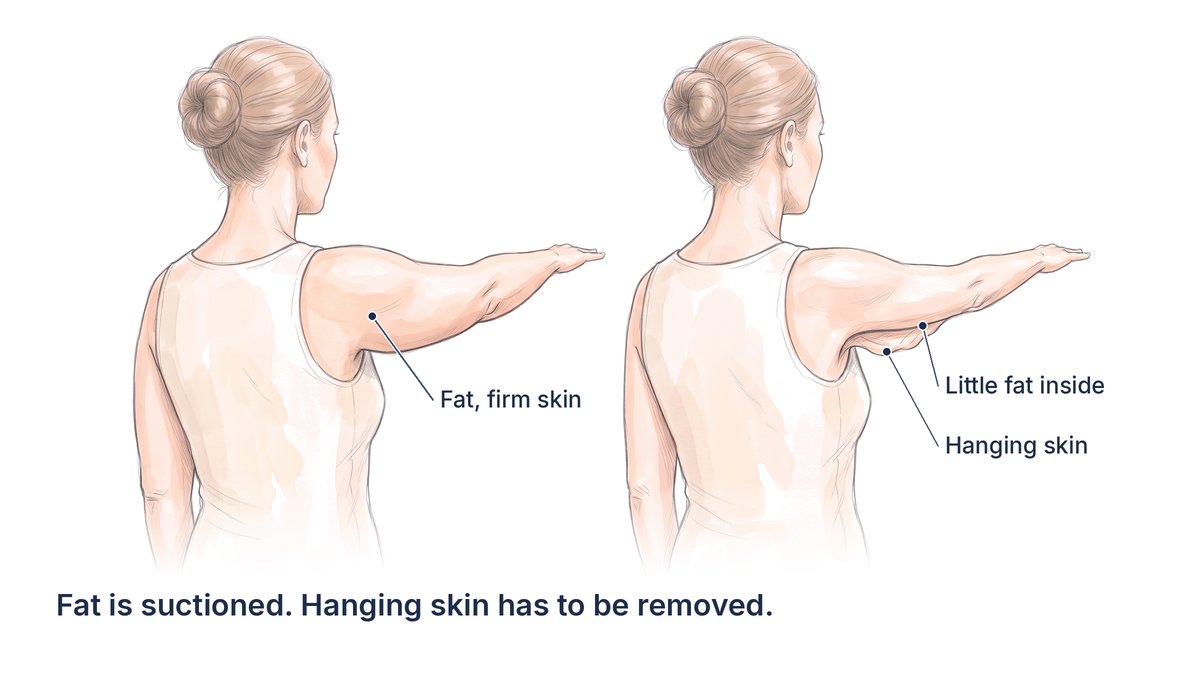
Arm liposuction removes fat from the upper arm through a few small entry points; an arm lift, or brachioplasty, removes skin and fat through an incision running from the armpit toward the elbow. The skin decides between them, not the size of the arm.
Quick answers
- Can liposuction fix saggy arms? Not when the sagging is skin. An arm with a real skin excess usually needs an arm lift, alone or with liposuction.
- Is my skin too loose? With the arm held out, a hang of more than 10 cm with little fat inside is the classic arm-lift arm; a mainly fatty arm may do well with liposuction even when it hangs.
- Does VASER tighten arm skin? Somewhat, and unreliably. Dr. Yongwoo Lee treats any tightening as a bonus, not a plan.
- Where does the arm-lift scar go? Along the inner arm; Dr. Lee places it on the back-inner side, armpit to just above the elbow, or in the armpit alone for a short-scar lift.
Can Liposuction Fix Saggy Arms, or Do I Need an Arm Lift?
Liposuction can fix an arm that is heavy, but not an arm whose skin hangs. If the fullness is mostly fat and the skin springs back, liposuction can slim the arm through entry points a few millimeters long; if the skin itself hangs, removing the fat leaves an emptier fold, and the operation that removes the fold is an arm lift.
They treat different tissues. Patient information from the American Society of Plastic Surgeons describes an arm lift as reshaping the under portion of the upper arm, from the underarm region to the elbow, and notes that sagging from weight change, aging and heredity cannot be corrected through exercise.
Is My Arm Problem Fat, Loose Skin, or Both?
Every heavy or hanging upper arm is a mix of two things: how much fat sits under the skin, and how far the skin hangs. A pinch estimates the first; the vertical hang below the fold on the underside of the arm, measured with the arm held out to the side, estimates the second.
The pinch. Skin and fat on the back of the arm are pinched between the fingers to estimate the fat and see how the skin behaves. One clinical review describes a pinch test showing less than 2 cm of fat, with good skin tone, as the profile of the ideal candidate for liposuction alone. That is expert opinion, not a measured cut-off.
The hang. Surgeons measure the sag, called brachial ptosis, as the vertical distance between the brachial sulcus and the lowest curve of the hanging arm. That sulcus is a line on the back-inner side of the upper arm, behind the groove between the biceps and triceps. In the grading used by later authors, a hang under 5 cm is grade I, 5 to 10 cm grade II, and over 10 cm grade III.
The recoil. Neither measurement says how the skin will behave once the fat is gone. A hang filled mostly with fat can shrink a long way after liposuction; a hang of thin, stretched skin with little inside it cannot.
What Is Under the Skin of the Upper Arm?
Under the skin of the upper arm lies fat in two layers separated by a thin fibrous sheet, and beneath them the fascia over the muscle. On the inner side, the groove between the biceps and triceps carries a large vein and two small skin nerves, and both operations are planned around that groove.
A clinical review describes the superficial fascial system dividing arm fat into a superficial (alveolar) layer and a deeper (lamellar) layer, with excess fat accumulating mainly in the deeper layer.
In 8 cadaver arms, the medial brachial cutaneous nerve ran alongside the basilic vein in every arm, with branches at about 7.8 and 15.3 cm above the medial epicondyle, the bony point on the inside of the elbow; the authors note that liposuction cannulas, as well as the scalpel, can injure these nerves. A second nerve, the medial antebrachial cutaneous nerve, named for the forearm skin it serves, was found in 10 cadaver arms to pierce the deep fascia about 14 cm above the medial epicondyle, within the standard dissection plane of an arm lift.
In a 28-woman series of ultrasound arm liposuction, the surgeons treated only the lower half of the arm’s circumference, below the bicipital groove, and avoided the groove itself; the authors marked the groove as the upper limit of treatment. For an arm lift, the first cadaver study notes that a more posterior incision may help avoid these nerves.

How Do Surgeons Classify Upper-Arm Laxity, and What Does Each Grade Need?
Published classifications sort arms by fat and skin, and they agree on the essential point: fat with good skin is a liposuction arm, hanging skin with little fat is an arm-lift arm, and much of both often needs both.
A 1998 grouping defined four categories by fat and skin laxity, from liposuction alone to a traditional arm lift for minimal fat with extensive laxity. A 2006 algorithm added where the excess sits, near the armpit, along the whole arm, or along the arm and the side of the chest, which decides between a limited, a standard and an extended lift, as summarized in a review chapter on arm liposuction.
A 2007 classification of 60 patients combined the fat with the hang below the brachial sulcus into five stages, treated by single-stage liposuction, staged liposuction, a short-scar lift with liposuction, or a conventional arm lift.
| Stage | Fat | Hang below the brachial sulcus | In a 28-woman ultrasound liposuction series |
|---|---|---|---|
| 1 | Minimal | None | Not studied |
| 2a | Moderate | Under 5 cm | Included (2 women) |
| 2b | Severe | 5 to 10 cm | Included (16 women) |
| 3 | Severe | Over 10 cm | Included (10 women) |
| 4 | Minimal or none | Over 10 cm | Excluded: the authors call the arm lift the gold standard for this skin |

After massive weight loss, the Pittsburgh Rating Scale grades adiposity with good skin tone as grade 1, treated with ultrasound or suction liposuction, and loose, hanging skin as grades 2 and 3, treated with brachioplasty, plus liposuction when adiposity is severe. Liposuction alone appears only where skin tone is good.
Does VASER Liposuction Tighten Loose Arm Skin?
VASER can tighten arm skin somewhat in some patients, but not reliably enough to replace an arm lift. The arm evidence for extra retraction rests on two treatment sites in one small, manufacturer-sponsored trial.
That trial treated 20 women, one side with VASER and the other with traditional suction; results presented in 2009 reported retraction 40 percent better overall on the ultrasound side, and 30 percent better on the arms, from only two arm sites. Its registry record lists the VASER manufacturer as lead sponsor, with no results posted.
An evidence review that kept 25 controlled comparisons out of 9,972 articles found ultrasound beat traditional suction only for gynecomastia, with no skin-tightening benefit shown. A 2025 meta-analysis of 23 studies did not measure retraction, but reported seroma in 2.34 percent after ultrasound versus 1.06 percent after suction, burns or blistering in 0.56 versus 0.32 percent, and skin irregularities in 0.12 versus 3.36 percent; the authors rated the evidence not gradable and warned that the pooled rates may be overestimated.
The most encouraging arm series, 28 women, reported mid-arm circumference falling from 43.0 to 32.9 cm at two months with no complications. Without a comparison group or a measurement of skin retraction, it still suggests that a young arm made heavy mainly by fat can do well with liposuction even when it hangs; the full device comparison is in VASER vs traditional liposuction.
Arm Liposuction vs Arm Lift: How Do the Options Compare?
Arm liposuction gives a slimmer arm with tiny scars but depends on the skin to shrink; an arm lift removes the hanging skin at the cost of a long scar on the inner arm; a short-scar lift sits between them for looseness near the armpit. Many arms need liposuction and a lift together.
At a Glance: Arm Liposuction, Short-Scar Arm Lift and Full Arm Lift
| Arm liposuction (usually VASER) | Short-scar (armpit) arm lift | Full arm lift (brachioplasty) | |
|---|---|---|---|
| What it removes | Fat | Skin near the armpit, usually with liposuction | Skin and fat, armpit toward elbow |
| Typical arm | Fat with good recoil | Looseness limited to the upper arm | Hanging skin along the whole arm |
| Scar | Entry points of a few millimeters | In the armpit | Along the inner arm |
| Fixes hanging skin | Only if the skin shrinks on its own | Near the armpit only | Yes |
| Main risks | Irregularities, seroma, burns with ultrasound | Scar revision; reaches only the upper arm | Scar problems, seroma, wound separation, nerve injury |
A clinical review describes the short-scar approach as suited to less than 12 cm of hanging skin, measured from the middle of the upper-arm bone to the lowest point, citing a 1,200-patient series with a 12 percent revision rate, mostly scar revisions, a different measuring point from the brachial-sulcus grades above. When the excess runs to the elbow, the incision can be extended across it: in 92 women after massive weight loss compared with 78 who had the standard incision, upper-arm satisfaction at one year was higher with the extended incision, and patients accepted the extra scar.
For combined operations, a meta-analysis of 29 studies found added liposuction associated with a lower incidence of certain complications, and a registry of 144 massive-weight-loss patients found that liposuction outside the excision at the same operation did not significantly change complication rates. In a small retrospective study of 31 women after massive weight loss, liposuction-assisted brachioplasty, where the fat in the excision zone is suctioned first and the skin then removed superficially, had minor complications in 9 percent of 11 women, against 60 percent of 20 who had the standard technique.
How Does Dr. Yongwoo Lee Decide Between Arm Liposuction and an Arm Lift?
I perform both operations myself, and I decide from the skin, not from a request for a device or a scar length. Most arm liposuction I perform with ultrasound, VASER, to loosen the fat first, with any skin tightening a bonus rather than a plan; when I lift an arm, I place the incision posteromedially, on the back-inner side.
What I look at in the consultation
I examine the arm held out to the side at shoulder height, the position in which the hang below the brachial sulcus is measured, and then relaxed. I pinch the skin to judge how much fat is left under it and how fast the skin springs back.
When the skin has clearly lost its recoil, I say before surgery that ultrasound is not a substitute for removing skin.
How I perform arm liposuction
I keep conventional suction alone for small, soft areas; upper-arm fat is often dense, which is where ultrasound helps the cannula move evenly. The general steps, from tumescent fluid to how I run the VASER probe, are the same as elsewhere on the body. On the arm, I use 3 mm cannulas and work mainly the deep (lamellar) layer where excess arm fat collects, leaving the superficial layer under the skin as undisturbed as I can.
I keep the suction below the groove between the biceps and triceps, the line published technique descriptions treat as the limit for arm liposuction, because the nerves and the basilic vein run in it. On thin arm skin I deliberately undercorrect slightly, because a dent there is far harder to fix than a soft leftover pocket, as explained in lumpy or uneven results after liposuction.
Where I place the arm-lift incision
I place the arm-lift incision posteromedially, along the back-inner side of the arm, just behind the groove between the biceps and triceps, running from the armpit to just above the elbow. When the looseness sits only in the upper arm near the armpit, I use a short-scar lift instead, with the scar kept in the armpit.
What the clinic adds around both operations
Patients from abroad recover in lodging in the same building as the clinic. Blood-thinning painkillers and supplements stop two weeks before surgery, GLP-1 drugs one month before, estrogen-containing hormones four weeks before, and alcohol two weeks before and after; the full list and the reasons are in what to stop before plastic surgery. Aspirin or a blood thinner prescribed for the heart, a stent or a stroke is never stopped without the doctor who prescribed it, and neither is any diabetes medicine. Smoking and other nicotine slow healing and make a long arm-lift wound more likely to separate, so they stop well before surgery too.
Against clots, the legs are compressed during surgery, everyone walks early, and a blood-thinning injection is added for patients at higher risk.
Arm Liposuction or Arm Lift: Which Patient Are You?
Most upper arms fit one of five patterns. These profiles are illustrative examples, not real patients, and describe decisions, not results.
A woman in her early 30s whose arms are heavy mainly with fat, with only moderate laxity. Ultrasound-assisted liposuction is reasonable here, after a frank discussion that some looseness may remain.
A 46-year-old woman with a lot of fat and a hang of 5 to 10 cm, whose skin springs back slowly. The borderline arm. Liposuction alone may leave a soft fold; liposuction with a lift, together or staged, removes it at the cost of a scar.
A 41-year-old woman with looseness only in the upper third of the arm. This is the arm a short-scar, armpit lift was designed for, often with liposuction along the rest of the arm.
A 61-year-old woman who lost 18 kilograms over two years and whose arms now hang more than 10 cm with little fat inside. The hang is mostly empty skin. Liposuction with any device would only empty the fold further; an arm lift, with liposuction where fat remains, is the operation to discuss.
A 39-year-old man after bariatric surgery, with loose skin from the elbow onto the side of the chest. An extended arm lift, with liposuction where fat remains, once his weight has stopped changing.
Where Does the Arm Lift Scar Go, and Does It Fade?
An arm-lift scar runs along the inner arm from the armpit toward the elbow, in one of three lines: in the groove between the biceps and triceps (medial), slightly behind it (posteromedial), or along the back of the arm (posterior). It usually matures and fades over 12 to 18 months, but it does not disappear, and its position decides who sees it.
Each position trades one problem for another, and the evidence is thin on every side:
- Medial, in the groove. In an online survey of 136 people rating scars drawn onto photographs of one arm, the straight groove scar scored highest, 4.0 against 3.14 for a straight scar in the brachial sulcus, behind the groove, which the survey called posterior, and 58.8 percent preferred a longer scar to leftover fat. The 29-study meta-analysis found medial incision placement associated with a higher risk of complications, although the abstract does not say how incisions just behind the groove were classified, and the groove is where the skin nerves run.
- Posterior, along the back. A surgeon reporting 205 patients followed for 29 to 98 months judged the posterior scar comparatively the least visible, while noting that its upper end can show from behind; the ratings were his own.
- Posteromedial, between them. In a comparison of 8 patients per group, perceived scar visibility was significantly lower with a posteromedial scar than with a posterior one.

The posteromedial line I use sits between the other two: the scar lies behind the groove rather than in it and, in that one small comparison, was less visible than a posterior scar. Scar position alone does not protect the skin nerves, because the skin removed still reaches toward the groove; published technique protects them by keeping the dissection superficial over the basilic vein. A review of 27 studies concluded that no single method of brachioplasty has been shown to be definitively superior.
For scar care, a clinical review lists silicone sheet or gel, massage, sun protection and steroid injection for thick scars, over a maturation period of 12 to 18 months.
What Is Recovery Like After Arm Liposuction Compared With an Arm Lift?
Arm liposuction recovery runs on a compression garment for about six weeks and a final contour at three to six months. An arm lift adds a long wound to heal, so strenuous use of the arms waits.
After arm liposuction. Arm recovery follows my general liposuction schedule: walking from the first day, the garment for about six weeks and unrestricted training after six weeks. Garment wear, exercise, numbness and firmness are set out in the week-by-week liposuction recovery timeline.
After an arm lift. A clinical review notes that most patients go home the same day, higher-risk patients stay overnight, strenuous activity and driving wait at least two weeks, and a compression garment is worn for about four weeks; it adds that drains are surgeon-dependent and do not reliably reduce seroma. In my practice an arm lift is done under general anesthesia and followed by a one-night stay; the stitches come out at about two weeks, and a compression sleeve is worn for six weeks.
Numbness or tingling that spreads into the fingers or hand, a hand that turns pale, cold or dusky, one arm that suddenly swells tight, or pain that suddenly gets worse is a reason to call the clinic immediately, not later that day. Chest pain or sudden shortness of breath is an emergency: call your emergency number (119 in Korea) first, then let your surgeon know. Fever, spreading redness, discharge or a wound that opens needs a call the same day.
Surgeon’s Insight: The Hardest Arm Is the One in the Middle
The arms that are easy to advise sit at the two ends: a young arm full of fat with skin that springs back, and an arm that hangs after a large weight loss with little fat left inside it. Where the conversation gets difficult is the arm in between, heavy with fat and starting to hang.
For that arm I lay out both paths before surgery: liposuction with the honest warning that some looseness may remain and a lift may be needed later, or a lift now with a scar she will see when she raises her arm. I want the patient to decide while looking at her own arm in the mirror, raised, because that is where both the leftover skin and the scar show.
What Are the Risks of an Arm Lift, and of Arm Liposuction?
The commonest arm-lift problems are scar-related, followed by recurrent looseness, wound separation and seroma; nerve injury and lymphatic swelling are less common. Arm liposuction carries the usual liposuction risks of irregularities and fluid collection, with burns as the extra risk of ultrasound.
How often do arm-lift complications happen?
A 2022 meta-analysis of complications in brachioplasty, 29 studies and 1,578 patients, gives the clearest picture:
| Complication after arm lift | Pooled rate |
|---|---|
| Abnormal scarring | 9.9 percent |
| Recurrent looseness | 7.8 percent |
| Wound separation | 6.8 percent |
| Seroma | 5.9 percent |
| Infection | 3.6 percent |
| Nerve-related problems | 2.5 percent |
| Lymphedema or lymphocele | 2.5 percent |
| Hematoma | 2.1 percent |
| Reoperation for appearance | 7.5 percent |
How complications are defined changes the number. In an insurance database of 2,294 patients counting only emergency visits, admissions or reoperations within 30 days, major complications occurred in 3.4 percent; 4.4 percent when combined with other procedures versus 1.3 percent alone, with combined procedures, male sex and a body mass index of 30 or more as independent risk factors. A 10-surgeon cohort of 96 patients that counted every problem reported major complications in 17.7 percent and a total revision rate of 22.9 percent, and found arm liposuction at the same operation was not associated with more complications.

Will my arm or forearm be numb after an arm lift?
Some numbness along the scar is expected and usually shrinks over months; numbness of the inner forearm, from injury to the medial antebrachial cutaneous nerve, is uncommon but real. In 40 women followed for a mean of 50 months, the nerve was injured in 2 patients, 5 percent. Nerve-related problems of any kind were 2.5 percent in the meta-analysis and 1.5 percent in a review of 1,065 patients.
Can an arm lift cause swelling of the arm or hand?
Occasionally. A clinical review lists pre-existing lymphatic drainage problems as a contraindication, and warns that excessive skin excision can cause swelling below the scar, venous congestion or even vascular compromise. Mention any previous armpit surgery or arm swelling at consultation.
What are the risks of arm liposuction?
Contour irregularities, seroma, temporary numbness and, with ultrasound, burns. A single-surgeon series of 261 ultrasound liposuction patients reported complications in 4.6 percent, mostly contour irregularity (1.9 percent) and seroma (0.8 percent).
What Changes After Massive Weight Loss, Bariatric Surgery or GLP-1 Drugs?
After massive weight loss, the arm is usually a skin problem, so an arm lift, with liposuction where fat remains, is the usual operation rather than liposuction alone. Complication rates are also higher than in other arm patients.
The authors of the 28-woman ultrasound series state it directly: traditional brachioplasty is still the gold standard for post-bariatric patients, due to poor-quality skin. Prior bariatric surgery was associated with major complications in the 96-patient cohort, and seroma ran at 19.1 to 23.1 percent in the 144-patient registry, far above the pooled 5.9 percent.
Weight loss on semaglutide or tirzepatide raises the same question about the skin. The principle for any body contouring is to wait until the weight has stopped moving; the reasoning, on and off the drug, is set out for the face in Ozempic face: facelift, fat grafting or wait. Regained weight also tends to settle in untreated areas, the arms among them, as explained in whether fat comes back after liposuction.
What Should Decide Between Arm Liposuction and an Arm Lift?
The question that decides between arm liposuction and an arm lift is not which device or how short a scar, but what your skin will do once the fat underneath is gone. If it will shrink, liposuction is the smaller and more fitting operation; if it will hang, an arm lift is the honest one, and liposuction alone would trade a heavy arm for a loose one.
A careful consultation answers that with the arm held out to the side. If a device is promised to tighten skin that already hangs, ask what happens if it does not. For what to check about the surgeon who will operate, see choosing a plastic surgeon in Korea.
Written by Dr. Yongwoo Lee, board-certified Korean plastic surgery specialist in facial anatomy and aesthetic procedures at VIP Plastic Surgery, South Korea.
Frequently Asked Questions About Arm Liposuction and Arm Lifts
What is a short-scar arm lift, and who is it for?
It removes loose skin near the armpit through a scar kept in the armpit, usually with liposuction along the rest of the arm. A clinical review suits it to less than 12 cm of hanging skin, measured from the middle of the upper-arm bone, and cites a 1,200-patient series with a 12 percent revision rate, mostly scar revisions.
Can an arm lift be extended past the elbow or onto the chest?
Yes, when the excess runs that far. In 92 women after massive weight loss, an incision extended across the elbow gave higher upper-arm satisfaction at one year than the standard incision, and loose skin that continues onto the side of the chest calls for an extended lift.
What is the pinch test for arm fat?
Skin and fat on the back of the arm are pinched to estimate the fat and test the skin. One review calls a pinch under 2 cm with good skin tone the profile for liposuction alone; that is expert opinion, not a fixed rule.
How long does an arm lift scar take to fade?
It matures over 12 to 18 months and fades, but it does not disappear. A clinical review lists silicone sheet or gel, massage and sun protection, with steroid injection for a scar that thickens.
Can liposuction and an arm lift be done together?
Often, yes. A meta-analysis linked added liposuction to fewer of certain complications, and a 144-patient registry found no significant difference when liposuction outside the excision was done at the same time.
What are the most common risks of brachioplasty?
In pooled data from 1,578 patients: abnormal scarring 9.9 percent, recurrent looseness 7.8 percent, wound separation 6.8 percent, seroma 5.9 percent, infection 3.6 percent and nerve problems 2.5 percent.
Who has a higher risk of complications after an arm lift?
In an insurance database of 2,294 patients, combining the arm lift with other procedures, male sex and a body mass index of 30 or more were independent risk factors for major complications. Prior bariatric surgery was linked to major complications in a 96-patient cohort, and smoking makes a long arm wound more likely to separate.
Do I need drains after an arm lift?
It depends on the surgeon. A clinical review calls drains surgeon-dependent and notes that they do not reliably reduce seroma, the fluid collection that affected 5.9 percent of patients in pooled data.
How long is recovery after arm liposuction compared with an arm lift?
About six weeks in a garment after arm liposuction. After an arm lift in Dr. Lee’s practice: one night in the clinic, stitches out at about two weeks and a compression sleeve for six weeks.
Should I wait until I finish losing weight before an arm lift?
Yes. Operating while weight is still falling risks new looseness afterward. In Dr. Lee’s practice GLP-1 drugs such as semaglutide or tirzepatide are paused one month before surgery, with the pause and the restart planned with the prescribing doctor.
Will fat come back in my arms after liposuction?
Removed fat cells do not grow back, but the remaining ones can enlarge with weight gain, often in untreated areas such as the arms. A stable weight protects the result.
This article is for informational purposes only and does not constitute medical advice. Always consult with a qualified medical professional before making any decisions about surgical or non-surgical procedures.
