
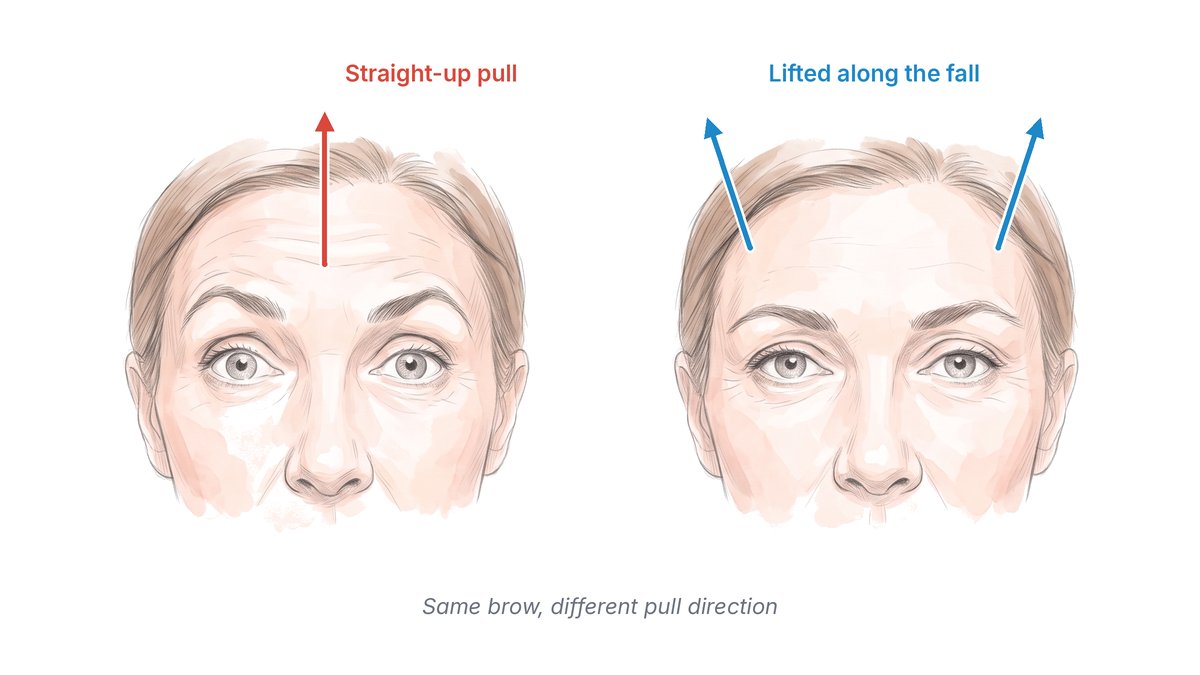
A brow lift surprised look is a brow lifted too high at its inner end, or with its arch peak moved toward the nose, so the face looks permanently startled or worried. It depends less on how many millimeters the brow rises than on where the lifted forehead is held and which direction it is pulled, which is why two lifts of the same height can look completely different.
Quick answers
- Why do some brow lifts look surprised? The inner brow was raised too much, or the arch peak ended up too far toward the nose. A review of brow aesthetics calls over-elevation the most frequent brow-lift mistake.
- Will a brow lift change my eyebrow shape? Yes, a little, always. The points that hold the forehead and the direction of pull decide which part of the brow rises most.
- My brows look too high after surgery. Will they drop? Often somewhat, mostly in the first 3 months: one series lost an average of 2 to 3 mm of the lift in that time.
- When is the shape final? It is judged at about 3 months and settles over 6 to 12 months.
- Is one brow higher than the other normal? Before surgery it is the rule: 93 percent of eyelid-surgery candidates in one study had at least 1 mm of brow or lid asymmetry.
- Can a brow lift be reversed? Partly. Toxin can lower a high segment for a few months; surgical lowering exists but is less predictable than lifting less in the first place.
- What about men and East Asian brows? A man’s brow should stay low and flat. East Asian brows often start closer to the lashes and are propped up by the forehead muscle, so both ends usually move a little.
Why Do Some Brow Lifts Give a Surprised Look?
Most surprised-looking brow lifts have one of three faults: the inner brow was raised, the whole brow was raised too far, or the highest point of the arch moved toward the nose. Each one pushes the brow toward the shape a face makes when it is startled or worried, when the forehead muscle pulls the inner and middle brow straight up.
A review of brow aesthetics names over-elevation as the most frequent mistake in brow lifts, a peak placed too far toward the nose as a second cause of the surprised look, and a low inner brow under a high outer peak as the recipe for an angry one. Surprise and anger are mirror errors. One lifts the head of the brow too much; the other lifts the tail alone.
A 2024 meta-analysis of endoscopic brow lifts examined postoperative photographs from its 12 studies and found the final peak of the brow toward the nose in 39 percent of 69 brows, central in 51 percent and toward the outer eye in only 10 percent.
A worried look is the same fault with a slant, the inner ends high and tilted toward the center. Either way the fix starts at planning, and planning starts with what actually sits low: the brow, the eyelid skin or the lid itself, sorted out in telling excess skin, ptosis and a low brow apart; the device or stitch that holds the forehead is compared in brow lift fixation: Endotine vs suture.
Key numbers
- Pooled long-term brow rise after endoscopic lifts: 3.25 mm at the inner brow, 3.86 mm centrally and 4.35 mm at the tail (12 studies, 478 cases).
- Final arch peak in published postoperative photos: toward the nose in 39 percent, central in 51 percent, toward the outer eye in 10 percent.
- Early settling: an average loss of 2 to 3 mm of the lift within the first 3 months in one series.
- Between year 1 and year 5 after a lift in the plane directly on the bone, the brow rose a further 1.9 to 2.5 mm in one study.
- Brow or lid asymmetry before eyelid surgery: at least 1 mm in 93 percent, 2 mm in 75 percent, 3 mm in 37 percent.
- Korean women’s preferred brow in one survey: arch height about equal to eye width, rising at about 10 degrees.
What Does a Natural Eyebrow Shape Look Like?
A natural female brow starts at about the level of the inner eye corner, rises gently to a peak over the outer part of the eye and ends at roughly the same height as it began. A natural male brow sits lower, close to the bony rim of the eye socket, with a flatter line and only a slight peak.
The classic model describes a head in line with the inner eye corner, a tail on the line from the nostril wing through the outer eye corner, both ends at about the same height, and a peak above the outer edge of the iris, with the female brow several millimeters above the rim and the male brow on it. Measured preferences place the peak a little further out. In a study of 40 adults, women placed the lower edge of their ideal brow just below the rim at the inner eye corner, at the rim over the pupil and several millimeters above it at the outer eye corner, and in both sexes the peak sat just inside the outer eye corner.
So the peak belongs between the outer edge of the iris and the outer eye corner, the exact point varying with the face. A peak that drifts inward, over the pupil or toward the nose, reads as surprise.

How do eyebrows change with age?
In many women the inner brow rises with age while the tail stays level or drops, the opposite of what most people expect. In photographs of women aged 20 to 30 and 50 to 60, measured from a line through the inner eye corners, the brow sat 15.7 mm above the inner eye corner in the younger group and 19.1 mm in the older group, and 19.8 versus 22.4 mm above the pupil. Above the outer eye corner the difference was small, 21.3 versus 22.4 mm. The older brow had flattened: its inner and middle parts had climbed toward the level of the tail.
A video study comparing 20 women in their 20s with 20 women aged 50 to 70 found the tail lower in the older group in all six facial actions tested, with less up-and-down movement at every point of the brow. Its authors point out that the outer segment of the brow has no forehead-muscle insertion to hold it up, and they advise focusing rejuvenation on the tail.
What is different about a man’s brow?
In men the brow sits lower, the tail is lower and the peak is softer. Men in the 40-adult study preferred a lower brow with a lower tail and a less accentuated peak, and the classic model places the male brow on the rim with only a slight arch. Raising a man’s brow, or giving it a clear peak, is one of the quickest ways to feminize the upper face, which is why a facelift planned for a man changes the brow little.
What eyebrow shape do Korean and East Asian women prefer?
In a survey of 300 Korean women aged 21 to 40, the favored brow had a peak whose height above the eye opening roughly equaled the width of the eye, a ratio of about 1:1, with the brow rising from its inner part at about 10 degrees. Women in their 20s measured close to that, at 1:1.01 and 12 degrees, and with age the arch became relatively lower and the angle steeper.
Among 76 viewers in an eye-tracking study, the peak looked most appealing above the outer eye corner in Asian faces and halfway between the outer iris and the outer eye corner in Caucasian faces. Preference belongs to the person, not to a nationality, but both studies describe a soft arch peaking well out toward the outer eye, the opposite of the surprised shape.
Will a Brow Lift Change My Eyebrow Shape?
Yes, every brow lift changes the shape a little, because the forehead does not rise as one rigid block. The part of the brow nearest the points that hold the forehead, and in line with the direction of pull, rises most, so the new arch is decided by choosing those points and that direction, not only by the number of millimeters.
Where the lifted forehead is held
In an endoscopic forehead lift the forehead is freed from the bone through short incisions in the hair, slid upward and held while it reattaches. What holds it is a separate question; for shape, what matters is where the holding points sit. A point near the midline lifts the inner and central brow. Points over the outer part of the brow, roughly in line with the outer iris and the outer eye corner, lift the peak and the tail.
Which direction it is pulled
A straight vertical pull raises the brow along the same line the forehead muscle uses when we look surprised. An upward and slightly outward pull, along the line the tail actually descended, raises the tail more than the head and keeps the peak toward the outer eye.
A technique designed to stop the tail falling back after an endoscopic lift starts from the same observation: its author lists relapse of the outer brow among the leading causes of dissatisfaction. In 29 of his patients followed for at least a year, mean brow rise ranged from 3.31 mm over the inner eye corner to 6.27 mm at the tail, and forehead height did not change significantly.

What the release frees, and what the frown muscles do
The release decides what is free to move. Freeing the tissue along the outer brow and temple lets the tail travel, while releasing the inner brow less limits how far the head can rise. The frown muscles between the brows, the corrugators and the procerus, pull the inner brows down and together, so weakening them lets the inner brows relax upward and apart. Done gently, this softens the frown; overdone, it can widen and raise the inner brow, the start of a surprised or blank look.
Time keeps shaping the brow after the release. One long-term study found that the brow kept rising between the first and fifth year after a lift in the plane directly on the bone, by 2.2 mm at the inner brow, 2.5 mm centrally and 1.9 mm at the tail, so an inner brow that is slightly high at one year can be higher still at five.
Lateral Brow Lift vs Full Forehead Lift: Which Keeps the Brow Shape Natural?
A lateral, or temporal, brow lift raises only the tail through short incisions in the temple hair and leaves the inner brow where it is, so it carries little risk of a surprised look. A full endoscopic forehead lift moves the whole brow and the frown area, suits a brow that has fallen along its whole length, and depends entirely on where and in which direction it is held for its shape.
Because the tail falls most with age and the inner brow often rises, many women over 50 need only the tail lifted. A whole-brow lift fits a brow that sits low from end to end, deep forehead lines from years of holding it up, or a heavy frown.
Lifting both ends can be done in a controlled way. In a Bangkok series of 100 patients and 200 brows, a whole-brow technique designed to shape both ends raised the median brow-to-outer-eye-corner distance from 21 to 28 mm and the brow-to-inner-eye-corner distance from 18 to 21 mm at six months, with no hematoma or forehead nerve palsy. The authors stress that the target was a shape for each face, not the largest possible lift.
Smaller options sit below both: a sub-brow excision of thick skin under the brow and a browpexy that steadies the tail through the eyelid incision, both compared in the droopy-eyelid guide linked above, and a toxin “brow lift”, whose peaked Spock brow is covered in droopy eyelid and brow after Botox.
At a Glance: Brow Procedures and What They Do to the Shape
| Option | What rises most | Inner brow | Risk of a surprised look | Scar | Typically suited to |
|---|---|---|---|---|---|
| Tail (temporal) lift | Tail and outer peak | Unchanged | Low; the tail can look sharp if overdone | Short incisions in the temple hair | Descent limited to the tail, inner brow already high |
| Endoscopic forehead lift | Whole brow, shaped by holding points and pull direction | Rises unless deliberately held back | Present with a vertical or central pull | Several short incisions in the hair | Whole-brow descent, deep forehead lines, a heavy frown |
| Sub-brow excision | Skin under the brow; the brow barely moves | Unchanged | Very low | Along the lower edge of the brow | Thick hooding skin under the brow |
| Browpexy | Steadies or slightly lifts the tail | Unchanged | Very low | In the eyelid crease | Mild tail descent during eyelid surgery |
| Toxin brow lift | Tail, slightly, for a few months | Can rise if the forehead is dosed unevenly | Possible, as a peaked tail | None | A small, temporary lift |
Asian Brow Lift: Why Do East Asian Brows Need a Different Plan?
East Asian brows often sit lower against the bony rim, closer to the lashes, to begin with, and many are held up by the forehead muscle to keep a heavy upper lid open. Raising such a brow a lot turns a short brow-to-lash distance into an unfamiliar, startled face, and lifting only the tail can look sharp or angry over an upward-tilting eye, so both ends usually move a little.
In a series of 518 Asian patients treated with eyelid surgery, an under-brow excision or a forehead lift, those who habitually used the forehead muscle to manage heavy lids showed marked changes between lid and brow after surgery, and treating the lid skin reduced forehead activity and unmasked a truly low brow. A meta-analysis found the same effect in numbers: the brow fell 0.67 mm after simple blepharoplasty, 2.10 mm after ptosis correction and 2.52 mm after double-eyelid surgery, and East Asian author groups reported a significantly larger fall.
So a brow seen in consultation may sit above where it actually rests, and a plan that ignores the muscle misjudges the lift. The Bangkok authors make the shape point directly: some techniques lift mainly the inner brow over time, giving a surprised look, while lifting only the tail may look angry in patients whose eyes naturally tilt upward.
Thick skin under the brow is the other East Asian pattern. When the weight lives there rather than in the brow, removing that skin directly is often the smaller and better operation, as explained in sub-brow lift versus upper blepharoplasty.

How Can a Surprised Look Be Avoided, and How Does Dr. Yongwoo Lee Plan a Brow Lift?
I decide the shape before the height: I mark where the peak should sit and how much of the brow, if any, should stay where it is, with the patient upright and the forehead completely relaxed. Then I place the holding points over the outer half of the brow and pull upward and slightly outward, so the tail rises most and the inner brow rises little or not at all.
Measuring with the forehead switched off
I perform endoscopic forehead lifts at the clinic, and when the heaviness lives in thick skin under the brow rather than in the brow itself, I use a sub-brow lift instead. Before marking, I ask the patient to close the eyes, let the forehead go slack and open the eyes gently without raising the brows. Where the brow sits then is its resting position, often lower than it looks during conversation.
I lift the brow with a fingertip to see how much of the apparent excess eyelid skin disappears, and I check the lid edge, because a low lid keeps the forehead working. If the eyelids also need surgery, I treat the brow first or in the same sitting; when the brow lift goes with a facelift, I operate on the eyelids the day before and remove upper-lid skin conservatively, allowing for the planned brow lift. I measure the difference between the two sides and show it in photographs, so an asymmetry that was always there is not discovered for the first time after surgery.
Choosing the peak
I place the planned peak in the zone between the outer iris and the outer eye corner, chosen for the face and erring outward. In a woman over 50 whose inner brow has already risen, I do not lift the inner brow further. In East Asian faces I lift both ends modestly, for the reasons above, and keep the arch soft.
Holding points and direction of pull
The holding points sit in the hair, not at the midline, and the pull follows the line the tail descended. I release the outer brow and temple fully so the tail can travel without strain. I weaken the frown muscles through the same small incisions conservatively, enough to soften the frown but not so much that the inner brows drift apart and up. I hold the forehead with a deep-tissue suture or with bone tunnels, depending on the case: mainly how thick and heavy the forehead is and, in a revision, how much firm tissue is left to grip. The holding method itself does not change these choices about position and direction.
How much higher than the target
Some early loss is expected as swelling settles and the tissue reattaches, so I set the tail slightly above where I want it to end up. I do not do the same at the inner brow, because published data show the inner brow can keep rising for years, and an inner brow that ends high is the one that looks surprised.
In men
In men I change the brow little and keep it flat, near the bony rim, with no new peak. When a man’s whole forehead has fallen, the plan brings the brow back to the rim, not above it.
My Eyebrows Look Too High After a Brow Lift. Will They Drop, and When?
Usually somewhat, and more in the first 3 months than later. Swelling, the deliberate extra height at the tail and early settling of the tissue all add height in the first weeks, and one series reported an average loss of 2 to 3 mm of the lift within the first 3 months.
Swelling settles over about 7 to 10 days, the forehead feels tight for a week or two, and hairline stitches or staples come out at about day 7 to 10, which travelers plan around as set out in how long to stay in Korea after surgery. Most of the visible drop happens by month 3, when the shape is judged, and settling continues for 6 to 12 months.

Over the long term, each part of the brow behaves differently. Pooled across 12 studies and 478 cases, the brow held about 3.25 mm higher at the inner end, 3.86 mm centrally and 4.35 mm at the tail. Most of the included studies reported some recurrence, mainly at the tail. In a 31-patient series followed for a mean of 5.4 years, the tail ended only 0.7 mm higher than before surgery, while another study found the whole brow still rising at year 5.
A brow that looks high at week 2 often looks right at month 3; one still surprised at month 3, especially at its inner end, is less likely to settle much further.

Why Is One Eyebrow Higher Than the Other After a Brow Lift?
Most often because it was before, at least in part. Brows are rarely symmetrical, and uneven swelling, sleeping on one side and uneven early settling add to that difference in the first weeks.
In 100 consecutive patients assessed for upper eyelid surgery, 93 percent had at least 1 mm of asymmetry in brow or lid position, 75 percent at least 2 mm and 37 percent at least 3 mm, and the two brows differed by an average of 1.34 to 1.78 mm depending on the point measured. A heavier lid on one side also makes the forehead muscle lift that brow harder, so correcting a lid can bring that brow down afterward.
What gets corrected, and when, follows the healing curve. In the first 3 months the answer is usually patience. After that, a small toxin dose can balance a mild remaining difference for a few months. A surgical touch-up is considered only once the position has been stable for a while, usually at 6 months or later.
A brow that cannot be raised at all after surgery is a different problem: possible weakness of the forehead nerve, which should be reported to your surgeon rather than put down to swelling. How that nerve usually recovers is explained in facial nerve injury after facial surgery.
Can a Brow Lift Be Reversed or Lowered?
Partly. In an overdone brow lift, toxin in the forehead muscle above a high segment can lower it slightly for a few months while the lift settles, and surgical lowering exists, but a 2024 meta-analysis points to the challenge of correcting overly elevated inner brows, which can need a reversal operation, so prevention is far more reliable than reversal.
Waiting. Up to about 3 months, much of what looks too high is still settling.
Toxin. A high inner brow is often held there partly by the forehead muscle, and relaxing the inner part of that muscle lowers it a little. The dose has to be placed carefully, because relaxing the whole forehead in someone who uses it to keep heavy lids open can make the lids feel heavy.
Revision surgery. Re-releasing the forehead and setting it lower is possible, but scar from the first operation and the position of the hairline limit how far and how precisely it moves. It is not done before the result has settled, usually 6 months or more.
Hardest of all is an inner brow taken high after aggressive removal of the frown muscles, because the tissue that pulled it down is gone.
Surgeon’s Insight: I Lift the Brow Where It Fell, Not Where It Is Easiest to Pull
Most brows that come to me for a lift did not fall evenly. The tail fell, the inner end often rose, and the forehead has been working to hold the rest up. If I pull the whole forehead straight up, I add height to the part that never fell, and the face looks surprised.
So the lift follows the fall, not the easiest pull. I would rather a brow be a millimeter too low than a millimeter too startled, because low can be added to and startled is hard to take back.
What Are the Risks of a Brow Lift Besides a Surprised Look?
Beyond the surprised look, the shape problems after a brow lift are a sharp or angry tail, a tail that falls back, asymmetry and inner brows that drift apart. The other risks are scalp numbness, temporary hair loss at the incisions, a stitch that works its way out and, rarely, weakness of the forehead nerve.
- An angry or sharp tail. A tail lifted alone and too far, especially over an upward-tilting eye.
- Tail relapse. The tail settling back toward where it started, a leading complaint in the tail-suspension series described above.
- Inner brows drifting apart and up after aggressive removal of the frown muscles.
- Asymmetry, partly pre-existing and partly from uneven healing.
- Numbness and tightness behind the incisions, usually fading over the following months.
- Suture and scalp problems. In one series of 118 lifts, a stitch worked its way out at the front scalp incisions in 6.8 percent and temporary hair loss around the incisions occurred in 5.1 percent.
- Forehead nerve weakness, uncommon (none in the Bangkok series above); what to do about it is covered under uneven brows.
- Eyes that feel dry or close less well when a brow lift is combined with upper eyelid surgery, which is why lid closure and dry eye are checked first; see blepharoplasty complications.
What Should I Ask Before a Brow Lift So My Brows Still Look Like Mine?
Ask where the peak of each brow will sit, which part of the brow will rise most and which will stay, and in which direction the forehead will be pulled. A plan stated in those terms, made with your forehead relaxed and your existing asymmetry measured, is a plan for your brow rather than a number of millimeters.
Then ask how high the brows will look at two weeks and at three months. A natural result, in the sense explained in what natural means in plastic surgery, looks like your own brow from some years ago, not like a brow that has been raised.
Individual results vary; consultation required.
Written by Dr. Yongwoo Lee, board-certified Korean plastic surgery specialist in facial anatomy and aesthetic procedures at VIP Plastic Surgery, South Korea.
Frequently Asked Questions About Brow Lift Shape and the Surprised Look
Will a brow lift make me look surprised?
It should not, if the inner brow stays largely where it is and the peak stays toward the outer eye. The surprised look comes from lifting the inner brow, lifting too far, or moving the peak toward the nose.
How long does the surprised look last after a brow lift?
Part of it settles: one series lost an average of 2 to 3 mm in the first 3 months. Whatever surprise remains at 3 months, especially at the inner end, tends to stay.
Will my eyebrows drop after a brow lift?
Somewhat, mostly at the tail. Pooled data show long-term brows still about 3 to 4 mm higher than before surgery, but one series followed for a mean of 5.4 years found the tail only 0.7 mm higher, while the inner brow tends to hold or even rise.
Can a brow lift change the arch of my eyebrows?
Yes. The points that hold the forehead and the direction of pull decide which part of the brow rises most, so the arch can be raised at the tail, flattened, or, if done poorly, pushed toward the nose.
Where should the peak of the eyebrow be?
Usually between the outer edge of the iris and the outer eye corner. Classic models place it above the outer iris; measured preferences put it just inside the outer eye corner.
Is a lateral brow lift better than a full forehead lift?
Neither is better overall. A lateral lift raises only the tail and suits a fallen tail with an inner brow in place; a full endoscopic lift suits a brow low along its whole length, with a carefully directed pull.
Is it normal for one eyebrow to be higher after a brow lift?
A small difference is common, partly because almost everyone has one before surgery: in one study 93 percent of patients had at least 1 mm of brow or lid asymmetry. Most early differences are judged after about 3 months.
Can a brow lift be reversed?
Partly. Toxin can lower a high segment for a few months and revision can reset the forehead lower after about 6 months, but an over-elevated inner brow is difficult to correct.
Can Botox fix eyebrows that are too high after a brow lift?
It can lower a high segment slightly for a few months by relaxing the forehead muscle above it. Relaxing the whole forehead can leave the eyelids heavy.
Can a man have a brow lift without looking feminine?
Yes, if the brow is kept low and flat, near the bony rim, with no new peak. Raising a man’s brow or arching it is what feminizes the upper face.
Is a brow lift different for East Asian faces?
East Asian brows often start closer to the lashes and are held up by the forehead muscle, so they are measured with the forehead relaxed and both ends are usually lifted modestly.
Should a brow lift be done before eyelid surgery?
The brow is usually set first or in the same operation, because lifting it changes how much eyelid skin is truly in excess. Removing eyelid skin first and lifting the brow later can leave too little lid skin.
Does a brow lift make the forehead look longer?
It can, because the hairline moves with the scalp, but in one series of 29 patients followed a year or more, forehead height did not change significantly.
Why can’t I raise my eyebrows after a brow lift?
The forehead feels tight for a week or two, but a brow that cannot be raised at all is a different matter: it may mean weakness of the forehead nerve and should be reported to your surgeon. None was seen in the 200 brows of one Bangkok series.
Does a brow lift keep its shape over the years?
Largely: pooled data show the brow about 3 to 4 mm higher at long-term follow-up, though most studies report some settling at the tail over the years, and the face keeps aging.
Can a brow lift raise just the tail of my eyebrow?
Yes. A lateral, or temporal, lift raises the tail and outer peak and leaves the inner brow in place, which suits the common pattern of a fallen tail with an inner brow that has already risen.
This article is for informational purposes only and does not constitute medical advice. Always consult with a qualified medical professional before making any decisions about surgical or non-surgical procedures.
