
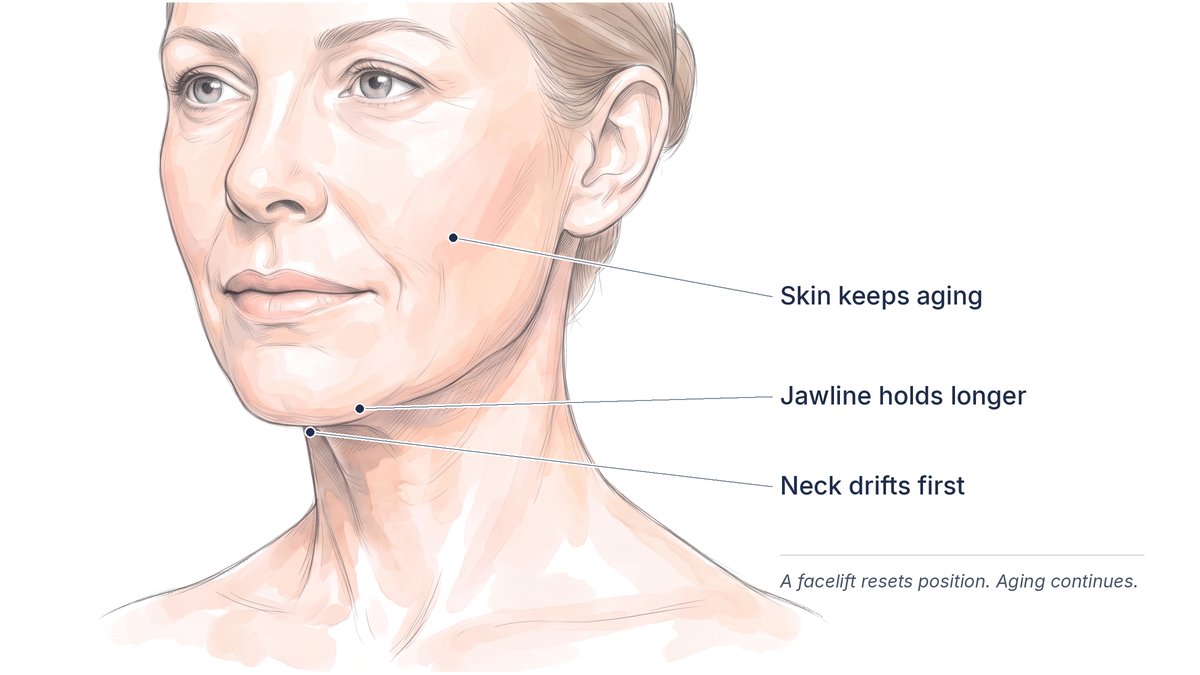
How long does a facelift last? It does not come with an expiry date. A facelift moves the deep tissue of the face and neck back up and fixes it there, and the face then goes on aging from the new position. The useful question is how far ahead of your un-operated self the operation puts you, and for how long.
Quick answers
- How long does a facelift last? No study gives one number. In one series 76 percent still looked younger at 5.5 years; in a survey, 68.5 percent still rated their result very good or better at 12.6 years.
- When do people have a second facelift? Among patients who returned for one in a 30-year deep plane practice, the mean interval was 10.9 years. That counts only patients who came back.
- Which part loosens first? The neck. At 5.5 years the jowl had lost 21 percent of its correction and the chin-neck angle 69 percent.
- What does Dr. Yongwoo Lee tell patients? Aging continues, and the difference from the un-operated face usually lasts 7 to 10 years or more, with no promise of a number.
How Long Does a Facelift Last?
A facelift has no fixed lifespan: the face keeps aging, and in Dr. Yongwoo Lee’s practice the difference from the un-operated face usually lasts 7 to 10 years or more, a clinical expectation rather than a measured figure. The published data bracket the answer instead of dating it. In one surgeon’s series, 76 percent of 50 patients still looked younger a mean of 5.5 years after a facelift than before it, and in a survey of another surgeon’s patients, 68.5 percent of 89 respondents still rated their improvement very good or beyond expectations at a mean of 12.6 years.
The common mistake is to treat the answer as a countdown: ten years, then the face falls back to where it started. No follow-up study describes that. What the studies show is a face that was reset and kept aging at its own pace, older at year twelve than at year one and still ahead of where it would have been.
Does a Facelift Wear Off, or Do You Just Keep Aging?
You keep aging; the lift does not come undone all at once. Two clocks run after a facelift: the repair, which is deep tissue held in a new position, and the face around it, which keeps changing in bone, fat and skin. What patients call “wearing off” is mostly the second clock.
The authors of the 5.5-year study put it plainly: “There is no significant objective or subjective sign of continued aging or ‘relapse’ in any area except for the neck.” In a small follow-up analysis of the 12.6-year survey group, patients over 60 at surgery showed regression in the graded facial areas at least a decade later, yet still looked younger than age-matched peers; the photographic comparison covered two patients per age group.
A facelift is also often described as turning the clock back ten years. In one study, 50 blinded raters guessed the ages of 49 patients from photographs taken at least six months after aging-face surgery and judged them a mean of 3.1 years younger than their true age, ranging from 4.0 years older to 9.4 years younger, and attractiveness scores did not change significantly. That figure compares the operated face with the calendar, not with the same face before surgery, so it does not measure years turned back. Patients’ own sense is larger: in the 12.6-year survey, 68.5 percent felt that ten or more years had been added to their youthful appearance. Neither number is a measured before-and-after change in apparent age.
Why Does the Face Keep Aging After a Facelift?
A facelift repositions soft tissue; it does not stop the processes that moved the tissue in the first place. Bone goes on resorbing, fat compartments change independently and skin keeps aging with sun and time, so the face ages forward from its new position.

Bone and fat. The upper jaw ages mainly by bone resorption, which CT shows, and facial fat sits in separate compartments that change independently. A lift moves descended fat back up; it neither rebuilds bone nor refills a compartment that has emptied, a separate decision covered in facial fat transfer versus filler.
Ligaments and the SMAS. Retaining ligaments sit in constant anatomic locations, where they separate the facial spaces and compartments, and surgically they matter because they can be released. The SMAS is the fibrous layer that encloses the superficial facial muscles, with the facial nerve branches running beneath it; a facelift carries it upward and stitches it in place, and in the neck it continues as the platysma, a thin sheet of muscle. Of all the layers, this is the one where the surgeon’s work is built to hold.
Skin. Among 186 pairs of identical twins, the twin who had smoked longer looked older, and so did the twin with more sun exposure. Twins share genes, so the difference points to exposure rather than inheritance.
Each layer, decade by decade, is covered in what actually ages in the face at 40, 50, 60 and 70.
What Do the Long-Term Facelift Studies Actually Show?
Three kinds of long-term study exist, and each answers a different question: measured change at five years, satisfaction past twelve, and time to a second lift over thirty. None is a randomized trial and each comes from one surgeon or practice, so every figure describes only the patients who could be followed.
At a Glance: What Each Long-Term Facelift Study Measured
| Study | Patients | Follow-up | Finding | Main limit |
|---|---|---|---|---|
| Landmark measurements (Jones and Lo, 2012) | 50, one surgeon | Mean 5.5 years | Jowl relapse 21 percent, chin-neck angle relapse 69 percent; 76 percent still looked younger | Only patients who happened to return |
| Satisfaction survey (Friel and colleagues, 2010) | 89 of 394 SMAS-platysma lifts | Mean 12.6 years | Very good or better: 97.8 percent at 1 year, 68.5 percent at 12.6 years | 305 of 394 not heard from |
| Time to revision (Levin and Frankel, 2026) | 93 revision lifts, deep plane | 30 years of records | Mean 10.9 years to a second lift | Counts only patients who came back |
Five years, measured. On standardized photographs, jowl height had been raised 6 mm and had lost 21 percent of that; the chin-neck angle had improved 13 degrees and had lost 69 percent. By the surgeon’s own account the 50 patients were drawn from more than 1,700 deep plane facelifts done between 2001 and 2011, people who came back for an unrelated reason, an honest statement of selection bias.
Twelve years, remembered. In the survey of one surgeon’s SMAS-platysma facelifts from 1994 to 1999, 87 of 89 respondents rated their one-year improvement very good or beyond expectations; at a mean of 12.6 years, 61 still did. Pleased patients may be more willing to answer, so the figure for all 394 is unknown.
Thirty years, counted. A 2026 chart review of one surgeon’s deep plane practice found a mean of 10.9 years between a first and a second facelift: 77 patients had a second lift, 14 a third and 2 a fourth, at mean ages of 53.5 for the first and 64.5 for the second. It does not say a facelift lasts 10.9 years. It says that patients who chose a second lift waited that long on average, with a standard deviation of 5.1 years, and it cannot say how many never wanted one.
Why Does the Neck Loosen Before the Jawline After a Facelift?
The neck drifts back first in the studies that measure it separately, and how long it holds depends largely on what was done to the platysma, the thin muscle sheet of the neck, not only on how much skin was removed. At 5.5 years the jowl had lost 21 percent of its correction and the chin-neck angle 69 percent, although the neck was still better than before surgery.

Other findings agree. In four sets of identical twins and one set of triplets given a full-incision or a short-scar facelift, eight surgeons graded the results alike at about one year and significantly different at about five, only in the neck, where the full incision scored higher. In a 25-year practice review, patients with fuller necks relapsed more, and opening the neck to treat the platysmal bands in the midline reduced recurrence. And platysmal bands have been reported to recur in more than one-third of cases even after the muscle was completely divided.
One surgeon who divides the muscle completely reported no band recurrence at five years in 80 patients, with blinded photo scoring but no control group. I do not use that technique; I join the two edges of the muscle in the midline, as described below. One uncontrolled series settles nothing, but it points the same way.
What a shorter operation leaves out of the neck is covered in mini facelift versus full facelift.
Does a Deep Plane Facelift Last Longer Than a SMAS Facelift?
No long-term head-to-head study has shown that either one lasts longer. A SMAS facelift raises the skin off the SMAS and tightens that fibrous layer from its surface, by folding or trimming it; a deep plane facelift goes beneath it and releases the retaining ligaments.
- In eight sets of identical twins given one of four SMAS-based techniques, no one technique produced a superior result.
- Two sets of identical twins were operated on by four surgeons with four techniques, from a lateral SMASectomy to a composite lift of the deep plane family. They were photographed at 1, 6 and 10 years, and the published abstract names no winner.
- In 21 patients given a different technique on each side of the face, the deeper dissections corrected more on the operating table, the sides looked alike by 24 hours, and no difference was detectable at 6 and 12 months.
What deep plane surgery does have is short-term measurement of what it moves: a midface volume gain of 3.2 mL per side at one year or more and a jawline lengthened from 7.1 to 9.8 cm at 19 months, both from one surgeon’s group, over one to two years, not ten.
In my experience a deep plane result lasts longer, and the reason I expect it is anatomical: releasing the retaining ligaments lets tissue move without loading the skin, as explained in deep plane versus SMAS facelifts. That is clinical experience, not proof. Long-term comparative studies have not yet shown a difference, and I would rather say so than borrow a claim the data do not make.
Does a Facelift Last Longer If You Have It Younger?
A facelift done at a younger age appears to last longer in the available data, with real limits. In the 30-year revision series, patients whose first lift was at 53 or younger returned after a mean of 12.4 years, against 9.3 years for older patients, a statistically significant difference.
In the 12.6-year survey group, patients under 50 at surgery rated every graded facial area 4 or 5 out of 5 at long-term follow-up and those over 60 rated them 2 or 3. The 25-year review also found that younger patients with fuller faces held better.
None of this proves that operating early causes a longer result. A patient whose first lift is at 48 has more years in which to return than one first operated at 68, and the series counted only those who returned. Age is a reason not to fear an early operation when the anatomy calls for one, not a reason to lift a face that has nothing yet to move.
How Does Dr. Yongwoo Lee Build a Facelift to Hold?
I perform deep plane facelifts with a superolateral vector, meaning upward and outward, usually with a neck lift through a small incision under the chin, and I fix the lifted deep layer with permanent stitches to fascia that does not move.
Release, then anchor
I release the zygomatic and masseteric retaining ligaments and move skin, fat and SMAS as one unit, so the hold sits in the deep layer and the skin is closed without tension. Skin stretches under load, and a result that hangs on skin loosens as soon as the skin does.
- In front of and above the ear. Permanent stitches fix the lifted SMAS to the deep temporal fascia at the temple and to Loré’s fascia, the dense fascia just in front of the ear.
- Behind the ear. Permanent stitches anchor the platysma to the mastoid fascia, over the bone behind the ear.
The neck, where drift shows first
Through the incision under the chin I first deal with what lies beneath the platysma: its fat, part of a bulging digastric muscle and part of a sagging submandibular gland. Then I sew the two inner edges of the muscle together down the midline and tie that seam to the fascia over the hyoid bone, the small bone at the corner between chin and neck, so that it works with the side pull to the mastoid fascia as one repair; each step is shown in the neck lift for platysmal bands.

That hyoid anchor is there to help keep the neck from loosening over time. It does not make a neck permanent, and I do not tell patients it does.
Volume, and the conditions I set
A lift repositions; it does not refill, so my facelifts usually include fat grafting under the same anesthetic. Eyelid surgery, when planned, is done the day before; why that order sets the eyelid height more accurately is explained in combining a facelift, eyelid surgery and fat grafting in one trip.
No nicotine in any form, whether cigarettes, vapes, patches or gum, is allowed for four weeks before and four weeks after surgery, and a patient who cannot stop has the operation postponed, for reasons given in whether a smoker can have a facelift. After weight loss on a GLP-1 medicine I wait until weight has held within about 2 kg for six months, because a face still losing volume keeps changing under the lift. The medicine itself is paused one month before surgery, because it slows stomach emptying, a risk under anesthesia, and restarted 1 to 2 weeks afterward; both steps are agreed with the doctor who prescribes it, never done on your own.
What I tell patients about years
Aging continues; 7 to 10 years or more is an expectation, and I attach no guarantee to it. My maintenance advice is short: stable weight, no smoking, sun protection. If something loosens later, the default is a small touch-up: re-tightening the neck or jawline, fat grafting or an energy-based treatment, as needed. A second full operation is rare.
Which Facelift Patient Are You, and What Does That Mean for How Long It Lasts?
How long a result lasts depends more on the face and its habits than on the calendar. These profiles are illustrative, not real patients, and they describe expectations, not promises.
48, early jowls, a full face, never smoked. She matches the group with the better long-term results: under 50 at surgery, with fuller facial volume.
64, a heavy neck with cords at rest. Expect the lower face to hold better than the neck. Fuller necks relapsed more in the 25-year review, so the plan should spell out how the platysma is repaired and anchored.
57, still losing weight on a GLP-1 medicine. Not yet. The lift belongs to the face that exists once weight has held for six months.
66, nine years after a first facelift, jowl returning. An ordinary moment to be examined: in the 30-year series, patients who returned did so at a mean age of 64.5. Examination decides between a small touch-up and a second lift.
When Should You Start Counting How Long a Facelift Lasts?
A facelift reaches its final result at 6 to 12 months, and that settled face, not the swollen one, is the baseline the following years are measured against.
The operation is done under general anesthesia given by a board-certified anesthesiologist, patients stay one night, and the stitches and staples are out by about two weeks; every date in between is set out in the facelift recovery timeline, week by week.
Early swelling fills and smooths the face, so some softening as it clears over the first months is the face arriving at its result, not leaving it. Small asymmetries seen at three months are judged again later, because any question of revision waits at least six months.
Surgeon’s Insight: Compare Yourself With the Face You Would Have Had
Patients ask me how many years they are buying, and I think the question measures the wrong thing. A facelift is not a coating that wears through. I move the deep layer of the face and neck back up and stitch it to fascia that stays where it is, and from that day the face ages again, from higher ground.
So the comparison I ask for is not with your face one year after surgery. It is with the face you would have had without it. That gap usually stays visible for 7 to 10 years or more and closes first in the neck, which is why so much of my operation happens there. What I cannot stitch is yours to manage: weight, nicotine and the sun.
What Shortens a Facelift Result, and What Are the Risks of Chasing a Longer One?
Smoking, sun and large changes in weight are the factors most clearly linked to faster facial aging, and the main risk in chasing a longer result is tightening more instead of anchoring better.
Smoking and sun. In the identical-twin study, longer smoking was linked to an older appearance, and so was greater sun exposure, increasingly with age; both links were statistically significant.
Weight. Among those twins, a body mass index 4 points higher was linked to looking older under 40 and younger over 40. Major weight loss after a facelift can empty a face that was lifted full.
Skin. In the 25-year review, skin resurfacing and topical retinoids were reported to improve long-term results. That is expert observation, not a trial.
Tension is not durability. A lift pulled tighter does not last longer; it looks pulled sooner. A second operation works through scar with less spare skin, and it carries at least the same surgical risks as the first: bleeding under the skin in the first day, weakness of a facial nerve branch (usually temporary), and skin healing problems.
What to watch for. Gradual softening of the jawline and neck over years is aging. A sudden or one-sided change, a new lump or weak facial movement should be examined. Swelling or pain that grows quickly, especially on one side, in the first days after a facelift is a reason to call your surgeon at once, day or night. Swelling of the neck with difficulty breathing or swallowing, sudden breathlessness, chest pain, or a swollen, painful calf is an emergency: call emergency services or go to the nearest emergency department first, then contact your surgeon. Sudden blurred or lost vision, eye pain, or weakness, numbness or slurred speech after a facelift with fat grafting is also an emergency: call emergency services first. A patch of skin that turns dark or purple, a fever, or redness that spreads should be reported to your surgeon the same day.
What Should You Ask Instead of How Many Years It Will Last?
Ask which layers the operation will move, what they will be anchored to, and what will keep aging afterward. A surgeon who can answer those three questions for your face is describing a result; a number of years on its own describes nothing.
Then ask about the neck, where the data show the first drift: what is done beneath the muscle, how its edges are joined, and where the pull is fixed. And ask what happens if something loosens at year eight: a small correction, or the whole operation again.
Individual results vary; consultation required.
Written by Dr. Yongwoo Lee, board-certified Korean plastic surgery specialist in facial anatomy and aesthetic procedures at VIP Plastic Surgery, South Korea.
Frequently Asked Questions About How Long a Facelift Lasts
Is a facelift permanent?
Not in the sense of stopping time. Dr. Yongwoo Lee fixes the lifted deep layer with permanent stitches to fascia that does not move, but bone, fat and skin keep aging around it, so the face ages forward from its new position. In one series, 76 percent of patients still looked younger a mean of 5.5 years after surgery than before it.
Does a tighter facelift last longer?
No. A lift pulled tighter does not last longer; it looks pulled sooner, because skin stretches under load. Dr. Yongwoo Lee places the hold in the deep layer, anchored with permanent stitches to fascia, and closes the skin without tension.
Why does my face look less lifted a few months after a facelift?
Usually because the early swelling is clearing. Swelling fills and smooths the face at first, so some softening over the first months is the face arriving at its result, not losing it; the final result takes 6 to 12 months. Small asymmetries seen at three months are judged again later, and any question of revision waits at least six months.
What is the average time between a first and a second facelift?
Among patients who returned in a 30-year deep plane practice, the mean interval was 10.9 years, with a standard deviation of 5.1 years, and the mean age at the second lift was 64.5. Not everyone has one, and the study cannot show how many never wanted one.
What does a facelift look like 10 years later?
Older than at one year, and usually still better than before surgery. In a survey at a mean of 12.6 years, 68.5 percent of respondents still rated their improvement very good or better, down from 97.8 percent at one year.
What can be done if my jawline or neck loosens years after a facelift?
In Dr. Yongwoo Lee’s practice the default is a small touch-up, chosen on examination: re-tightening the neck or jawline, fat grafting or an energy-based treatment. A second full operation is rare, and any revision is considered no sooner than six months after the previous operation.
Does a short-scar facelift hold the neck as long as a full-incision facelift?
The closest comparison is a study of identical twins and triplets given a short-scar or a full-incision lift. Graders saw no difference at about one year. At about five years the two differed significantly in the neck only, and the full incision scored higher.
Does weight loss or Ozempic after a facelift ruin the result?
It does not undo the repair, but large weight loss removes facial volume, and in a study of identical twins a higher body mass index was linked to looking younger after 40. Stable weight is one of Dr. Yongwoo Lee’s three maintenance rules after a facelift, and a patient still losing weight on a GLP-1 medicine is operated on only once weight has held within about 2 kg for six months.
How can I make my facelift last longer?
Keep your weight stable, do not smoke and protect your skin from the sun; those are Dr. Yongwoo Lee’s three rules. In 186 pairs of identical twins, the twin who smoked longer or had more sun exposure looked older.
How many years younger does a facelift make you look?
The study most often quoted does not answer it directly. When 50 blinded raters guessed the ages of 49 patients at least six months after aging-face surgery, they judged them a mean of 3.1 years younger than their true age, a comparison with the calendar rather than with the face before surgery. Patients report more: in one long-term survey, 68.5 percent felt ten or more years had been added to their youthful appearance.
Will I still look younger than people my age years after a facelift?
In the little data there is, yes. In a follow-up of the 12.6-year survey group, patients over 60 at surgery showed regression at least a decade later yet still looked younger than age-matched peers; the photographic comparison covered only two patients per age group.
Can you have a facelift two or three times?
Yes. In one 30-year deep plane practice, 77 patients had a second facelift, 14 a third and 2 a fourth. A repeat operation works through scar and has less spare skin, and Dr. Yongwoo Lee considers any revision no sooner than six months after the previous operation.
Do facelifts last as long in men as in women?
Few men are studied; only 4 of 77 patients in the 30-year revision series were men. A 25-year practice review of 1,089 facial surgery patients reported similar results and revision rates in men and women.
This article is for informational purposes only and does not constitute medical advice. Always consult with a qualified medical professional before making any decisions about surgical or non-surgical procedures.
