
Should I Get Botox or a Neck Lift for My Neck Bands?
Botox treats platysmal neck bands that come from active muscle pull, and a neck lift treats bands that come from a loose, separated muscle with loose skin and fat around it. The common mistake is to choose by downtime instead of by the kind of band. Toxin in a lax neck relaxes a muscle that was never the whole problem, and a neck lift in a firm neck whose cords appear only when talking is more operation than that neck needs.
Platysmal bands are the vertical cords down the front of the neck, the inner edges of the platysma, a thin muscle sheet just under the skin. Since October 2024 a fixed dose of BOTOX Cosmetic has carried a US approval for them, and its trial numbers make the comparison with surgery more honest.
Are My Neck Bands Dynamic or Static, and Why Does It Matter?
Dynamic platysmal bands appear only when the neck muscle contracts; static bands are visible with the neck at rest. That difference, plus what else is loose around the bands, decides the treatment: dynamic bands in firm skin are a muscle-pull problem toxin can reach, and static bands in loose skin or over deep fullness are a structural problem it cannot.
A layered review of neck lift technique sorts bands as static, dynamic or both, and traces them to age-related laxity of the platysma and the retaining ligaments of the neck. A 2023 study of 55 cadaver heads adds that true static bands result from the resting tone of the platysma together with laxity of the surrounding fascia, not simply from a muscle that is squeezing.
The oldest large toxin series agrees. In 1,500 patients treated across three practices, the degree of muscle flaccidity and hypertrophy most influenced success. A thick, active band in a firm neck tends to respond; a thin band in a slack neck tends to disappoint.
Two mirror checks start the sorting: grimace or say a forced “E” and watch whether cords leap forward, then pinch the skin under the jaw and see whether it snaps back. More bedside checks are in neck liposuction versus a neck lift.
Why Do Platysmal Bands Form?
Platysmal bands form when the inner edges of the platysma loosen, separate and come forward under the skin, and in some necks the muscle also shortens and holds more tone at rest. How the two muscle sheets meet under the chin, and how much fat cushions them, decides how visible the edges become.
A 2025 expert review, written with manufacturer involvement, calls the cause multifactorial: the muscle’s attachment along the jaw loosens with age, the muscle can thin yet stay short and tense, the two sheets drift apart in the midline, and as the fat under the skin thins the edges show with speech or swallowing.
Anatomy sets the stage. In the de Castro classification summarized in that review, the sheets interlace for 1 to 2 cm below the chin and then separate in about 75 percent of people (Type I), interlace all the way to the thyroid cartilage in about 15 percent (Type II), and do not interlace at all in about 10 percent (Type III). In Types I and III, the gap between the free inner edges lets fat beneath the muscle push forward.

Fat hides or reveals the edges. In 11 fresh cadaver necks, about 45 percent of the fat and gland weight in the front of the neck lay above the platysma, about 31 percent beneath it, and the submandibular glands made up about a quarter. Remove only the layer above the muscle and the cords lose their cushion: in 301 patients after chin liposuction, new bands were linked to submental obesity and to platysma edges that did not cross in the midline.
The platysma is also continuous with the SMAS, the fibrous layer over the facial muscles, so bands and a blurred jawline often travel together, as set out in how deep plane and SMAS facelifts differ.
What Did the FDA Approve for Neck Bands in 2024, and at What Dose?
On October 18, 2024, AbbVie announced FDA approval of BOTOX Cosmetic for moderate to severe vertical bands connecting the jaw and neck, which the company described as the first FDA approval for this use. Its dose is fixed: 16 units along the jawline plus 10, 15 or 20 units on the bands, a total of 26, 31 or 36 units.
The US prescribing information words the indication as “temporary improvement in the appearance of moderate to severe platysma bands associated with platysma muscle activity” in adults. That phrase matters: the label targets muscle activity, not loose skin.
| Bands treated | Injection sites | Total dose |
|---|---|---|
| One band on each side | 18 | 26 units (0.65 mL) |
| One band on one side, two on the other | 23 | 31 units (0.78 mL) |
| Two bands on each side | 28 | 36 units (0.9 mL) |
Every protocol starts with a jawline row of 2 units at each of 4 sites per side; each band then receives 1 unit at each of 5 sites. The dosing instructions place the jawline row 1 to 2 cm below and parallel to the jaw border, from a point in line with the corner of the mouth back to just in front of the jaw angle. Band sites run 1 to 2 cm apart down the cord, injected superficially into the muscle. One boundary is explicit: do not inject into structures deep to the platysma, particularly in the front of the neck.

That jawline row resembles the older Nefertiti lift, whose 2007 report of 130 women had no placebo group.
What the two trials showed
The approval rests on two randomized, double-blind, placebo-controlled phase 3 trials with 834 adults, 408 on toxin and 426 on placebo; the second trial alone enrolled 426 people. Its main target was strict: at day 14, with the neck fully contracted, both investigator and patient had to rate the bands minimal or mild and see at least a two-grade improvement. It was met by 32 percent against 2 percent on placebo in one trial, and 31 percent against 0 percent in the other.
The first trial, 408 people at 30 sites in the US and Canada, adds softer measures: investigators rated 56.9 percent of treated patients minimal or mild at day 14 against 5.8 percent on placebo, about 80 percent improved by at least one grade against 19 to 23 percent, and 65.9 percent were satisfied against 11.1 percent. Over visits at days 30, 60, 90 and 120, the effect gradually declined.

Note the population: 94.1 percent of participants were women, 89.7 percent were White, and the manufacturer sponsored the trial. The approval is also American and names one product. Its trial results and 26 to 36 unit doses apply only to BOTOX Cosmetic; other toxins, including Korean products, are off-label for neck bands, and the label says its units cannot be converted into any other toxin’s. It is fair to ask which product is being injected.
What Can Botox Do for Neck Bands, and What Can It Not Do?
Botox can soften bands that come from active muscle pull, for about three to four months per treatment and without an incision. It cannot tighten loose skin, remove fat above or beneath the muscle, lift a sagging submandibular gland or close the gap between separated muscle edges, because none of those is a contracting muscle.
An editorial on maximal dosing gives onset at about 48 hours and an average duration of three to four months. Neck treatment becomes a recurring appointment, and its units count toward the same total as forehead, jaw or skin injections, as explained in why Botox can stop working.
The layered review is direct about the limit: toxin treats dynamic bands, but a neck lift is needed for long-term correction of platysma laxity. Toxin weakens muscle; it does not move tissue. The jawline row can help a jaw edge pulled down by the platysma but cannot lift jowl fat that has already slid, a distinction drawn in treatment options for jowls.
More units are not the answer. Before the approval, the 1,500-patient 1999 series used 30 to 100 units per session and up to 250 for severe bands. Other reports described difficulty swallowing and neck-flexor weakness above 75 units, and one patient needed tube feeding for six weeks after only 60 units. The 2025 expert review keeps the session under 50 units. A band that does not respond to a standard dose is usually a band toxin is not the right tool for.
What Does a Neck Lift Do to the Platysma?
A neck lift treats bands by repairing the muscle: the separated inner edges are sewn together in the midline, the outer edge is pulled up and back toward the ear, and in some techniques the muscle is partly or fully divided low in the neck. It can also remove the deep fullness no injection reaches.
Midline plication. The original corset platysmaplasty report joined the inner edges with a continuous suture down the length of the neck, a flat seam with no free edges, and added sutures under the jaw that pleated and corrected a visible gland bulge; it described 75 patients, most followed for one to three years.
Lateral suspension. Here the free outer edge is pulled up and back and stitched to firm tissue near the ear. A study of 10 cadavers and 30 patients suspended it to dense fascia near the earlobe. A five-step neck lift combines both pulls and warns that a neck done without these principles can look skeletonized, tethered and hollow.
Choosing the pull. The layered review uses the midline gap as a guide: plication when the gap is 3 cm or less, and for wider gaps a lateral window anchored to the mastoid fascia behind the ear. For static bands it describes a low horizontal cut across the muscle near the cricoid cartilage plus plication; for dynamic bands, removal of a wedge from the inner edge.
The deep layer. Fat beneath the platysma is fibrous and poorly suited to liposuction, so it is removed directly, flush with the digastric muscles; taking more leaves a hollow with ridges that is very hard to correct. A bulging digastric can be trimmed and a sagging submandibular gland resuspended or partly reduced.
No method has been proven superior: a 2023 review of 21 studies and 2,331 patients found outcomes mostly judged by the operating surgeon and no randomized head-to-head comparison.
At a Glance: Botox vs Neck Lift for Platysmal Bands
| Decision point | Botox for neck bands | Neck lift (platysmaplasty) |
|---|---|---|
| What it acts on | Muscle activity of the platysma | Muscle edges, deep fat, digastrics, gland, skin |
| Band type it suits | Dynamic bands, firm skin | Static bands, lax skin, deep fullness |
| Loose skin or deep fat | Not treated | Treated directly |
| Standard dose or method | 26, 31 or 36 units (US label) | Midline plication, with or without lateral suspension or division |
| When it shows | About 48 hours, full near two weeks | Contour refines over months |
| How long | About three to four months per treatment | A repaired structure that keeps aging; bands can recur |
| Anesthesia | None needed for the injections | Sedation or general in published series; general in my practice, alone or with a facelift |
| Main risks | Spread to swallowing, voice, breathing muscles | Bleeding, lower-lip weakness, contour hollowing, recurrence |
| Strongest evidence | Two placebo-controlled trials, 834 adults | Case series and cadaver studies |
Do Platysmal Bands Come Back After a Neck Lift?
Yes, bands can come back after a neck lift or facelift. Even complete division of the muscle does not prevent it: in a series of 150 facelift patients with full platysma division, bands came back in more than one-third at one year, a finding later cited as evidence that division alone does not stop recurrence.
Two explanations have the strongest anatomical support. One is nerve supply: in 8 fresh cadavers, the cervical branch of the facial nerve stayed intact after four common platysma maneuvers, including full-width division, so the inner muscle can still contract. The other is tethering: the 55-head study found that complete division is associated with a significant incidence of recurrent bands because the muscle stays bound to skin above and fascia beneath, so tension still crosses the cut.
Lower rates come with limits. A single surgeon’s 80 patients after total platysma division, followed for 5 to 8 years, reported no recurrence at five years, without a control group. A multicenter percutaneous technique reported recurrent bands in about 5 percent of 391 patients, with a median follow-up of 109 days (mean about eight months) and authors tied to the device maker.
A neck lift changes the structure the bands sit in, and that structure then keeps aging; the expert review notes the potential for recurrence within a year of surgery. A small band that returns and shows only on effort is muscle activity again, which toxin can treat.
How Does Dr. Yongwoo Lee Treat Platysmal Bands?
I treat platysmal bands in two ways, and the examination decides between them: toxin for bands that come from muscle pull in a neck that is otherwise holding, and a neck lift, usually combined with my deep plane facelift, when the bands sit in a lax neck or come with fullness beneath the muscle.
Toxin
I inject neck toxin myself. I look at the neck at rest and then during a grimace, because a band that is present at rest tells me toxin will soften only part of the picture, and I say so before injecting. I ask about difficulty swallowing or breathing, because the label says these patients may be more susceptible to those problems after toxin. When patients ask about units, I explain the US label range of 26 to 36 units rather than a dose that grows each visit. I see patients again at about two weeks, when the full effect is visible, and I do not repeat treatment sooner than three months.
The neck lift
Through a small incision under the chin, I work from the deep layer outward.
- Fat beneath the platysma. I remove the subplatysmal fat.
- Digastric muscle. When the anterior belly of the digastric bulges, I trim part of it.
- Submandibular gland. When the gland sags or bulges, I remove part of it; otherwise I leave it alone.
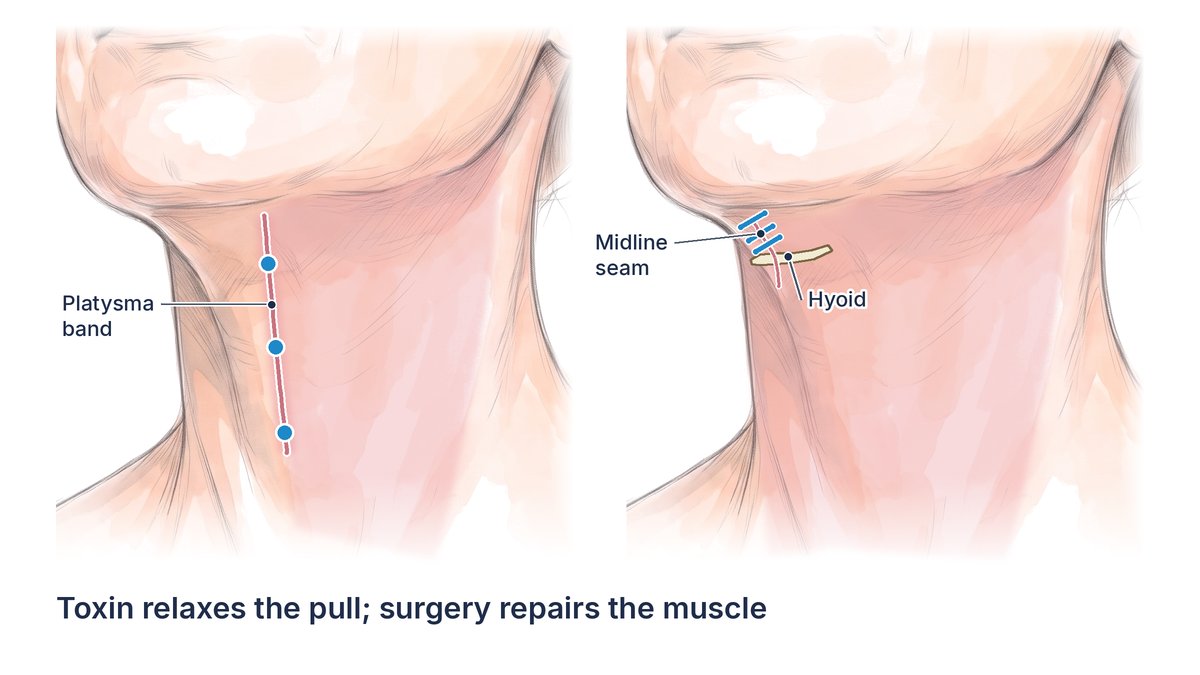
- Midline platysma plication. I stitch the two inner edges of the platysma to each other, a corset-type plication that works like a sling. While suturing I anchor the platysma to the fascia over the hyoid bone, the small bone at the corner between chin and neck, which helps keep the neck from loosening over time. Above the hyoid, the stitches take the fascia at the base of the anterior belly of the digastric.
- Lateral pull. The lifted SMAS and platysma are fixed with permanent stitches: behind the ear, the platysma is anchored to the mastoid fascia; in front of and above the ear, the anchors are Loré’s fascia and the deep temporal fascia.
Together, the midline seam closes the gap the cords come from, the lateral pull tightens the sheet from the side, and the hyoid gives the seam a fixed point at the angle under the chin.

I perform every neck lift under general anesthesia given by a board-certified anesthesiologist, with full monitoring, whether it is done alone or, as usually happens, together with a deep plane facelift. After the combined operation patients stay one night; the details are in facelift anesthesia: general vs sedation.
I do not tell patients that a neck lift ends bands for good: the anchoring is meant to help the repair hold, and a band that returns is examined and treated, not dismissed.
Which Neck Band Patient Are You?
Most necks with bands fit one of a few patterns. These profiles are illustrative examples, not real patients, and they describe decisions, not results.
A woman in her 30s with cords only when she talks or strains, and firm skin. Dynamic bands in a neck that is holding: toxin at a label-range dose is a reasonable, reversible first choice.
A woman in her late 50s with cords at rest, loose skin under the jaw and early jowls. Static bands in a lax neck: a neck lift with platysma repair, usually with a facelift, is the operation built for this anatomy.
A lean patient, full-necked for years, with new cords after liposuction. The fullness is likely beneath the muscle and the cords were unmasked; the deep layer needs addressing.
A patient a year after a facelift with one cord back on grimace. A small dynamic band often responds to toxin; a static band at rest is a discussion about revision and its recovery.
What Is Recovery Like After Neck Botox and After a Neck Lift?
Neck Botox needs no recovery beyond waiting about two weeks for the full effect. A neck lift means weeks of swelling and tightness under the chin, and a contour that refines for months.
After toxin. In the first trial, treatment-related side effects occurred in 3.0 percent against 4.8 percent on placebo and lasted a median of six days.
After a neck lift with a facelift. My facelift timeline applies: one or two small drains for the first couple of days, the hemostatic net out at day 3 to 4, stitches out at about day 7, and a final result at 6 to 12 months. Every step, including dissolving stitches for patients flying home, is in the facelift recovery timeline week by week.
Surgeon’s Insight: Toxin Switches a Muscle Off, a Stitch Holds It in Place
The question I ask first is not “Botox or surgery?” but “Is the band there when your neck is at rest?” A band that appears only when you speak is a muscle doing too much, and relaxing it for a few months is honest treatment. A band that stands at rest in loose skin is a muscle edge with nowhere to go, and no dose turns it back into a flat sheet.
In surgery the gap between the edges and the slack in the sheet are two different problems, which is why I close one in the midline and take up the other from the side. Toxin cannot hold anything up, and a stitch cannot switch a muscle off; a neck that needs both may end up with both.
What Are the Risks of Neck Botox and of a Neck Lift?
The main risk of neck toxin is spread to the deeper muscles of swallowing, voice and breathing, uncommon at label doses but serious when it happens. A neck lift mainly risks bleeding, temporary weakness of the lower lip, hollowing from removing too much, and bands that return.
Toxin. The label’s boxed warning says toxin effects can spread beyond the injection site hours to weeks later, with generalized weakness, double vision, drooping eyelids, or difficulty swallowing, speaking or breathing; severe swallowing difficulty can lead to aspiration and, rarely, death. In the first trial at 26 to 36 units, side effects were similar with toxin and placebo (23.6 against 21.5 percent), and no difficulty swallowing, neck weakness or distant spread was reported. New trouble swallowing, a change in voice or shortness of breath after neck injections is an emergency: call emergency services or go to the nearest emergency room first, then tell the doctor who injected you.
Neck lift. Bleeding under the skin is the early risk shared with facelift surgery, covered in how surgeons prevent hematoma after a facelift. Gland reduction adds a bleeding risk that can affect the airway. Swelling under the chin or on one side of the neck that grows quickly, a tight feeling in the throat, or new difficulty breathing or swallowing after a neck lift is an emergency: call emergency services or go to the nearest emergency room first, then contact your surgeon.
In a 504-patient series in which 307 (61 percent) had gland resection, 5.8 percent of all patients had temporary lower-lip weakness and 0.4 percent a saliva collection. Which nerve branch causes which lip weakness is explained in facial nerve injury after a deep plane facelift.
My precautions follow the facelift protocol. Medicines and supplements that raise bleeding risk stop two weeks before surgery, GLP-1 drugs such as semaglutide one month before, and estrogen-containing hormones four weeks before; the full list and the reasons are in what to stop before plastic surgery. A blood thinner prescribed for the heart, a stent or a clot, or a diabetes medicine, is never stopped without the doctor who prescribed it. Tranexamic acid against bleeding and leg compression devices against clots are used as in my facelifts.
What Should Decide Between Botox and a Neck Lift?
One question about your own neck should decide: are the bands there at rest, and what else is loose around them? Toxin is a repeatable treatment with placebo-controlled evidence for effort-only bands in firm skin; surgery is the only treatment for structure, with the honest caveat that bands can return. A consultation should begin with your neck examined at rest and on a grimace, before either treatment is named.
Written by Dr. Yongwoo Lee, board-certified Korean plastic surgery specialist in facial anatomy and aesthetic procedures at VIP Plastic Surgery, South Korea.
Frequently Asked Questions About Platysmal Neck Bands
Does Botox work for platysmal neck bands?
For bands driven by muscle activity, yes: in two placebo-controlled trials with 834 adults, about 1 in 3 treated people met a strict two-grade improvement target at two weeks, against 0 to 2 percent on placebo. It works less well in loose skin.
Is Botox for neck bands FDA approved?
Yes. In October 2024 the FDA approved BOTOX Cosmetic for the temporary improvement of moderate to severe platysma bands associated with muscle activity in adults. That approval names one product.
How many units of Botox are used for neck bands?
The US label uses 26, 31 or 36 units: 16 units along the jawline (2 units at 4 sites per side) plus 1 unit at each of 5 sites per band.
How long does neck Botox last?
Neck Botox starts working at about 48 hours, is fully effective at about two weeks and fades over about three to four months. Dosing more often than every three months has not been clinically evaluated, according to the label.
Can Botox in the neck cause trouble swallowing?
It can, which is why the label carries a boxed warning. At 26 to 36 units, the first trial reported no difficulty swallowing or neck weakness; published problems were reported at higher off-label doses, from about 60 units upward. People with existing swallowing or breathing difficulty, or a neuromuscular disease such as myasthenia gravis, may be more susceptible and should say so before treatment; neck toxin is usually postponed during pregnancy and breastfeeding.
What is the Nefertiti lift?
It is toxin placed along and under the jaw border to relax the platysma’s downward pull on the jawline. The 2024 US label includes a similar 16-unit jawline row as part of the neck band dose.
What is a corset platysmaplasty?
It is a neck lift technique in which the separated inner edges of the platysma are sewn together in the midline, so the muscle forms a flat seam instead of two free cords. It is often paired with a lateral pull toward the ear.
Do neck Botox units add up with my other Botox treatments?
Yes. Neck units count toward the same running total as forehead, jaw or skin injections, and that total is part of why toxin can stop working over the years. The 2025 expert review keeps a single neck session under 50 units.
Why do I still have neck bands after my facelift?
Either the facelift did not address the midline of the platysma, which a lift limited to the cheek and jaw often does not, or the bands recurred. A band that appears only on effort often responds to toxin once surgical swelling has settled.
Why did neck bands appear after my neck liposuction?
Most likely the fat above the platysma was cushioning the muscle edges, and removing it unmasked them. Static bands in a full neck point to a neck lift with work on the deep layer; bands that show only on effort can be softened with toxin.
Do young people get platysmal bands?
Yes. In a survey behind a 2025 expert review of platysma prominence, the 259 people photographed ranged from 19 to 72 years, with a mean age of 39. A young neck with firm skin and bands only on effort is the pattern toxin suits.
Will a neck lift affect my swallowing or voice?
A neck lift works on the platysma and the structures just beneath it, not on the voice box, so a lasting change in voice is not expected. Tightness and mild discomfort when swallowing are common for a few weeks while swelling settles; swelling that grows quickly or new difficulty breathing or swallowing means calling emergency services first. The nerve-related effect to know about is temporary weakness of the lower lip, not a change in voice.
This article is for informational purposes only and does not constitute medical advice. Always consult with a qualified medical professional before making any decisions about surgical or non-surgical procedures.
